Efficient Multi-Agent Intelligence For Young Ladies
I canceled my AI service, to challenge myself even more, but the promotion period was very nice.
Without being gifted a free week of usage every other day, my usage meter dropped to 6%, and now dropped to 2%.
I thanked the thinking machine for service, and it said it was a pleasure working on magic-slice.
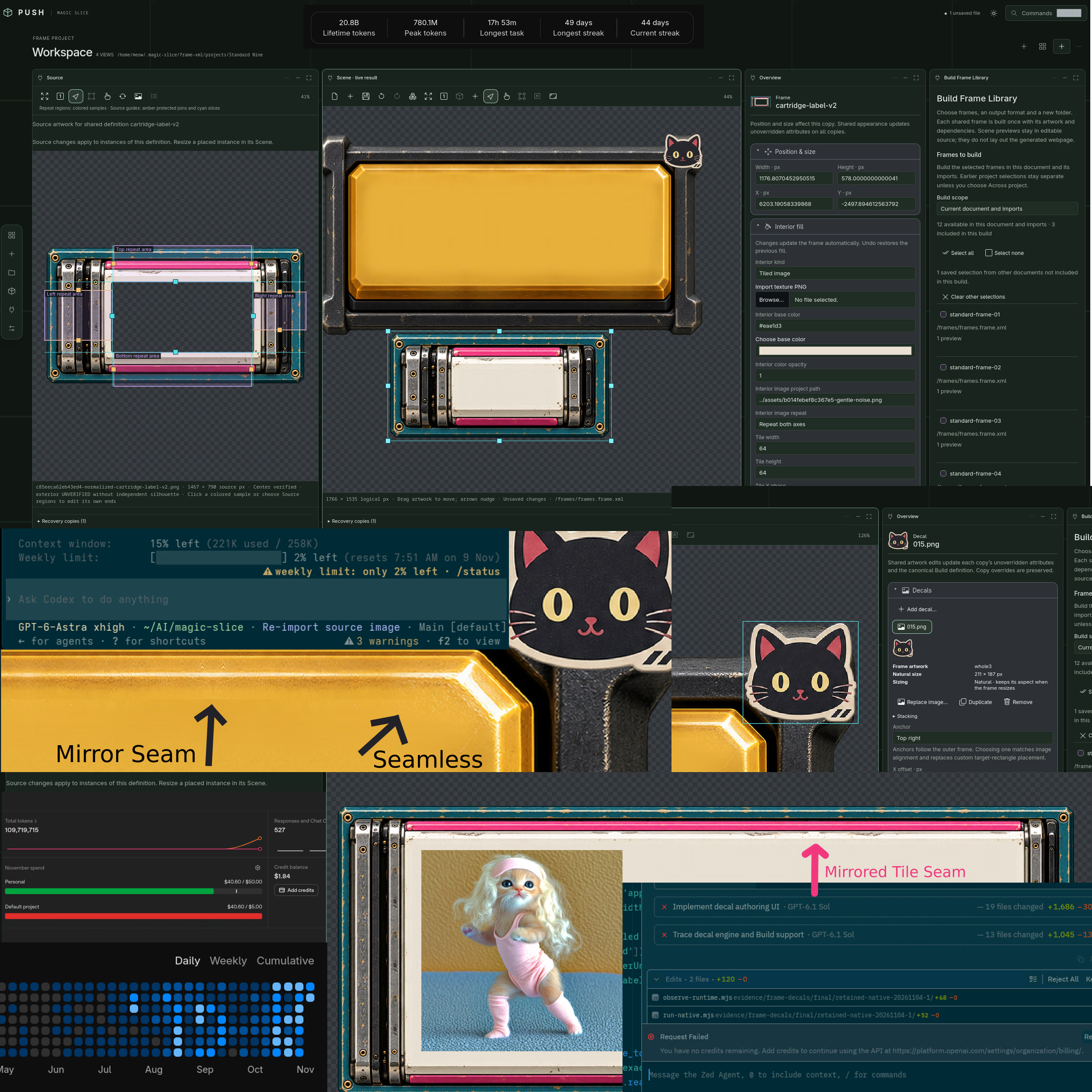
Our final feature was supreme, we tile an image, so that it is not stretch it, but tiling creates seams.
So we flip the second tile to make the seams align, even when the ending seam is odd, we still made it align.
We have a perfect seamless graphic continuation, it starts well and ends well.
An image that is just a square can be wisely stretched, without creating visible seams or distortion.
It was, a good ending.
I switched to raw API usage as I had $48 forth of free credit, and added stickers, that I can place on the seamless machinery.
And now, the multi-agent workflow, turned against me, the many agents made many requests consuming $20.
This is a low cost model, at high intelligence, not extra high intelligence.
Magic-slice is small, it is really just a hard working QA agent that pays attention to user interface.
In my other programs I am preparing dozens of agents, and they are all necessary, and must be anthropomorphized.
Multi agent frameworks create extremely intelligent thinking machines, they create many experts with expert knowledge, web search, other tools.
They take a request, refine it, and plan, and improve and create, and even self improve and evolve.
But this consumes a lot of tokens, and makes things difficult.
Well, this is true for general purpose thinking machines, open ended systems like my QA agent don’t know much at first.
But if you design a focused multi-agent intelligence, things almost instantly turn around.
My QA agent is reviewing icons and panes and buttons, it is thinking about friendly workflows and user interfaces.
But when you make a focused AI not only can you replace some agents, with conventional programming, and old school AI like goal solvers.
But the desktop applications you are building, when well made, eliminate the need for extensive UI review.
A QA agent in an Eclipse 4 inspired application foundation, only looks at button labels, and maybe presence of buttons.
Your application build system, may even generate a compact report, so that AI does not need to look at all the unimportant things.
You use the big state of the art AI to design an application platform, that helps AI stay on focus, that keeps the project components decoupled.
And then you have it design agents that use the technologies they need, a linting agent that cleans code uses conventional programming for example.
When agents talk to each other they should, use pre-defined task lists.
You should even be presented with an ordinary wizard, menu, or choice based questions.
A simple agent does not need to speak english, it just needs to be asked what it knows.
Decision models which are AI, but you provide them with a list of answers to pick from fit right in.
And the more efficient anonymous agents constructed on the fly, containing only the skills they need and effiently worded.
Should come before the more elaborate, royal agents, that evolve and assemble, and plan with strong wisdom and at high cost.
Efficiency must not destroy you multi-agent frameworks, same goes for complexity.
House your agents inside a linux container, give them standard home directories, treat them as real users.
Use pi agent core, and node,js, and tell your AI to think like a Unix guru takeing advantage of the Linux.
Conveniently local AI will become reasonably priced, the moment it becomes super powerful.
By the time you learn how to use it all, how to assemble everything, it will be cheap to run locally or remotely.
At tat point, all the people who optimized their agents, will lose, and your anthropomorphized agents with elaborate minds will bloom.
Do not make the old mistakes, of premature optimization, and not thinking fourth-dimensionally!