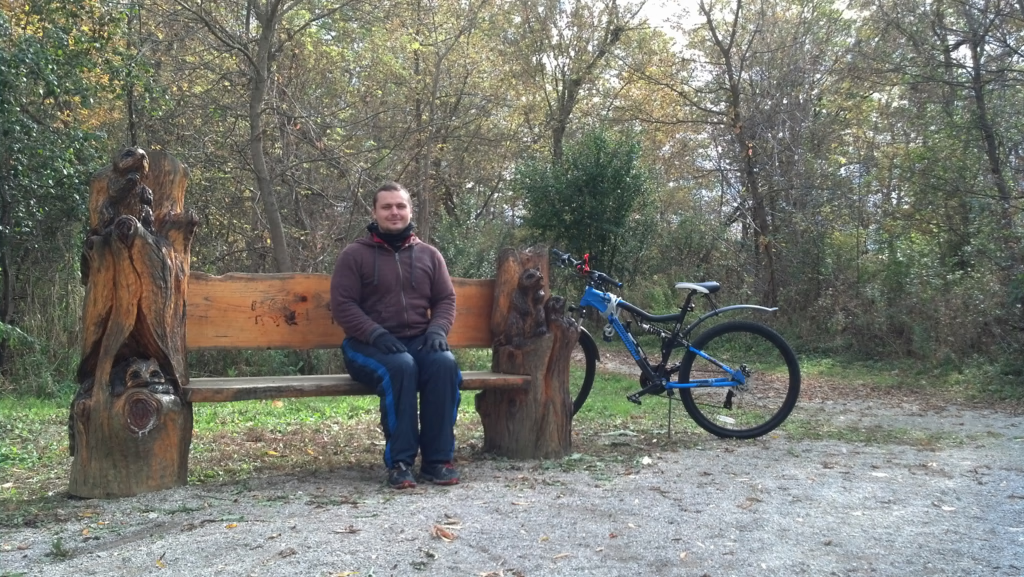
On a quiet Wednesday, I spent the day programming while reflecting on my bicycle, birds, rain, and a new website domain; after preparing for a ride, I took my bike through spring-scented streets, enjoyed crisp air and singing birds, and stopped at overpasses to scribble code or watch traffic, discovering tiny hidden spots—graffiti, sculptures, abandoned railways—that made the day feel like a gentle adventure.

The post celebrates the idea that each person possesses a unique “center”—an inner collection of experiences, passions, and qualities—that defines their identity and fuels growth. It urges readers to safeguard this core self against external influences, noting that neglecting it leads to loss. By nurturing this inner richness through love and dedication, one can develop a wide array of talents—from science and arts to sports and crafts—ultimately becoming a leader, creator, or visionary. The message concludes by encouraging perseverance, confidence, and continuous self‑practice so that the individual remains strong, healthy, and worthy throughout life.
In the poem, the narrator wakes to tackle a full day of spring cleaning and maintenance tasks. While sorting kitchenware and preparing his tools—slippers, ladder, scissors, screwdriver—he climbs three steps to update fire alarms, struggling to fit a screw and ultimately using a mop to finish the job. After successfully creating a hole for the alarm, he feels proud but notices a new screw missing from the bottom of the ladder. Despite the mishap, he concludes his work is done and marvels at the blinking red light that signals completion.
The post describes a restless, energetic young person who wants to avoid the routine of school buses and instead share with their parents that “school is crazy.” They claim they are not lazy but need plenty of games, don’t bother memorizing presidents, and insist on trips to every national park so they can spend their life in bright places rather than darkness. The narrator also desires all audio‑books ever made, believing that only then will they feel ready to face life unafraid.
In this post the author argues that true learning happens when concepts are linked together rather than isolated; using a city‑navigation metaphor, they explain how jumping from one “city center” to another without clear roads leaves us lost, while a continuous chain of related ideas—like streets connecting neighborhoods—creates a memorable and coherent learning path. They claim cramming individual subjects into separate compartments hinders understanding, whereas a fluid, connected sequence of curiosities allows new knowledge to flow naturally from one idea to the next.
Written as a poem, the piece contemplates education as a trickster that hands out disjointed snippets of knowledge, leaving the student feeling robbed of a complete school experience; it urges readers to think for themselves before accepting instruction, arguing that true learning comes from personal initiative rather than passive receipt.
Captain’s Log Supplemental, Quarantine, Day Forty is an inspirational reflection on human ambition and learning. The author celebrates humanity’s capacity to reach great heights—citing pioneers from the Wright Brothers to Yuri Gagarin and Galileo—to affirm that we are “captains of our souls” and masters of our fate. He stresses that a culture of wisdom and inherited knowledge must be preserved, for without it each person will return to zero despite their best efforts. The log ends by urging readers to begin their own quest for knowledge with the great minds listed in the linked category of science communicators.
In his Day 39 Quarantine log, the author describes accidentally spilling salad onto tomato juice, creating a surprisingly tasty sprinkled drink that he intends to enjoy every day.
In Day 37 of his Quarantine log, the writer reflects on a creative but exhausting week marked by rhyming “seven” with “eleven” and “heaven,” while juggling coding tasks across multiple languages. He’s been experimenting in Bash, missing older Perl syntax (including non‑capturing regexes), and feeling nostalgic for classic CGI and editor tools. The post then shifts to lament the current state of web development: mixing SASS, C++, CSS, async/await, and JavaScript feels chaotic, yet he insists that the “language of the web” is the proper choice for front‑end work. He humorously notes how quickly languages fall behind—Perl was overtaken by newer tech—and ends with a call to keep one’s utilities simple and robust so they remain useful over time.
Captain’s Log, Quarantine, Day Thirty Six records a reflective day marked by mixed experiences that required strength and perseverance. The entry highlights teamwork, noting that each member plays an essential hero role and none are insignificant. It stresses shared care and gratitude, culminating in collective happiness and cheer.
In his Day 35 Quarantine log, the captain describes a creative routine: he plans to write poetry to fill his hard drive, cycling through subjects from cats and bureaucrats to Lowbrow Art and figures such as Descartes or Napoleon Bonaparte. After jotting these musings, he intends to hop on his bicycle at dawn with notepad and pen, hoping the fresh ride will inspire new ideas.
The writer recounts completing a substantial program and feeling ready for new projects while simultaneously tackling a poem that proves challenging because its subject remains elusive. They describe moments of confidence that shift into uncertainty as they draft the verses, and then reflect on past attempts to dress in eclectic outfits—from a Blues Brother suit to cowboy shoes, then leather pants and a Matrix coat—each effort ending with self‑congratulatory humor but little success. The post ends with a casual flourish, noting the poem’s completion and wishing readers goodnight.
In his thirty‑third day of quarantine, the captain reflects that days pass swiftly yet knowledge can be accumulated in hours through video lectures or audiobooks; this learning expands their powers, sets them free, and lets them inherit the might of past masters to rise to greatness.
On Day 32 of his “Quarantine,” the narrator reflects on a long bicycle trip that starts early in the morning and takes him through varied scenery—from dew‑slicked trails to highway underpasses, woodland parks, and endless grass fields—while noting encounters with geese and insects at five and seven miles. By fifteen miles he reaches a new city, and by twenty miles the “real adventure” begins, requiring water and street smarts. He continues until he arrives at a pier on Lake Erie, feeling weary but fulfilled as he returns home to his bed after 30 miles of cycling.
In this one-page log dated Day Thirty of Quarantine, the narrator recounts a day spent debugging and cleaning up code, feeling both dirty and eventually proud after resolving issues; he describes his slow CPU as compared to a BBQ, attempts to create a rhyming dictionary that turned into an 8‑megabyte web page almost wiping out the internet, and ends by noting a shower and simple wishes.
Captain’s log for day twenty‑nine in Quarantine records a creative routine that blends graphic design, programming, and music. The writer reflects on the joy of making art with computer tools, noting how brevity becomes essential when working in the command line environment. They describe switching between design work and coding, feeling the two worlds overlap yet differ, and emphasize that whether the final piece comes from a computer, music or visual medium, it matters only that the creator completes what they start, proving that using one’s heart makes them an artist.
In the log entry dated Quarantine Day 28, the narrator describes an evening spent reflecting on the craft of poetry—expressing excitement for a “little poetry date,” intent to focus, meditate, and let words percolate. They note that poetry is a self-contained universe in which each poem has its own mind and becomes a milestone. The writer acknowledges that while many paths can lead to completion, the final message depends on the intended meaning.
In this nighttime log from “Captain’s Log, Quarantine, Day Twenty‑Seven,” the writer describes how they wait until 11 p.m. to begin composing rhymes, feeling ready for bed but choosing instead to sit and craft a poem; they note that finding the right rhyme can be challenging and requires patience, and recount how they finally settle into writing after waiting for the perfect cadence, even though it’s late and they’re not fully bright, they persist with their creative work.
In his Captain’s Log dated Day Twenty‑Six of Quarantine, the author recounts how he has abandoned forks and now exclusively uses metal chopsticks to eat everything from pork to salads, jelly, peanut butter, even cutting sausage with them. He notes that these sticks serve as both utensil and tool—cutting food, stirring tea or protein brews—and while he misses the convenience of forks, he humorously laments only once wishing for a spoon during a “blue moon.”
Captain’s log for “Quarantine” Day 25 recounts that Bernie has departed and reflects on the weight of expectations and the rhythm of hits and misses in life; it then turns into an exhortation for readers to become citizens of the world, seize knowledge from beloved heroes, and rise like mountains—learning, teaching, dancing, and preaching freedom, reason, and peace—while reminding that the time to act is now.
Day Twenty‑Four of my “Quarantine” log finds me preparing for bed in a relaxed routine: dressed in workout clothes, stretching left and right, fluffing pillows, and settling into the comfort of a familiar audiobook by Bill Bryson. As I drift off to sleep, the narration of *A Short History of Nearly Everything* plays softly until dawn, while I reflect on lessons from online lectures and audiobooks that keep me focused and proud of my appearance. Though I miss working out at the gym, I remain committed to staying slim, and I end the entry with hopeful cheer that quarantine will soon be over.