·

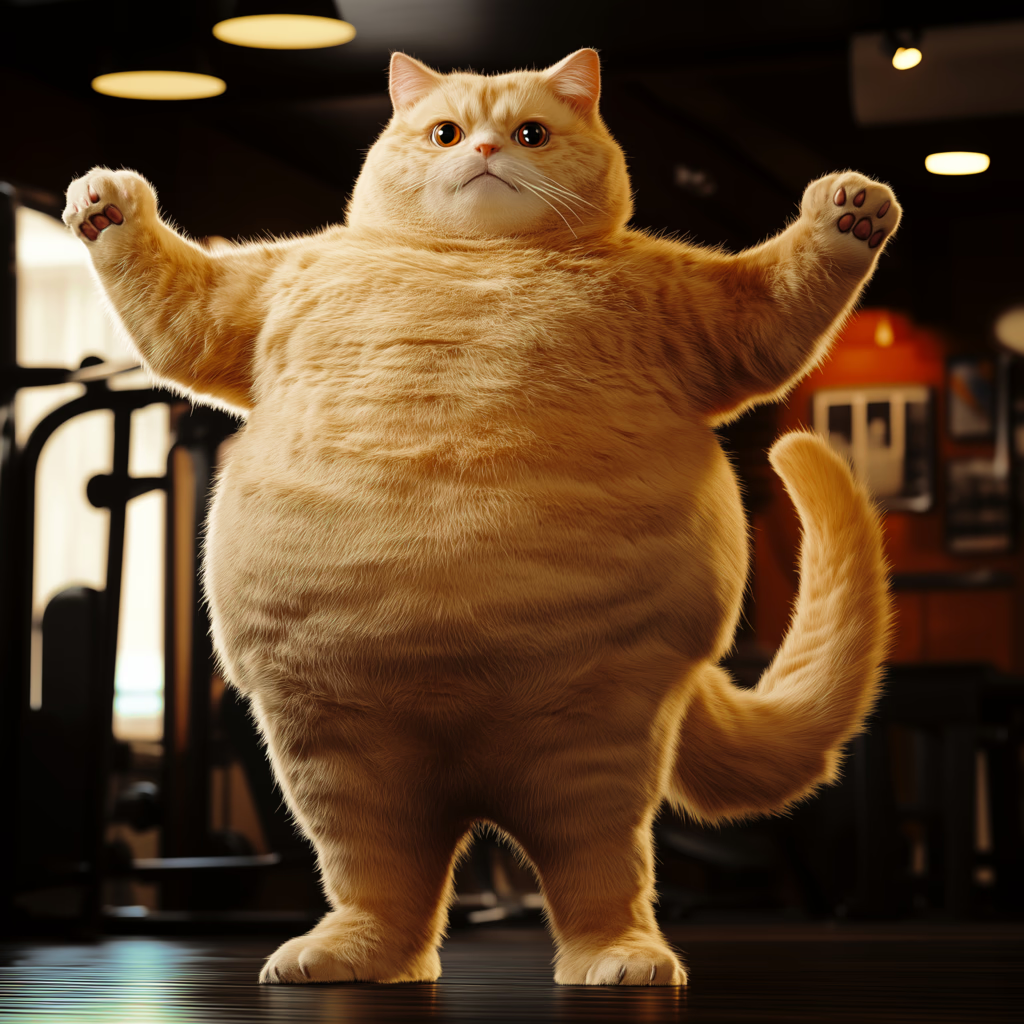
#1685: Of The Bodybuilder Curse And Jogger Wisdom; Or, Bodybuilding Is A Weighted Endurance Sport

The author argues that most people fail at fitness because they follow wrong or over‑simplified advice—copying athletes or bodybuilders without understanding the gradual, individualized progression required for muscle growth. He explains that our bodies are self‑renewing machines and need to be gradually overloaded with weight, just as a car is accelerated slowly, otherwise we hit plateaus. The text contrasts jogging, which naturally builds muscular endurance through repetitive movement, with bodybuilding, which often relies on big weights and can stall when the increments become too large for the equipment or the person’s adaptation capacity. Ultimately, success comes from listening to real results and applying evidence‑based, incremental increases in load rather than mimicking others’ routines.

·

#1684: Once In A Jogger

A jogger’s routine can be adapted into a simple, effective dumbbell program: start with 3–5‑lb weights, perform continuous, low‑rep sets that mirror the endurance of running, and gradually increase weight or volume while shortening rests. By using an interval timer, eating trail‑mix‑style carbs, and syncing lifts to music beats, you create a rhythmic “dance” workout that builds muscle without heavy machines or long sessions. The key is steady progression—like jogging—rather than large sets of heavy reps—and the result is increased muscle mass, improved health, and lasting fitness at any age.

·

#1683: Does A Tail Help?

In this whimsical post the author explains how attaching a “tail” to their weight‑lifting belt has become a source of extra energy, motivation and even dust‑free workouts, claiming it helps with sideway motion and hip hop‑like movement. They describe the first time they wore the tail in October—mailmen noticing them, laughs from strangers, and the tail’s playful “shooting up” when bending down—and tie these moments to ancestral tails that supposedly made early humans fit. The writer also notes how a tail can keep dust off their clothes, boost flexibility during lifts, and give a visual cue for better form. Finally they weave in personal reflections on childhood superhero costumes, the authenticity of growing up, and a Thoreau‑inspired call to live deliberately, suggesting that wearing a tail is both a playful exercise hack and a metaphor for embracing life’s challenges.

·

#1682: Easy Bodybuilding For The Sophisticated Lady

This post blends the idea that music‑driven “dance trance” can keep a long walk or hike energetic and enjoyable, while a well‑made trail mix—rich in complex carbs, peanuts, dried fruit, and no added sugar—provides steady endurance for both walking and heavier dumbbell exercises. The author suggests soaking the trail mix overnight to aid hydration and dental health, then using it as fuel during extended sessions that combine light‑to‑moderate dumbbell lifts with progressive weight increases and deliberate rest periods; breathing hard is a cue that the workout tempo needs tightening. By moving through nature—parks or lakes—while keeping the music upbeat and incorporating cycling or jogging for leg work, one can build muscle and burn fat over 5–7 days per week without relying on heavy gym sets, thus achieving steady progress with minimal soreness.

·

#1681: Costume Suggestion: Super Simple Instructions For A Sturdy Gym Friendly Tail

The post explains how to craft an adult‑sized cat tail for about $15 using a 4–6 inch wide foam weightlifting belt (synthetic with mesh surface), a sturdy steel wire paper towel holder, and sharp galvanized steel wire; the author describes sourcing fabric from thrift or costume stores, cutting and piercing the belt with the wire to attach the holder without visible marks, and adding acrylic paint for color matching; they detail their own construction steps—bending the belt, looping the wire, attaching the holder, and testing it during workouts—and note that this DIY tail can be worn comfortably at the gym while also serving as a whimsical “antenna” accessory.

·

#1680: Your Sacred Journeys

The poem is addressed to young people and is also a tribute to friends who have been missed or lost, including cultural figures like Charles Bukowski, Christopher Hitchens, Sir Ken Robinson, and Daniel Dennet. It urges the reader to build their own self from the inside out, layer by layer, until they become unbreakable, and then start living as a laughing philosopher. The writer describes practical steps for stress relief—clearing the kitchen, creating a fitness zone, setting alarms—and encourages a trip to the library in the morning before heading into nature on the Appalachian Trail, where the narrator hopes the reader will learn to become a monument of perseverance through hikes, tears, and bruises. Finally, the poem concludes with an exhortation to let life bloom, rise above mediocrity, and embrace the stars as a creature destined for growth.

·

#1679: Individuality And The End Of The Dark Ages

The post contends that our schooling is largely fabricated and that we’re indoctrinated into political lies and war‑making, which keeps us in groups that ultimately exploit each other. It argues that true wisdom comes from individuality—once we become independent thinkers we can rise above “liars,” “mind hackers,” and opportunists to create friends, projects, and lasting contributions for humanity. The author offers a simple charm (“grow, grow all the way up…”) as a mental step out of repetition and into authentic learning: free ourselves from fantasy and false books, find real great beings, learn their culture, and build on their shoulders.

·

#1678: Lol! How You Just Became A Powerful Programmer

The post introduces an AI‑powered visual programming framework that lets developers build programs incrementally by having the AI generate small code snippets and orchestrate them with a supervisor‑worker architecture inspired by the actor model. In this system, each “box” represents a program component whose inputs and outputs are connected by pipes, while supervisors manage queues of tasks, handle retries, scale workers across CPU cores or cloud resources, and automatically rebuild parts when data sources change. The visual language provides a GUI with drag‑and‑drop boxes styled after classic dashboards, enabling non‑experts to compose pipelines for tasks such as web scraping, data transformation, or concurrent downloads—all while the AI generates code, monitors execution, and refines the workflow without manual documentation.

·

#1677: Upgrade Your Fitness By Replacing Rest With Light Dumbbells

The post explains that the usual gym routine of lifting 20–30 lb dumbbells for 3–6 sets of 10–15 reps can give quick early gains, but soon stalls when the body stops adapting to the heavy load and the rest periods are too long. To avoid this plateau the author recommends switching to a lighter “endurance‑style” approach: use 3–5 lb dumbbells for high‑volume work, sync lifts with music (“dance trance”), fuel with trailmix/protein, and gradually increase the weight over weeks, alternating light volume days with heavier sets. This hybrid strategy should accelerate muscle growth and keep progress moving forward.

·

#1676: Sustainable Bodybuilding: Don’t Lift Heavy, And Lift For Life

The post argues that bodybuilding can be effective at any age if approached with light, gradual loading and sustained movement rather than heavy, quick lifts; it stresses walking or “shuffling” while carrying small dumbbells (e.g., 5‑15 lb) for long periods as a “dance trance,” allowing the body to adapt naturally, and highlights that heavy lifting can slow growth and increase injury risk; the author also likens the process to steady corn‑stalk hops, insisting on controlled speed, good nutrition with seeds and dried fruit, ample rest, and a disciplined routine that makes the gym feel like an enjoyable drive rather than a strenuous workout.

·

#1675: A Good Starter Project For Learning JavaScript, Is A Primitive WikiWiki – A Tiny High Level Overview

The post explains how to quickly start building a simple Wiki application using Node.js: store pages as plain text files (e.g., “Main.txt”), use Bootstrap for styling, and render content with an EJS templating engine running on the server or within Express; create two routes—one that reads and displays a file’s contents, another that presents an edit form with a textarea and message field, appending changes to a log file with timestamps. It suggests exploring other template engines like Handlebars or Mustache, highlights the importance of proper string sanitation for security, and even proposes building an extra “honeypot” HTTP server to observe bot traffic for learning purposes. The idea is to iterate on starter projects, making them simpler, more secure, or visually pleasing as you gain experience.

·

#1674: Programming Is The Very Least You Should Learn In High School

The post argues that many high‑school programs feel like “fake education” because they deliver only superficial lessons while teachers promise mastery; it then proposes a remedy: building a visual programming language based on an actor model where each component is a “box” with input and output ports connected by lines, and using AI (e.g., Ollama’s LLM) to transform data between these boxes. The author illustrates this with a simple three‑box pipeline that reads a poem, sends it through AI for readability enhancement, and finally delivers the polished version back to the user or another actor such as a human reviewer who can score and loop improvements. Alongside this, the post suggests learning JavaScript, HTML/CSS/SVG, web components, event emitters, OOP, mixins, CouchDB/Mongo/SQL, and that by mastering these tools one can program everything else with the visual language—thus turning personal notebooks into diagrams of future projects and enabling AI‑assisted individualized instruction to overcome the current “teacher fraud” and truly empower students.

·

#1673: Bodybuilding For Shy Girls

The post blends poetry and practical advice to show how embracing a quiet confidence can transform both mind and body through disciplined bodybuilding. It urges readers to view their shyness as a hidden strength, to take small, steady steps in the gym—starting with light dumbbells, walking while lifting, and pairing moves with slow music for rhythm—and to treat each workout as an adventure that builds muscle, endurance, and self‑awareness. By mixing simple lifts (biceps, shoulders, chest) with movement and mindful pacing, the writer claims you’ll grow both physically and mentally, turning everyday training into a lifelong journey of growth, courage, and renewed youth.

·

#1672: Door Key Meow

From the moment I first read an analog clock as a child—misreading the long hand and earning a gentle laugh—to my later fascination with gears, wires and nails, my early life was shaped by hands-on experimentation. The same curiosity that let me pick padlocks in five minutes also drove me to open a C‑64 cartridge, learn BASIC, build robots out of letters, and eventually acquire a 286 and Pentium PC while learning English abroad. Each step—from crafting simple programs on the Commodore to mastering Visual Basic 6—became a new chapter in my self‑directed education, inspiring me to design an AI‑driven, individualized learning system that values personal curiosity over standardized tests. Through building, inventing and reinventing small programs I keep myself sharp, while my watchmaking craft and rule‑breaking spirit continue to fuel both creativity and practical skill.

·

#1671: Sooner Or Later You Will Have To Spend A Bit Of Time With Artificial Intelligence

The post describes installing Ollama on a Raspberry Pi 4 and running the new Llama 3.2 model, noting that it performs well even on modest hardware. The author tests the AI by asking for an actor‑model example and a JavaScript cookbook lesson plan; both responses are detailed,

·

#1670: If You Got A Tailbone, Your Tail Is Totally Not Gone

The post humorously explores the idea of having a tail—whether naturally or as a prosthetic—and describes how you might create one using everyday items like belts and L‑shaped tools. It then lists imagined benefits, claiming that possessing a tail would make people better at various jobs (police work, politics, medicine) and help parents stay calm, all while concluding that scientists agree a tail is advantageous for everyone.

·

#1669: The Weighted Vest; Yes! But Get The Right Materials

I recently used a 10‑lb weighted vest for ten three‑hour workouts and found it to be both effective and comfortable, so I recommend getting a vest that allows you to add removable weights up to 20–30 lb for gradual progression; the added load boosts fat burn and muscle gain without being too heavy at first. The vest should be machine‑washable on a delicate setting and made of sturdy cotton‑backed woven nylon rather than neoprene, which deforms over time, traps moisture, and can scratch skin—plus iron pellets inside can rust and powder off onto clothes. Adjustable straps are essential to fit different shirt cuts, and the vest’s construction should keep weights in place while staying smooth against the body. In short, a removable‑weight vest made of durable nylon with soft inner fabric offers an easy, safe way to add progressive load to your workouts.

·

#1668: Starry McStarshipface, Astrobsidian, Super Intelligence, And A Desperate Call For New Philosophers

The post reflects on recent ideas of super‑intelligence (SI) emerging from algorithms, and its potential to bring personalized learning, extended lifespans, and routine interstellar travel. It envisions AI as a machine that will guide humanity toward a future where aging is halted, space missions become routine, and learning becomes an adventure rather than rote memorization. The author describes the promise of SI to pilot spacecraft, craft new materials like “Astrobsidian,” and even cook cosmic meals, while acknowledging the arms race and cultural shifts required for this leap. Overall, it’s a hopeful vision that AI will reshape human life by making knowledge perfectly paced, travel feasible, and humanity free from old limits.

·

#1667: The Supervisor Programming Model

I’m building a free visual programming tool that lets non‑programmers design and run JavaScript programs by dragging “Supervisor” nodes (the actors) onto a canvas and wiring them together; each supervisor contains workers that perform the actual work, and can be auto‑restarted if something fails. The system uses a tweaked Actor Model with EventEmitter‑style ports for input/output, so you can compose a workflow—like scraping a web page, downloading MP3 files, and saving them to disk—by simply connecting three supervisors (Scraping, Download, Storage) and then pasting or auto‑generating worker code (e.g., a Cheerio/Fetch scraper). The whole stack is self‑healing, multi‑core, and has a minimal UI so anyone from kindergarten to retirement can learn JavaScript by building real programs.

·

#1666: One Way Or The Other: A Tale Of Two Tails And A Call To Greatness

The post celebrates the autumn holidays of September and October—particularly All Hallows’ Eve (Halloween)—by linking them to ancient harvest rites and personal expression through costume, especially the playful idea of donning a tail. The author argues that adding an artificial tail not only completes the traditional look but also offers practical benefits such as easing back pain, aiding muscle warming, and improving flexibility, echoing how warriors once wore tails for stealth and power. He frames Halloween as a time to reconnect with inner animality, embrace uniqueness, and break uniformity, urging readers to adopt the tail as a symbol of independence and fearless self‑expression.

·

#1665: Wake Up! Stop Thinking You Are Not Smart - It Is A Trick!

The post argues that real education is an active, authentic process of learning and character building—unlike the rote, profit‑driven “school” where teachers merely pay and students memorize—so don’t let anyone make you feel dumb because true learning comes from genuine effort, not just scores.

·

#1664: Accept The Responsibility For Your Own Unique Self Education

The post argues that formal teaching often prioritizes payment over quality, so students must take ownership of their own learning: by exploring libraries, reading diverse books (from UFO folklore to science popularization), and then applying what they’ve learned—illustrated through the author’s journey from childhood fascination with aliens to mastering programming concepts like automatic dependency management. By self‑studying, reflecting on real experiences, and continuously reinventing knowledge, one can achieve true excellence and become a “great being.”

·

#1663: Close The Gap: Repairing Your Body And Becoming Fit Is Fast And Painless

The post outlines a simple yet disciplined approach to building muscle and stamina using only dumbbells. It stresses the need for daily workouts—bodybuilding sessions with two‑day rests, followed by lighter “flimsy” days—and emphasizes continuous movement without long pauses, mirroring joggers’ rhythm. Progress is measured in weight increments (starting at 3–5 lb, moving to 7.5–12.5 lb, and eventually up to 20 lb), with careful rest intervals that gradually shorten over weeks. Music tempo should match the lifts, turning the workout into a dance‑like trance that keeps focus high. Nutrition is kept light (nuts and dried fruit) while protein intake supports muscle growth. The routine ends by adding small extra weights or vests as strength improves, but always with gradual progression to avoid plateaus. In short, it’s a dumbbell‑centric, rhythm‑driven plan that builds endurance, size, and consistency over time.

·

#1662: Obesity As A Launchpad To Greatness – Remodeling Your Kitchen, Power Walking, And Hiking

The post is an exuberant, motivational monologue urging readers to treat obesity as a solvable condition rather than a curse, drawing on the author’s own experience with blood clots and recovery. It exhorts listeners to overhaul their kitchens into makeshift gyms, adopt power‑walking (and later pseudo‑jogging) routines, embrace outdoor adventures such as camping and hiking, and maintain a journal of thoughts and AI‑assisted writings—all aimed at transforming one’s body and mind into “legendary” status. The narrative frames these habits as steps toward a vibrant life, interwoven with philosophical reading, AI‑generated content, and personal anecdotes that illustrate the journey from ordinary to epic.