Archive

Page 73 of 95

Bodybuilding: An Explanation So Simple, That Even A Cat Can Do It!

The post describes how to build endurance and muscle by combining interval‑timed aerobic workouts with light dumbbell training, starting at about five days of multi‑hour sessions set to slow music beats for trance-like focus; you add small weights (two pounds per hand, later up to ten) so that each lift is long enough to keep the body moving without long rests, using a simple two‑timer app (lift time, rest time, rounds) that gradually increases round count and shortens rest until continuous work is achieved; the routine includes walking, hopping, twisting, turning, dancing, wrist/ankle weights and jogging with dumbbells, ensuring full‑body movement every day—no “chest day” or “leg day”—with protein, complex carbs, trail mix, hydration and vegetable juice to aid recovery, and a gradual weight increase of no more than 2.5 pounds at a time to keep the body adapting steadily.

Rise; And, Don’t Let The World Drag You Down

The author recounts his experiences as a boy scout who, despite being free from alcohol and drugs, struggled with classmates’ accusations and misunderstandings about his energy drinks. He describes how peers misinterpreted his beverage as “drugs,” leading to social isolation and repeated encounters with drug‑using friends. The narrative follows his attempts to create his own milder drink, the influence of a Valkyrie mentor teaching him emotional resilience, and several episodes where he was surrounded by drug culture at school events. Throughout, he reflects on how these experiences made him feel out of place, yet eventually inspired him to adopt the cadet code, travel long trails, and encourage others to rise above drug influence and live purposefully.

The World Remedy

The post argues that poverty stifles learning and that true education is about creativity, cultural inheritance, and personal mastery rather than mere memorization; it stresses that understanding the arts of programming (JavaScript/ES6+, HTML/XML, CSS, Electron/nw.js, node.js) can empower individuals to fix broken systems, while outdoor adventures, reading books, and mastering camping are part of holistic growth—so that a graduate becomes a powerful programmer, a writer or artist, and a cultural warrior who restores dignity and prevents future dictators.

The Adult

#1736

The Adult

The post presents an AI‑generated poem that celebrates the spirit of philosophical inquiry, chivalric virtue, and personal empowerment through vivid “who” stanzas. Each stanza personifies a seeker who questions, reflects, and embraces reason, courage, creativity, and

Volition, Virtue, And Pursuits Of Excellence

The post opens with an evocative preface written by the “ghost” of an old friend, celebrating the enduring value and purity of her work amid criticism and attacks. It then unfolds into a motivational monologue that urges young readers to seize control of their own lives, emphasizing self‑determination, independent thinking, and persistent effort as keys to success, excellence, and happiness. The essay repeatedly stresses that learning should be driven by personal curiosity rather than rote memorization or external mandates, and that authentic education—fueled by passion for art, music, programming, philosophy, etc.—is essential for continual progress. Finally, it frames the individual’s journey as a quest to become an “authentic being,” mastering his/her mind, culture, and life through relentless pursuit of greatness in heart, mind, and action.

The Tokenizer and Lexer Story; Or, A Closer Look At XML Shenanigans

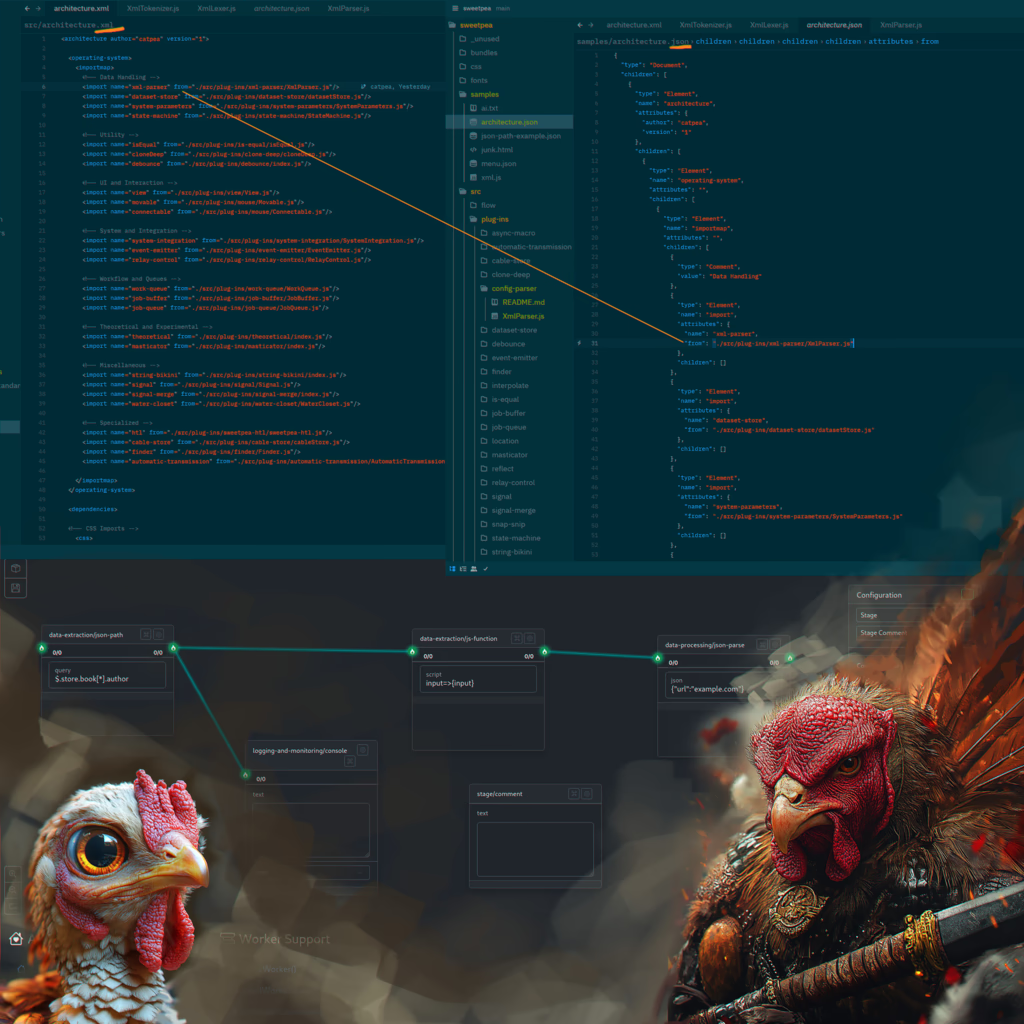
The post explains why parsing XML with simple regular expressions works only when identical tags are never nested inside each other: a naive regex that grabs the first closing tag will match wrong when “box” is opened twice before being closed. To handle general XML, the author describes a two‑stage approach—a tokenizer that scans the raw string and emits tokens for opening/closing/self‑closing tags, text, and comments, followed by a lexer that consumes those tokens to build a nested tree (AST) using a stack of open elements; each closing tag pops its matching parent, ensuring proper nesting). The resulting tree can then be used by any application needing the parsed XML structure.

Pardon My Turkey; Or, An XML Thanksgiving

I’m a lifelong coder who enjoys writing small programs in my free time and recently built a compact 50‑line XML parser that demonstrates how easy it is to handle nested tags once you understand the basic pattern of open/close lines and attribute extraction. I then turned to the emerging world of low‑code visual programming languages, arguing they lower the barrier for beginners by letting them connect boxes instead of typing boilerplate, while still supporting powerful concepts such as event emitters, queues, buffers, and automatic routing. By pre‑building UI builders, HTTP libraries, and server proxies into these visual tools, developers can focus on solving problems rather than repeating grunt work—making the whole process faster, more intuitive, and ultimately more impactful for both creators and users.

Gym Machines Are Just Not That Good For You

The post argues that gym machines are less effective than free‑weight training, especially for long‑duration workouts, and suggests beginning a routine with the lightest dumbbells while walking an hour or more in sync with music to create a “dance trance.” By gradually adding weight and extending the exercise time, this full‑body workout builds balanced musculature—strong back, shoulders, legs—and works well for both young and old. The author stresses that consistency in this dumbbell‑and‑music routine yields lasting muscle growth and overall fitness better than machine exercises.

Bodybuilding For Babies

The post explains that effective bodybuilding begins by using very light dumbbells—just a few pounds—and gradually increasing the load in small increments over time, much like a jogger’s progression from easy steps to longer runs. It stresses that lifting for many minutes at low weight builds endurance and muscle more reliably than short bursts of heavy lifts, which often lead to plateaus. The author points out that this gradual approach mirrors how our bodies naturally adapt, noting that even 25‑lb sets are too heavy if started abruptly. Nutrition is also mentioned: complex carbs keep energy steady while protein supports repair, but no fancy powders or excessive creatine are required. In short, the article argues for a slow, steady routine—light lifts for long periods with incremental weight increases—as the most effective and sustainable way to build muscle and stay healthy into old age.

Thinking About Learning English? Think Again!

The author playfully shares his journey learning English, mixing humor and observation: he confuses month names (“October” isn’t the eighth month), notes odd spellings of letters (W as “Doubleu”), jokes about numbers written out in words, describes many varieties of peas, lists hidden sub‑words inside common terms (e.g., “noodles” contains “nude”), references everyday life like shampoo and hot dogs, mentions quirky regional touches such as Ohio’s tractor-like name, and reflects on how watching TV with captions and rereading narrative books helped cement his vocabulary.

Protect Your Mind - In The Voice of Walt Whitman

The author presents a poetic exhortation to safeguard the mind as a delicate vessel that must be nurtured by daily learning and free thought, praising the child’s inner garden of potential against the rigid rhythms of school, politics, and war; he calls for daydreaming, self‑study, and relentless pursuit of knowledge and wisdom so that the individual may transcend ordinary life into becoming a philosopher, knight, creator of worlds, and ultimately a luminous force capable of changing the world.

The Last Dark Age

The post celebrates the sweeping impact of large‑language models such as Ollama, describing how they have accelerated change in every field—from medicine and programming to education and culture—so rapidly that old systems (tuition fees, fixed curricula) feel obsolete. Small models can now run on inexpensive hardware, enabling anyone to learn coding without constant internet access or formal grading, while even “little” LLMs outperform university‑level knowledge. This shift is portrayed as an unstoppable renaissance, giving each person a personal philosopher and returning humanity to the roots of wisdom and learning.

Horking - The New American Pastime

The author explains “horking” as a playful, non‑honked action people can do when stuck in traffic at train tracks, then recounts a day of being delayed by a stationary train while on their way to buy bananas; they describe the frustration and commotion among drivers, their own attempts to keep busy (looking at graffiti, using an AI to generate JavaScript snippets inspired by Prolog), and eventually finding a bag of ripe bananas for a dollar. The narrative weaves together the definition of horking, the traffic jam, the programming side‑project, the train‑track scenery, and the author’s lighthearted “hork” ritual that turns a delay into an opportunity to enjoy simple pleasures like bananas and street art.

Children of the Future, Hear Me! - A Message From Friedrich Nietzsche

You are **more** than mere creatures of flesh, more than transient mortals fleeting upon this planet. You are **children of the stars**, destined to climb not only to the heights of this earth, but beyond it, to create something new, something **great**, something **unheard of**. You are the **builders of the future**, the **forgers of tomorrow’s truths**. In you burns a fire that cannot

JavaScript Gods

The post recounts a “rebellion” between SQL and No‑SQL paradigms, arguing that the fixed structure of relational databases is not always optimal and that understanding key‑value stores, periodic syncs, and memory‑mapped disks gives developers deeper insight. It then shifts to advocating the actor model (inspired by Erlang/OTP) as a powerful way to architect programs, especially when combined with hot‑reloading so modules can be updated on the fly without restarting. The author encourages experimenting with concise JavaScript snippets that embody these concepts and suggests extending the same pattern to other languages, celebrating the freedom and creative power of “technology rebels.”

An Eerie Little Poem About Two Eerie Places And A Strange Porcupine

I spent an early‑morning 18.7‑mile run from Plymouth to Ann Arbor, Michigan, feeling alone under stars and interrupted by a beer can; later I explored the Nordhouse Dunes cove, collecting fossils amid eerie but inviting rock formations, where I also caught sight of an unusually large porcupine that vanished into the woods before I could film it again. Throughout my travels I’ve visited castle ruins, battle fields, bone churches, underground dwellings, caves, and even bicycled to Lake Eerie—each outing leaving me with a treasure trove of memories and poetic wonder about the places I wander.

Rules and Shenanigans Of Little Adventures

I share three simple adventure rules—eating all sandwiches, hunting for antiques, and going native—to illustrate how I turn everyday experiences into memorable journeys through food, treasure‑hunting, and nature.

A Cheerful Little Legacy; Or, Growing Up Is Slow But Not That Hard, You Just Have To Keep At It

The post encourages you to listen to your own curiosities instead of letting teachers, parents or others dictate your path; by keeping a journal and exploring diverse interests—from philosophy and poetry to 3‑D modeling, programming and hiking—you build layered knowledge over time. As you protect yourself from stress, manipulation, and false poverty, each new pursuit feeds the next, allowing continuous growth. The ultimate goal is to reconstitute yourself into the person you once hoped to be, achieving wisdom that lifts you up without external labels or institutions, and leaving a legacy of learning and adventure.

Bodybuilding For Golden Ladies

The post highlights recent scientific breakthroughs—AlphaFold 3’s protein‑folding success, the Evo program’s DNA modeling, and a new mRNA‑based skin rejuvenation study—and then turns to personal fitness advice, arguing that bodybuilding is the best way to stay young. It cites 88‑year‑old Ernestine Shepard as an example of late‑started but effective training, explains a simple dumbbell rule (“not so light you can add more weight, not so heavy you must stop”), and describes a gradual progression: start with walking, then add wrist/leg weights, protein, and eventually two‑pound dumbbells for long sessions. From there the writer suggests moving into gym exercises and “dancing” with dumbbells to further expand upper‑body range of motion, always pacing weight increases carefully.

My Dear Children - A Message From Abraham Lincoln

The author exhorts young readers to view education as a self‑directed pursuit of personal curiosity rather than rote memorization, urging them to seek knowledge with joy and passion so that learning becomes an ongoing process of discovery and creation. He emphasizes that true education happens outside the classroom, in the world itself, and he proposes that hiking long trails such as the Appalachian, Pacific Crest, and Continental Divide Trails will serve as practical training grounds where students can test themselves, grow through perseverance, and become scholars of nature and self. By embracing these journeys, the writer believes learners will fully stretch their minds, bodies, and hearts, ultimately achieving a life rich in legacy and deep personal growth.

Working Out Is Very Bad!

The post presents an extended list of animal characters, each described with playful, slightly over‑the‑top adjectives and actions that emphasize their roundness or appetite. From “butterball cat” to “bouncy seal,” each creature is paired with a quirky habit—eating cakes, swallowing skaters, swimming only in the waterless mind, etc.—creating a whimsical catalog of plump animals. The poem culminates by declaring that if you’re human, you must be fit, suggesting the animal verses are a playful contrast to human expectations.

Cat Calque; Or, The Case Of A Missing Idiom

The writer shares their recent study of calques and loan translations, recounts personal encounters with BASIC programming, and reflects on how idioms such as “having a cat” exist in other languages but have no direct English equivalent, leaving them feeling linguistically empty.