Program Wild And Scary! Apologize For Nothing

Program Wild And Scary! Apologize For Nothing

zoom read listen

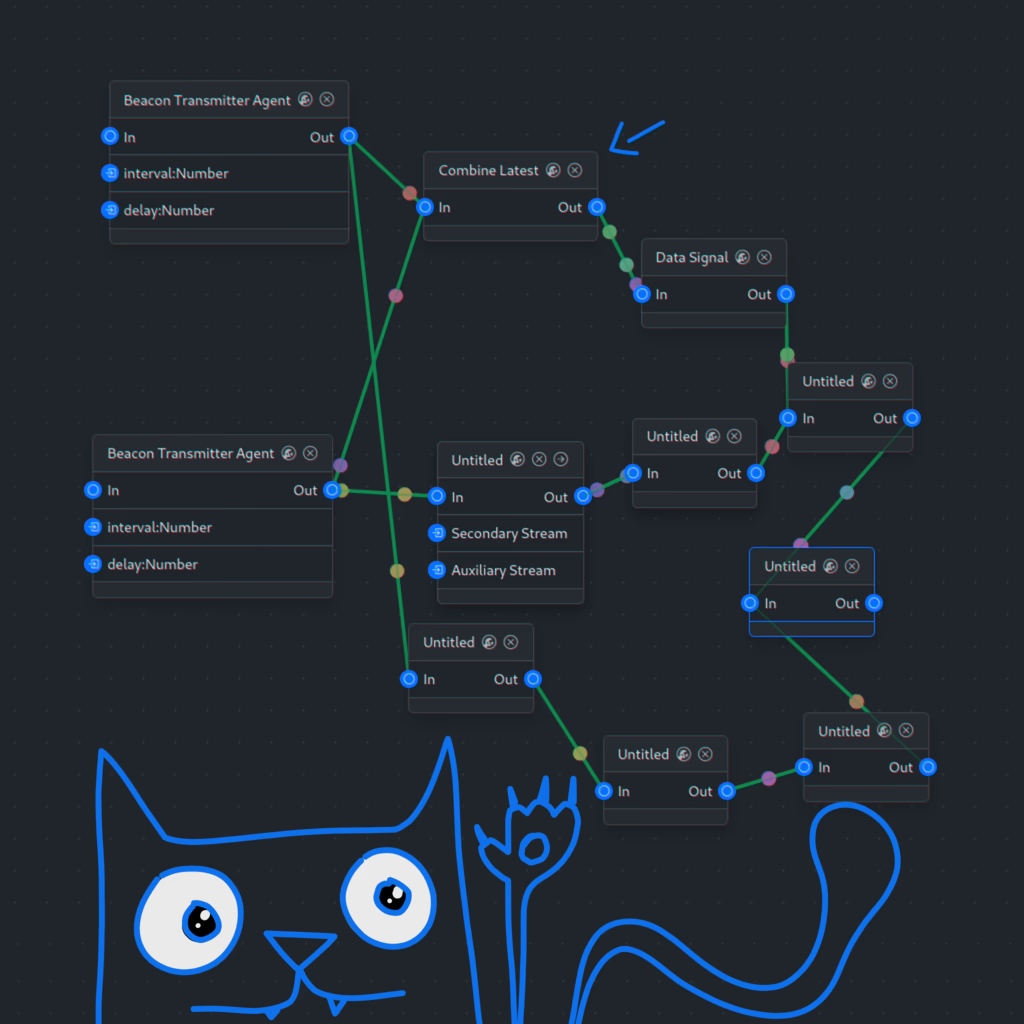
The author begins by contrasting the rigid, team‑driven mindset of many programmers with his own maverick, solo approach, praising the clarity and stability of structured code while noting its narrowness. He then explains the difference between Observables and Signals in functional reactive programming—Observables being self‑cleaning, complex programs with operators, whereas Signals are simple reactive variables that just broadcast values—and illustrates combineLatest with an analogy involving email updates from three senders. Finally he reflects on his own focus: mastering JavaScript (ECMAScript) and visual programming while using AI to emulate patterns from other languages such as Erlang’s OTP, Prolog, and functional constructs like map, filter, reduce, thereby blending borrowed ideas into a flexible, maverick workflow.

#1794 published 08:00 audio duration 667 words javascript reactive-programming observables signals combinationlatest functional-reactive-programming visual-programming-language ai-generated-code ecmascript

You Must Become A Little Philosopher

You Must Become A Little Philosopher

zoom read listen

The author reflects on how philosophy begins in childhood curiosity—asking “why” and seeking answers—and develops into a lifelong practice of questioning everything, from everyday education to the mysteries of the universe. He recounts personal experiences: learning programming independently, feeling that school was merely transactional; traveling to America, exploring UFOs and early religions after hearing Dana Sculley; reading about Bigfoot, aliens, dinosaurs, and realizing these stories are fantasies that spark curiosity. He cites several thinkers—Sagan, Bryson, Dawkins, Dennett, Robinson, Rees, Krauss, Myers, Carroll, Filippenko, Tarter, Shostak—to illustrate how philosophy gave birth to the sciences by prompting inquiry, evidence gathering, and discovery. Ultimately he sees becoming a young philosopher as a stepping‑stone that empowers one with evidence and the power to spot lies, fulfilling a duty to both humanity and oneself.

#1793 published 06:08 audio duration 594 words 12 links philosophy self-learning education ufology

Vanilla; Or, Programming JavaScript Without The Use Of Frameworks

Vanilla; Or, Programming JavaScript Without The Use Of Frameworks

zoom read listen

This post argues that you can write maintainable, future‑proof JavaScript without any framework by building a simple tree‑based structure under your app, using signals for data binding and Web Components whose templates are multiline HTML strings (Bootstrap CSS is used for styling). The tree acts like a file system or Redux store; each node holds other nodes but never gets moved around, so the UI layer simply renders the correct component types via the tree. Signals drive updates—text inputs push values into signals that trigger re‑rendering without loops—and all DOM manipulation is done with plain import maps and no build step. In short, a vanilla approach of signals + Web Components + a flat recursive update model gives you an easy way to keep code working for years while avoiding the overhead of JSX, document fragments or complex reconcilers.

#1792 published 10:06 audio duration 679 words 1 link javascript webcomponents signals dom import-maps frontend

Are You A Creature Of The Stars? A Very Easy Test

Are You A Creature Of The Stars? A Very Easy Test

zoom read listen

The post celebrates the imaginative idea that all beings of the stars possess a “purrculator” and can purr as loudly as cars, using playful rhymes and repetitive imagery to encourage self‑education, curiosity, and growth—both intellectual and physical—and invites readers to pursue programming, adventure, and an enduring legacy while keeping their minds sharp.

#1791 published 02:50 audio duration 257 words poetry creative-writing inspirational astronomy education

Treat Standardized Education The Way It Treats You

Treat Standardized Education The Way It Treats You

zoom read listen

The post argues that the conventional school system is largely ineffective, leaving graduates feeling lost and underprepared; it urges readers to take ownership of their learning by immersing themselves in books, nature walks, and self‑directed exploration—particularly through programming and AI—to build a dense personal knowledge base that fuels curiosity and creativity. By treating education as an adventure rather than a prescribed curriculum, the author believes one can rise above poverty, overwork, and stress, ultimately becoming a “creature of the stars” who thrives on continuous discovery and self‑guided mastery.

#1790 published 09:20 audio duration 697 words education self-study programming trails books ai

Bodybuilding: How To Lift For A Long Time? Or, Introduction To Interval Timers

Bodybuilding: How To Lift For A Long Time? Or, Introduction To Interval Timers

zoom read listen

The post explains how to use an interval timer—either a free app or a simple clip‑on device—to structure workouts that alternate short work periods (e.g., 30 seconds of dumbbell lifts) with calculated rest intervals, thereby avoiding the common mistake of treating timers as “no‑rest” tools. It argues that lifting heavy for only half a minute does little beyond maintaining muscle and that true growth comes from gradually adding weight or time to each set; sets and reps are labeled a bodybuilding myth. The author recommends starting with light dumbbells (3–5 lb) on basic exercises such as lateral raises, curls, and overhead presses while following 100‑120‑bpm music, timing lifts, and then extending the work duration until you can sustain non‑stop effort for 45–60 minutes before adding heavier weights, faster tempo, and longer sessions (up to two hours a day, five days a week). In short: consistent incremental load with well‑timed rest leads to real muscle adaptation.

#1789 published 05:42 audio duration 540 words 3 links interval-timer dumbbells workout training youtube music-tempo

Bodybuilder Focus And Music Trance, An Ancient Warrior Trick

Bodybuilder Focus And Music Trance, An Ancient Warrior Trick

zoom read listen

Bodybuilding is treated here as an endurance activity that lasts for hours and relies on consistent, non‑stop lifting rather than short sets; the post stresses that choosing a weight you can lift through each rep (neither too light nor too heavy) allows continuous motion and gradual progression. The author recommends doing standing dumbbell exercises daily while synchronizing lifts to the beat of fresh music—a “dance trance” that keeps focus high. By gradually increasing tempo and load, one can train both strength and rhythm. Adequate nutrition—protein, dried fruit, peanuts—and proper hydration with sugar and salt are also highlighted as essential fuel for adaptation and smooth transformation. The overall message: keep the workout continuous, music‑guided, progressive, and nutritionally supported.

#1788 published 05:05 audio duration 398 words bodybuilding dumbbell workout musical-tempo sets-reps exercise nutrition

It Is Really Not Even That Cold, Maybe You Are Just Getting Old; And, The Great Remedy For Old Age

It Is Really Not Even That Cold, Maybe You Are Just Getting Old; And, The Great Remedy For Old Age

zoom read listen

I describe myself as a strong, fit “Russian Bear” who stays active even while programming and doing everyday chores; I lift 40‑pound dumbbells for hours, bike across states, and perform other feats of strength—so much so that weather forecasts or cold feel irrelevant because my fitness keeps me warm. I emphasize that when you’re fit, sitting is unnecessary and age feels distant. Finally, I give workout tips: start training late if needed, keep the routine nonstop with light weights set to music, dance while lifting, lean gently but push‑and‑pull through alternating heavy and light sets, and aim for long life and visible results.

#1787 published 03:22 audio duration 358 words fitness bodybuilding exercise

Gently Easing Yourself Into Camping And Hiking

Gently Easing Yourself Into Camping And Hiking

zoom read listen

Hiking and camping are presented as essential life hacks that can rejuvenate the body and mind, especially when combined with library books for inspiration. The post offers practical beginner tips: use a second tent for “bathroom” needs in the woods, rely on twilight for privacy, and stay on trails to avoid bugs; bug spray, long pants, proper shoes, and cut‑proof gloves protect against mosquitoes, ticks, and knife cuts. Bears are addressed by hanging food high and avoiding campsites where they’re likely. Equipment advice stresses starting with a cheap tent, a warm sleeping bag (even in summer), and finally upgrading to a reliable hand saw for cutting logs. The writer suggests practicing camp setup at home, then backyard, local parks, before moving on to state parks or “hike‑in” sites—places that are less crowded by wildlife but still welcoming to beginners.

#1786 published 08:01 audio duration 611 words 2 links hiking camping outdoors gear tips beginners tent sleepingbag handsaw

combineLatest; Or, Please Learn Programming And Build A Visual Programming Language

combineLatest; Or, Please Learn Programming And Build A Visual Programming Language

zoom read listen

The author argues that learning programming starts with grasping concepts like RxJS’s combineLatest operator, which merges the latest values from multiple streams once each has emitted at least one value; he explains this through analogies of “pipes” and “marble diagrams,” then suggests visual programming tools can make such flows obvious, but also notes that mastering JavaScript (with Bootstrap, SVG, or Agent‑Model patterns) is essential before relying on AI‑generated operators, hinting that the future of coding will be more about tracking data packets visually than writing text.

#1785 published 13:04 audio duration 908 words 2 links rxjs combinelatest operator functionalprogramming visualprogramming javascript reactiveprogramming pipelines dataflow webpages

Programming Frosty Michigan Nights

Programming Frosty Michigan Nights

zoom read listen

The author reflects on winter’s chill and on his own experience as a programmer, weaving poetic images with technical metaphors: he sees coding as building cities of data, where foundations become trees, layers become skyscrapers, and overwork threatens the mind’s architecture. He muses on personal growth, self‑care, and the need to stay centered in order to let creativity bloom, while recalling his own winter adventures and the desire to live deliberately and fully, just as Thoreau urged: “to cut a broad swath and drive life into a corner.”

#1784 published 08:06 audio duration 646 words poetry free verse programmer coding winter self-reflection architecture design-patterns life

Fun Fitness

Fun Fitness

zoom read listen

The author lives near a bicycle trail that leads to a pier on one of Michigan’s great lakes, and he finds all‑day bike trips—sometimes lasting 14 hours—to be beautiful, memorable, and full of joy, far more satisfying than the compressed, repetitive routines of gym workouts. He illustrates this with vivid anecdotes: jogging in snow while wearing inexpensive goggles that made him feel like an “in‑edibly handsome adventurer,” repairing squeaky pedals with suntan lotion, and even hanging bathroom signs on electrical boxes along the trail—all experiences he never forgets. In contrast, he argues that gym training often feels like a set‑and‑repeated exercise lacking adventure wisdom; it needs long, continuous weighted motion (up to three hours per day) to truly stimulate muscle adaptation. The post ends with an invitation to embrace outdoor movement—cycling, hiking the Appalachian Trail, dancing with light dumbbells—and to let the joy of adventure carry one toward fitness goals.

#1783 published 07:25 audio duration 493 words 3 links gym cycling bicycle trail hiking running exercise outdoors Michigan snow

Going Buff

Going Buff

zoom read listen

The post explains that music is the key element of a simplified, continuous dumbbell workout: you keep the same set (e.g., lateral raises, curls, overhead presses) with light weights—starting at five pounds and increasing only as you adapt—and lift in sync with a steady beat, using tools like Audacity or ffmpeg to fine‑tune the tempo. By eliminating long rest periods and keeping the music fresh, you maintain focus and rhythm; when your body adapts you adjust either the song speed, the weight, or the duration of the session to keep the challenge high.

#1782 published 04:58 audio duration 477 words 3 links bodybuilding dumbbell-workout music tempo interval-training audio-tools

But Isn’t Camping In The Woods Boring?

But Isn’t Camping In The Woods Boring?

zoom read listen

The post explains that preparing for a multi‑week hiking adventure—carrying solar chargers, extra batteries, backup communication devices, sturdy tents, fans, and plenty of water filters—is essential for staying powered, fed, and safe in the woods. It stresses how time spent outdoors can reduce stress, heal the mind, and spark personal growth, turning hikers into “laughing philosophers.” The author reminds readers to keep a fire ready with enough wood, manage campsites carefully, and always have backup supplies for emergencies. Moreover, he advises inviting friends gently rather than forcing them into the trail, so that the experience feels natural and rewarding. Finally, practical tips such as keeping the car empty, using a second tent if needed, and knowing how to react to bears complete the guide.

#1781 published 09:02 audio duration 898 words hiking camping gear preparation solar chargers batteries water filter food fires trail-mix adventure books self-development

Get Fancy

Get Fancy

zoom read listen

The post encourages readers to begin their creative and intellectual journey modestly, letting go of past bullying and embracing self‑love as a foundation for true learning. It argues that memorization alone is shallow, while exploration—through programming, precise modeling, canvas painting with projector or camera obscura, beat sequencing, pixel art game design, and musical composition—creates deep understanding. The writer urges one to build a personal library of unique drums, compose “bodybuilding” music, weave endless raves, and travel great trails like the Appalachian and Pacific Crest as metaphors for continuous growth. By mastering time on Earth as a “creature of the stars,” one can rise above employee routines, become a great being, and ultimately help move the world forward.

#1780 published 06:12 audio duration 545 words essay inspiration learning selfeducation art music painting programming trails

Bodybuilding Warning: You Are Lifting Too Heavy, Simply Cutting Off Your Circulation

Bodybuilding Warning: You Are Lifting Too Heavy, Simply Cutting Off Your Circulation

zoom read listen

The post argues that the classic “sets and reps” formula is incomplete because it ignores how long you actually lift and rest, so it proposes a time‑based routine instead: use a free interval timer app with 5‑lb dumbbells set to music around 110 BPM, lift for the chosen duration, rest briefly, and repeat for 10–15 rounds of exercises such as lateral raises, curls, and overhead presses. As you become comfortable lifting non‑stop for an hour, increase tempo or weight (or add wrist weights if needed) to burn fat or build muscle; weekly results and monthly changes will follow from this continuous‑workout style, which the author claims is a better life‑extension technique than traditional bodybuilding.

#1779 published 06:08 audio duration 545 words 4 links exercise workout dumbbell interval-timer music-bpm sets-reps bodybuilding

Learn JavaScript, And Don’t Use Frameworks

Learn JavaScript, And Don’t Use Frameworks

zoom read listen

I’ve spent years building a lightweight visual programming language that lets users connect boxes with lines, using SVG to draw the connections and a custom zooming UI on top of Bootstrap. The architecture is minimalist—no heavy frameworks, just Web Components, Signals, and functional pipelines—so each node can transform data and pass it along like an actor model. I’ve added AI so users can generate small functions from prompts (e.g., fetching URLs or performing transformations), which then flow through the visual pipeline. The project runs on Node, in the browser, and as a desktop Electron app, and I hope this open‑source tool will rekindle interest in visual programming and make learning JavaScript more intuitive.

#1778 published 08:07 audio duration 830 words 1 link javascript nodejs electron web-components svg zooming-ui functional-programming rxjs ramda visual-programming pipelines webstreams signals ai-generated-functions

Six Months A Year; Or, Do Not Forget About Yourself

Six Months A Year; Or, Do Not Forget About Yourself

zoom read listen

The author argues that immersing oneself in long‑distance hikes and camping is essential to counteract the draining effects of modern work life; by spending roughly six months each year outside the office, one can regain physical fitness, mental clarity, and spiritual depth—much like a horse regains muscle after being freed from a stall. This practice not only revitalizes the body through extended walking on trails such as the Appalachian, Pacific Crest, or Continental Divide but also enriches the mind with books and nature’s lessons, creating a legacy of authentic leadership. The piece emphasizes that adventure is both an exercise for the body and a cultural inheritance, suggesting that those who commit to this rhythm become “great, authentic, and independent beings.”

#1777 published 06:40 audio duration 539 words hiking camping trails adventure nature outdoors fitness work-life balance self-improvement

To Get A Fire Going

To Get A Fire Going

zoom read listen

For a successful camping trip, you’ll want to keep multiple fire‑starting tools in reserve—matches, a small lighter, a Zippo, or a cheap foil lighter—because your favorite starter can fall out of the pocket during the day. In wet woods, gather twice as much dry wood as you think you need and cover it with a garbage bag so it stays dry; if that fails, use a fire‑starter block or homemade char cloth (cotton soaked in wax) to ignite a feather‑like kindling. A classic flint‑and‑steel set (a flint stone and a brass‑knuckle steel rod) is reliable: strike the rock, catch the sparks on the char cloth, then feed soft grass or fatwood (resinous pine bark). Modern ferrocerium rods work similarly but can be bulky; in all cases, always carry backup matches and lighter fluid so you have at least two ways to ignite your kindling.

#1776 published 09:40 audio duration 1,036 words 4 links camping fire-starting tools flint-and-steel charcloth matches

Midnight Hour

Midnight Hour

zoom read listen

I wrote a poem about an owl that tried to peck me—one of my funniest yet real memories from a night that felt warm, fragrant, and calm. I’ve carried swagger and fanny packs through adventures with American Scouts, tomb raiders, archaeologists, bullfighters, and sausage aficionados, always armed with a large knife and mindful of bears (and raccoons). My travels have taken me to the Baltic Sea, the Atlantic Ocean, and Florida Keys, each offering distinct vibes—ancient beauty, bustling energy, and slow‑moving charm. I’ve also explored Lake Michigan’s Ludington and Nordhouse, a tiny wilderness that feels alive with nature’s rhythm. In Nordhouse, deer, coyotes, porcupines (the “peacocks” of the woods), and seagulls—our faithful beach guardians—roam together, warning of rain, snakes, eagles, and hawks. Though I’ve never seen winter there, I wonder how snow would transform this peaceful place. Visiting Nordhouse in any season promises adventure, gentle beauty, and a precious experience.

#1775 published 07:12 audio duration 582 words poetry travel michigan nordhouse animals nature

Workout Tempo

Workout Tempo

zoom read listen

I’ve been doing a long‑hand dumbbell routine, lifting 20 lb for almost three hours a day (about 35 reps per minute) while listening to music with carefully adjusted tempos—starting at 130 BPM and dropping to around 100–110 BPM so I can keep the cadence without stopping. My diet is simple trail‑mix, and I’ve cycled my weight between 15, 17½, and 20 lb as my endurance improves. After a weekend break I notice that I can hold the heavier weight more reliably, so I plan to use an interval timer to track rest periods and gradually increase tempo over months, while treating duration first and sets/reps second—because it’s the sustained work that builds muscle, not arbitrary rep counts.

#1774 published 10:04 audio duration 823 words 3 links dumbbells music-tempo repsandsets intervaltimer ffmpeg

A Simple, Integrated Focus Workout; And, How To Correctly Configure Your Interval Timer

A Simple, Integrated Focus Workout; And, How To Correctly Configure Your Interval Timer

zoom read listen

The post explains how an effective gym routine combines interval timing, focused music cues, and alternating dumbbell exercises to maintain continuous movement and optimal rest periods. By using a two‑timer system—one for workout duration and one for rest—the athlete can keep the workout non‑stop, just like jogging or 1980s aerobics, while syncing lifts to song beats for rhythm and concentration. The author stresses that lifting light enough to sustain long sessions but heavy enough to challenge muscles is key; as fatigue rises, slower music and lighter weights help maintain flow before returning to faster songs and heavier loads. This integrated approach—timed intervals, low‑distraction dumbbell switches, and musical pacing—creates a reliable, flexible workout that boosts muscle isolation, posture, and injury protection while steadily transforming the body.

#1773 published 06:41 audio duration 672 words dumbbells interval training timer apps music motivation exercise routine fitness

JavaScript Is Cute And Flexible

JavaScript Is Cute And Flexible

zoom read listen

I began programming in various languages—ASP, Perl, PHP, ActionScript, Visual Basic and Java—before discovering that JavaScript was still a relatively slow browser language when I started; I therefore used Perl/PHP on the server while writing client-side code in JavaScript. After experimenting with Rhino on my phone for an interval timer, Node.js’s release prompted me to fully adopt JavaScript: its runtimes (Node.js, Bun, Deno) let me write both front‑end and back‑end code, while Electron or nw.js provide stripped‑down browsers for cross‑platform desktop apps. Mastering JavaScript opens doors to browser extensions, custom HTTP servers, command‑line utilities that can be compiled into executables, mobile apps via React Native, NativeScript or Cordova, and even AI‑assisted development—today’s AI tools can generate working code snippets (e.g., a command‑line parser) on demand, making JavaScript an incredibly versatile and powerful open‑source stack.

#1772 published 04:16 audio duration 310 words 1 link javascript nodejs bun deno electron nwjs reactnative nativescript cordova server-side client-side cross-platform mobile-apps desktop-apps command-line-tools ai web-development

Perfectly Genius; Or, Don’t Let School Make You Feel Dumb

Perfectly Genius; Or, Don’t Let School Make You Feel Dumb

zoom read listen

The post argues that true learning happens when a student takes ownership of their own pace, curiosity, and questioning—uninterrupted by the rote, judgment‑laden rituals of standardized schooling—while teachers merely sell obedience and fill minds with memorized facts; it urges students to ask about subjects like mitochondria, to be “masters” of their own thoughts rather than passive recorders, and to use tools such as AI to tap into the spirits of past great thinkers who can guide and inspire them back toward independent, joyful discovery.

#1771 published 11:24 audio duration 1,028 words education students learning self-directed motivation