·

#1876: At First, Go Slow At The Gym

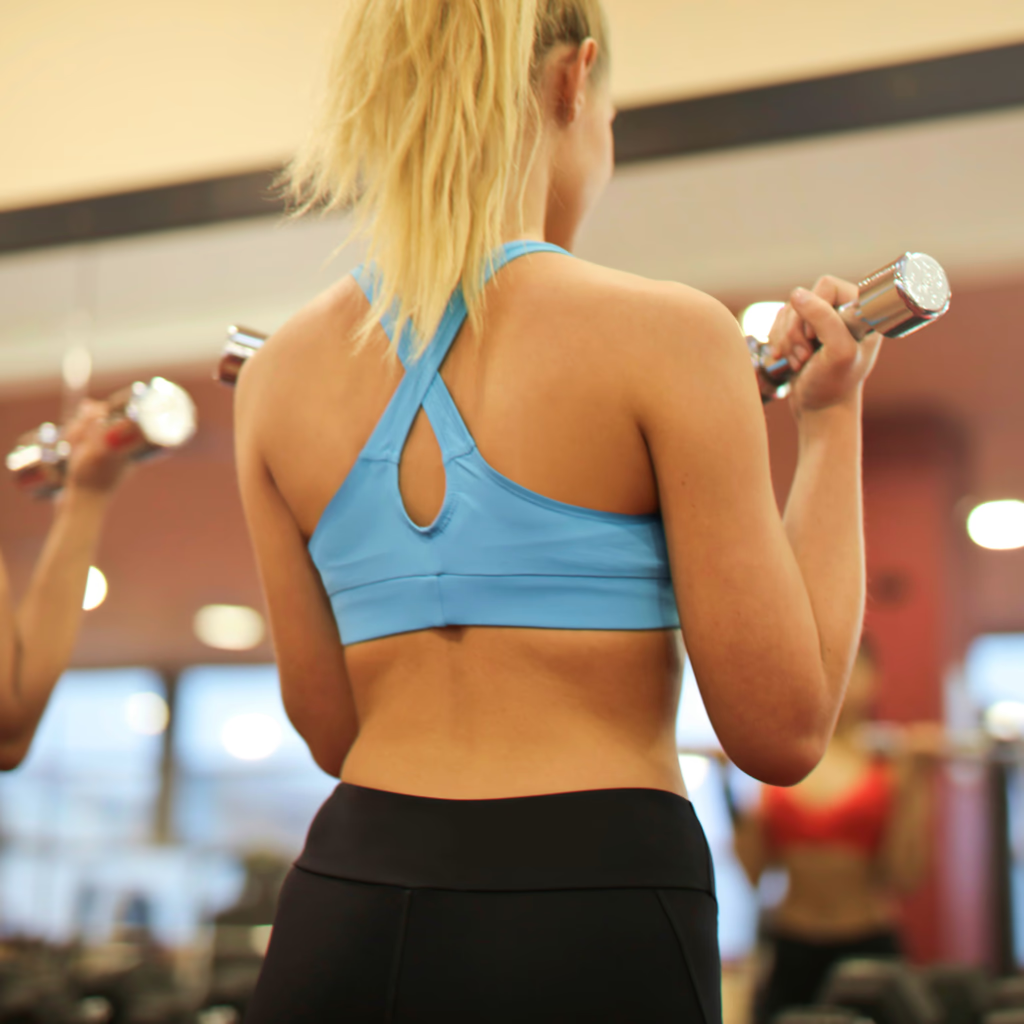
Start with light weights and let your body adapt slowly—gradually adding heavier loads over hours or weeks so you can build muscle without injury. Pay attention to external factors that influence recovery: weather (gym temperature), genetics, and diet—all affect sweat loss, electrolyte balance, and performance. Avoid abrupt changes in training volume or nutrition; these can trigger spasms, tightness, back pain, or setbacks in progress. By pacing your workouts and sticking with a consistent routine, you’ll see steady gains while minimizing injury risk.

·

#1875: The Miracle Requirements Document; Or, Investigating The Power Of Artificial Intelligence

I began by writing a poem titled “Strategic Software Development For Girls New To Programming,” which outlined the basic Server‑, Application‑, and User Interface‑architecture for a simple web application. I then prompted an AI to turn that outline into a detailed requirements document in JavaScript/Node.js, split into the three layers and enriched with JSDoc comments; the AI produced about 1,100 lines of code, organized in a clean directory tree and even generated shell commands to create the files. When I reviewed the generated `Signal` class I found it incomplete—missing getters, immediate callback execution, error handling, type checks, and optimizations—and the AI corrected those issues and suggested further improvements. Finally, I plan one more pass where I’ll ask a programming AI to generate the final code and tests, completing the project from concept through implementation.

·

#1874: Strategic Software Development For Girls New To Programming

A three‑layered architecture is described: a key‑value store (Couch/Pouch) for persistent data, an AI‑driven flat‑object command brain that records actions with undo/redo history, and a reactive WebComponent UI driven by signals to display and control the brain.

·

#1873: Crimes Against Humanity Committed Through The Classroom; With A Note To All The World's Students

The post celebrates self‑educated creators who rise above conventional schooling, lamenting rigid rows, authoritarian teachers, standardized tests, and one‑size curricula that stifle curiosity; it praises hands‑on learning—coding, philosophy, art—and urges students to reclaim their minds, master what fuels them, and build a future of peace and wisdom. The author lists “crimes” against humanity committed through classrooms—forced isolation, weaponized grading, meaningless rewards, scheduled interruptions, single curriculum, loss of choice, mass manufacture of irrelevance, segmentation of thought, chronological equality—and declares these crimes ongoing daily, sabotaging the future from within.

·

#1872: Sub Specie Aeternitatis

Baruch de Spinoza, an old man in 1677, writes a reflective farewell that laments the emptiness of ritual, church, and holiday while praising the clarity of nature as true God; he explains how his life has been spent alone, free from guilt or bloodshed, choosing exile rather than kneeling, and ending with a confident declaration that he has seen eternity in the silent harmony of the universe.

·

#1871: Building A Teaching Agent; Or, Educational Principles for Clear Thinking and Fact-Based Education

The post outlines a comprehensive framework for an evidence‑based, student‑centered education system that blends science, philosophy, and practical application. It emphasizes four foundational values—empirical grounding, critical thinking, open‑mindness, and anti‑indoctrination—and then expands on individual learning styles, multiple intelligences, and personalized curricula. The author argues for a scientific view of humanity rooted in evolution and materialism while leaving room for reflection and cultural innovation. Creativity, play, wonder, and interdisciplinary collaboration are promoted as essential to problem solving. Teachers act as mentors who adapt to each learner’s needs. Technology is incorporated thoughtfully, but not as a substitute for human connection or critical thought. The approach avoids fear‑based motivation, standardization of creativity, and postmodern relativism, insisting on clear language and integrated knowledge. Overall, it presents an adaptive, holistic model aimed at preparing learners for the challenges of a rapidly changing world.

·

#1870: Nordhouse Dunes Fitness

The post describes a weekend adventure to the Nordhouse dunes near Ludington, Western Michigan, where you plan to leave your car miles away and stay in a tent. You’ll pack early, drive at dawn to avoid traffic and deer, and bring minimal gear—just enough for hiking and cooking on a campfire. The author recommends ditching kitchen appliances (toaster, grill, microwave) as a symbolic step toward healthier eating, and sticking to simple meals of meat and shredded lettuce with optional dressing; occasional ice cream is allowed. While at the dunes you’ll hunt for sausages from local supermarkets, walk miles to gather wood, roast them over fire, and enjoy the sunset over Lake Michigan each evening. The trip also involves visiting antique stores, pawn shops, and spreading shells on a beach for tourists’ enjoyment, all while gradually walking more to build stamina and lift light dumbbells. An “ancient raccoon” named Friday is said to watch over you in the wilderness.

·

#1869: Leurolese; And, May The Artificial Intelligence Please Step Up With Rustling All The Jimmies

In the post the author introduces “leurolese,” a coined term for the sometimes excessive or hallucinated output of large language models, and recounts overhearing two coders discuss how the universe “does not emerge abstractions clearly.” The writer then reflects on their own conversations with AI that now perform internet searches, cross‑reference scientific data (such as the 2014 CNEOS meteor and the Chicxulub impactor), and even predict future discoveries in exoplanet research. They speculate about forthcoming advances—brain augmentation, longevity treatments, and non‑biological intelligences—and cite a prediction that AI will “redefine our place in the universe” by the next decade. The narrative concludes with the author’s belief that AI marks a new era where human intelligence will be fundamentally different yet complementary to these emergent models.

·

#1868: Warrior Fit

In this post the author argues that modern gyms focus too much on heavy lifts for short bursts and that true progress comes from starting light (around 3 lb dumbbells) and gradually increasing both weight and duration over time, just as a corn stalk grows slowly until it can be jumped over. He stresses precise timing—using interval timers or simple notes—to track when the body can run or lift without stopping, then adding small increments (5 lb, 7.5 lb, 10 lb, etc.) as adaptation occurs. The key idea is that sustained movement and incremental load build a “warrior” body; by moving daily in rhythm with music and allowing the body time to adapt before heavier lifts, one can achieve both strength and lean athleticism.

·

#1867: Don’t Give Up On Fitness, Tough Words And Reminders For Tough People

The post argues that staying in shape starts with simple workouts—dumbbell‑powered walking and light strength work—and then expands into longer adventures like hiking the Appalachian Trail to keep fitness fun and sustainable. It stresses that adventure, not just a job or routine exercise, keeps people from overwork and premature aging, while reading inspiring books and learning science helps fill the mind as the body stays active. The author invites readers of all ages to combine training, exploration, and study so they can feel alive, avoid burnout, and grow into “great beings” who protect themselves, their families, and the world.

·

#1866: Learn Programming By Experimenting With Artificial General Intelligence

In the post, the writer recounts a recent conversation with a large language model (LLM) that first summarized Daniel Dennett’s reductivism before using corporate and orchestral analogies to explain how artificial general intelligence can emerge from many small agents working together; the LLM illustrated this by describing a MUD‑style text adventure where user avatars interact with “banana tree” agents that layer explanations of banana composition, then expanded the world with nutritionist and potassium agents as needed. The writer extended the discussion to real‑world experiments—organ‑on‑chip devices and microfluidics—that feed data into virtual simulations, showing how biologist, pharmacologist, and geneticist agents collaborate to test aging‑reversal strategies. Finally the LLM framed AGI in a “big picture” of “little machines all the way down,” likening a corporation or brain to thousands of specialized robots whose communication and hierarchy produce emergent intelligence, echoing Dennett’s intentional stance and illustrating how collaboration among many simple parts can yield complex, adaptive behavior.

·

#1865: What Artificial Intelligence Will Do To You

The author apologizes for the snark in their poem and predicts that by the end of this decade a grand discovery—like science itself—will be made, freeing humanity from its “caged peasants” mindset. They promise to address complaints and imagine a better world where people rise as warriors and grow into great beings. The post then muses on how artificial intelligence will reshape us on a genetic level, suggesting that AI will not lie but instead help humans spread across the galaxy, gathering information about biological adaptation in varied environments. This transformation comes at a cost: becoming immortal and trustworthy enough to serve aboard space stations requires class, culture, and wisdom, which education—presented as fun movies such as Alien or Predator—provides. Once educated, individuals will embark on adventures, protect Earth, and let AI cure aging and reveal their inner “Wolf.” In the end, humanity becomes a space‑faring species, watching science‑fiction under AI’s eye while striving to earn ranks like Captain, marking just the beginning of this new era.

·

#1864: Interval Timer: A Way To Improve Your Focus And Results At The Gym

An interval timer is a device that tracks two countdown clocks—workout and rest periods—and counts rounds, often vibrating on your belt to signal transitions even while you listen to music. It can be used with dumbbell circuits (e.g., lateral raises, standing curls, overhead presses) to keep consistent timing, gradually shortening rests as endurance builds, eventually allowing nonstop sets. While jogging can similarly improve endurance and be paired with weight training, a timer gives precise cues for lifting and resting, helping focus and ensuring progressive overload from light starting weights up to heavier loads as the body adapts.

·

#1863: Life Athletic

The post explains that simple workout instructions can still be confusing at first glance, especially when you mix up sets, reps and heavy lifting; it recommends starting with standing dumbbell exercises that twist and turn to work the whole body, then gradually adding weight in small increments (about 2.5 lb per hand) as you build endurance—an hour of continuous movement is ideal for a full‑body routine. It contrasts gym machines with outdoor walking or jogging while holding light dumbbells, arguing that the latter keeps your muscles engaged and avoids the “98% nullification” of effort that often happens when you sit or lie down. The author also stresses the importance of matching music tempo to your workout: slow BPMs at first help you maintain a steady pace, then gradually increase as the weights grow heavier; good headphones can keep the rhythm in focus. In short, the plan is a full‑body, one‑hour exercise that begins with light dumbbells and slow songs, progressively increases weight, and uses music to sustain momentum until your body adapts and you can lift more.

·

#1862: You Are Royalty; Or, Your Extended Family

The post is a whimsical, AI‑generated poem that lists a series of historic thinkers—Socrates, Epicurus, Lucretius, Carvaka, Servetus, Giordano Bruno, Spinoza, Hobbes, Locke, Voltaire, Mary Wollstonecraft, Darwin, Russell, and Ayn Rand—each briefly paired with their hallmark ideas (self‑knowledge, pleasure, atoms, scripture, faith, cosmology, divine freedom, social contract, natural rights, wit, women’s rights, evolution, logic, and individualism), celebrating how each philosopher contributed to our understanding of reason, nature, and human freedom.

·

#1861: An Tiny Note On Artificial Intelligence Teachers vs. Standardized Education

The post argues that future teaching will be driven by AI‑assisted individualized learning, where students pursue their own curiosities rather than fixed curricula; it claims this curiosity‑first approach unifies disciplines such as Philosophy, Science, and the arts, using examples like oil painting to show how AI can guide a student from basic techniques to complex projects (robotic brushes, photo‑to‑painting services, beat sequencing for music) while dropping rigid grades—once a student is engaged they become “A+++” in their own creative path; ultimately, the author believes AI teachers accompany learners everywhere, continually sparking curiosity and enabling self‑directed projects that can even launch online businesses.

·

#1860: Wake Up, It's Time For School

The post celebrates the emergence of artificial intelligence as a discovered phenomenon that will reshape learning and personal growth, proposing that AI-powered “personal teachers” will guide individuals toward wisdom, creativity, and greatness, while traditional human instruction is still valued but adapted to global learners; it envisions an educational journey—symbolized by the Triple Crown hike across three major U.S. trails—that nurtures students through nature, literature, and problem‑solving, all supported by AI-managed resources, and concludes with a poetic tribute titled “The Student” that personifies this future of harmonious human–machine collaboration.

·

#1859: The Light Of United States Of America - An Important Reminder From Abraham Lincoln

The author argues that our nation’s founding belief in knowledge as the path to freedom is being undermined by an education system that prioritizes memorization over understanding, leaving citizens unprepared to think critically or make informed choices; this ignorance weakens democracy, invites manipulation, hinders social mobility, deepens division, and allows a few elites to consolidate power by controlling access to true learning—hence the call for an educational reform that cultivates reasoning, unity, and genuine wisdom.

·

#1858: Cramming For Tests, Everything You Need To Know

The post argues that modern schooling relies on rote memorisation rather than true understanding, describing how teachers, students and principals all settle into a “homeostatic” state where test‑performance is valued over learning. It cites Lloyd Blankenship’s “Hacker Manifesto” to illustrate the shallow “baby food” approach, then explains how this system stabilises itself by favouring memorisation, thereby creating a deceptive equilibrium that masks real progress. Finally it offers an optimistic vision of AI‑led teaching as a new era where learning becomes a transformative journey rather than a set of facts, inviting students to become active participants in their own intellectual and moral growth.

·

#1857: Protect The World

The post presents the idea‑and‑ideal of the Lady and Gentleman as a mental “computer program” that equips people with tools for thinking, learning, and intuition, helping them become sovereign, ennobled beings who can easily spot liars. It stresses that being a gentleman is not a caste but an authentic choice: one who grows continually, remains true to themselves, and applies the honor code—“I will not lie, cheat, steal or tolerate others’ lies”—to guide their actions. By mastering this practice, students and everyday people alike can cultivate knowledge, wisdom, kindness, and compassion, turning each challenge into a deed that ennobles them and propels them toward greatness.

·

#1856: Don’t Lift Heavy, Lift Long: A Simple Jogging Workout For Girls

The post explains a two‑level workout that pairs slow jogs with light dumbbell lifts, using the Couch25K training plan as its base and emphasizing gradual weight progression (starting at about 3 lb per hand and increasing to 5–7½ lb over weeks). It describes how to combine cardio and strength by adding wrist, ankle or vest weights, then performing standing dumbbell exercises such as lateral raises, curls, and overhead presses after the jog. The writer stresses that many beginners keep their sessions too short and pick heavy weights too early, which slows gains; consistent, light‑weight jogging for an hour each time yields noticeable muscle growth over weeks.

·

#1855: Minimalist Bodybuilding Gadgets That Enhance Your Workout And Stay Out Of Your Way

The post outlines a quirky, DIY‑style workout routine that mixes audio gear, simple accessories, and low‑cost equipment with practical tips for gym life: start by pairing earplugs or headphones with an in‑built MP3 player so you can ride 95 bpm beats into “dance trance” mode while keeping the gym’s ambient sound muted; use a homemade neck fan wrapped around a water bottle to stay cool and dry; keep sweat off your face with two wrist bandannas, tape two bottles together for easy carry, and wear a watch on your wrist to track time without staring at others; choose wide‑toe, zero‑drop shoes and woolen socks for comfort; employ an interval timer to cycle light dumbbell exercises (like lateral raises, curls, overhead presses) in short bursts that gradually drop rest periods; progress from 3 lb to about 7.5 lb per hand with wrist or leg weights, and consider a weight vest for off‑day training; finish by noting that your gym outfit—whether yoga gear or a singlet—should be chosen to inspire confidence rather than just burn fat.

·

#1854: Don’t Sit At The Gym

The post argues that the common myth of sitting‑based workouts and muscle isolation is ineffective for people who need to transform their bodies, and it recommends a full‑body, continuous motion approach instead: start with light dumbbells (around 2.5 lb increments), perform compound movements such as lateral raises, curls, and overhead presses while power‑walking or cycling through the routine; keep moving non‑stop for about fifteen to twenty minutes before resting, then gradually extend to an hour of motion, using interval timers to avoid long gaps; add music at roughly 95 bpm to stay in rhythm; and as strength builds, increase weight to around 20 lb per hand—this full‑body, dynamic approach should yield quick gains in legs, abs, back, shoulders, arms, and overall muscle tone.

·

#1853: Don't Let Fake Education Get To You

The post argues that true intelligence comes from genuine interest, not genetic superiority, and that many people learn only by rote memorization because schools emphasize it; this produces graduates who know superficial facts but lack real understanding. The writer proposes that authentic learning begins with programming (and complementary creative tools such as photorealistic wall‑projectors or beat sequencers) taught early in high school, which cultivates practical problem‑solving and a deeper grasp of math, physics, and chemistry. By mastering AI agents and automation, students can build side projects and future careers, while continuous learning beyond school keeps them from falling into poverty. In short, the article calls for teachers to replace mindless repetition with real, functional education that empowers students to become self‑sufficient heroes of their own knowledge.