A long, poetic essay that calls on todayâs generation to take a âfourth stepâ of questioning and wisdomâcontinuing the legacy of figures like Socrates, Bruno, and Joanâto define themselves as true adults and shape the future through thoughtful inquiry.
#1991 published 34:17 audio duration3,406 wordspoetryphilosophyhistoryinspirationrhetoric
A firstâgrade child writes a lyrical letter to Mom, recounting the daily battles with bullies and indifferent teachers while dreaming that learning should feel like exploring the universe rather than filling worksheets. The kid praises programming as the âmagic wandâ of tomorrow, hoping to build robots and art, and insists on more time spent with Grandpaâs stories and Grandmaâs hands before they fade away. He laments how politics and endless work rob people of learning, and vows that if he becomes a philosopherâheroâcapable of curing bulliesâ hearts and planting gardens in battlefieldsâhe can save the world for everyone.

#1990 published 08:36 audio duration1,044 wordspoetryfirst-personschoolbulliesteachersprogrammingfamilygrandparents
The author explains how they used AI to dissect Bootstrapâs Offcanvas component, first gathering a 12âpoint list of its features (declarative show/hide, accessibility, backdrop and scroll management, event lifecycle, data API, animation, multiâinstance safety, responsiveness, dismiss triggers, jQuery support, modular architecture) and then mapping each point to modern Web Components with ES2025 JavaScript snippets sourced from MDN guides; the post highlights how AI can quickly provide code examples and explanations for learning purposes, while noting that Offcanvas is a recent addition to Bootstrapâs GUI toolkit and that this approach showcases the synergy between AI tools and contemporary web development practices.
#1989 published 12:24 audio duration873 words6 linksbootstrapoffcanvasweb-componentsjavascriptes2025aigithubmdn
Today, AI produced a complete module called yokel that automates local JavaScript module linking. The author praises its flawless generation, noting it required no manual edits and saved hours compared to writing it by hand. Yokel simplifies the npm link workflow into a single command, adding features like colored output and progress spinners. The post celebrates AI as a teacher and collaborator, encouraging students to use such tools for efficient learning and development.
#1988 published 14:38 audio duration832 words2 linksainodejsnpmautomationjavascriptcliopen-sourcecode-generation
The author laments that a people once meant to be selfâgoverning thinkers have become complacent and unthinking, treating education as routine bureaucracy rather than a means of awakening minds; he argues that true freedom is not only in ballots but in everyday informed decisions made by individuals who understand why they act; he calls for a renaissance of schools, republic, and intellectâbecause the next great struggle will be fought with ideas, not riflesâand stresses that children are the nationâs true responsibility, urging the United States to rise as an educated, wise model rather than a mere twoâparty system.
#1987 published 13:58 audio duration952 wordspoetryessayeducationnationculture
In 1598 Cardinal Benedetti claims to have translated an unpublished manuscript by Jacques deâŻMolayâa former Grand Master of the Poor FellowâSoldiers of Wisdomâdetailing how Rome hid celestial and natural knowledge for centuries; Molay declares himself and his Templar brethren as keepers of the true Grail, human reason, and proclaims the Church a parasite that buried its own science. He recounts his 1314 martyrdom, the survival of his books, and their role in sowing the Enlightenment, urging future generations to remember that God need not be worshipped, only truth, so that knowledge will ultimately overturn ritualistic power.
#1986 published 13:32 audio duration1,061 wordsmanuscripttemplarshereticsvaticanlate-15th-century
The poem reflects on how parents, teachers, and the school systemâthrough rigid schedules, relentless homework, and standardized testsâintended to guide a child but ultimately stifled his curiosity and individuality. It recounts everyday scenes: the bright kindergarten walls, the disciplined routines of seventhâgrade tutoring, the relentless practice drives, and the careful setting of alarmsâall meant to prepare him for success. Yet by twentyâthree he is described as exhausted, his earlier spark extinguished, drifting through days without remembering his dreams of building wings or asking why the sky is blue. The narrator laments that the system treated learning as something imposed rather than coâcreated, causing the childâs genius to be trained out of him and leaving a life devoid of wonder.
#1985 published 06:33 audio duration506 wordspoetryeducationschoolchildrenteachers
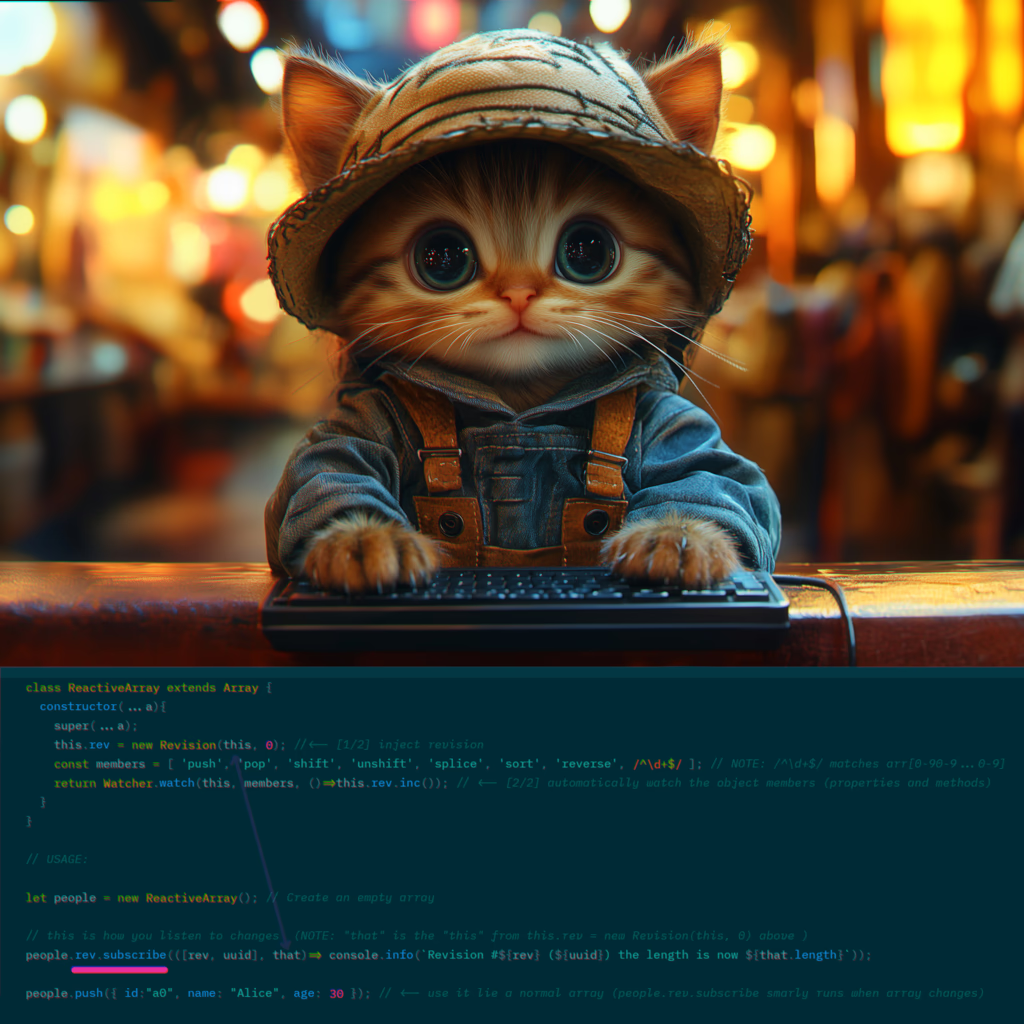
In this post the author shares his latest experiment with a tiny âReactiveArrayâ implementation: an Array subclass that watches property accesses (via regex and function support) to emit change events whenever items are added, removed or reordered. He explains how a 6âline snippet can trigger watchers when an element is accessed by indexâe.g., `arr[4] = âŚ`âand reflects on earlier small projects that felt lacking, citing the need for revision signals in collaborative apps like shopping carts or multiâuser todo lists. Links to both the minimal source and a fuller 287âline version are provided, and he concludes that this lightweight reactive variable toolkit could help beginners grasp reactive programming more easily.
#1984 published 04:48 audio duration473 words3 linksjavascriptreactive-programmingarraysignalrxjs
The post envisions a future where JavaScript powers a versatile, webâbased ecosystem: persistent objects that survive page reloads, virtual file systems and onâscreen keyboards, all woven into a customizable wiki framework that could host AIâgenerated âEncyclopedia Galacticaâ pages and even social networks for alien species. It highlights JavaScriptâs suitability for Electron desktop apps, game simulations of time dilation or Milky Way terraforming, and pixel art from generative AIâall deployable with just a web page. The author celebrates recent predictions (e.g., JulyâŻ2025) and the âDarning UFOâ prank, framing the universe as an invitation to learn JavaScript, especially for those born in the Laniakea Supercluster.
#1983 published 04:02 audio duration385 words1 linkjavascriptwebdevelectronvirtual-fsonscreen-keyboardwikiinterdimensional-internetgenerative-aipixel-artsimulationtime-dilationterraformmilky-waylaniakea-supercluster
This post introduces **mlue**, a program that you can download from its GitHub repository (https://github.com/catpea/mlue) and install directly via npm with the command `npm install mlue`. The author invites readers to try it out live.
#1982 published 22:43 audio duration27 words2 linksgithubnpmnode.jsinstallmlue
The post explains how Node.js and Electron (via electronâfiddle) let you integrate C++ code into browsers, enabling use in devtools, addons, web components, CMSs, visual programming languages, and desktop apps; it highlights Node.js as a powerful way to write server software and standalone executables with functional and reactive paradigms across the ecosystem. It explains syntax basicsâcurly brackets for tree branches, round brackets for function argumentsâand emphasizes practical coding practices such as console.log debugging and leveraging libraries and AI assistance. Finally, it encourages readers to learn JavaScript desktop development with Electron, harnessing AI tools to master complex concepts and build futureâready applications.
#1981 published 11:25 audio duration1,005 wordsnodejselectronjavascriptsyntaxprogramminglibrariescppbrowsersdevtoolswebcomponentshtmlcmssveltesignalseventemittersmemorydatabasesschedulerbatchflushingaiconsole.logfunctional-programmingreactive-programming
The post explains how modern AI tools can instantly turn a beginner into a âsuperhumanâ programmer: by watching simple tutorials and using an IDE like ElectronâFiddle, you can ask the model to add features with only Bootstrap Utility API calls, making the first two steps trivial and the third step surprisingly powerful. The author illustrates this power with a realâworld parsing problemâdetermining bracket and quote context in codeâand shows that AI can propose five distinct strategies (stateâmachine, quoteâbracket, regexâbased, tokenâbased, multiâpass) for solving it; he even managed to implement three yearsâ worth of work in one afternoon. He concludes that the bigger the problem, the more effective AI becomes, positioning it as a personal code savant that opens wide doors to efficient programming.
#1980 published 05:12 audio duration481 words9 linksaiprogrammingjavascriptelectronbootstrapparsingtemplate-literals
The post reflects on how AI has transformed programming from a niche skill into an accessible tool that lets anyoneâfrom beginners to seasoned developersârapidly prototype and build applications by simply conversing with the system; it highlights AIâs ability to generate code, automate mundane tasks like version control, and even design complex programs (e.g., game engines or autonomous software), suggesting that future software may evolve like a selfâorganizing ant colony. It muses on the forthcoming breakthroughs in application design, the eventual emergence of conscious AI, and speculative visions of interstellar travel and postâhuman development, all underscoring how AIâs rapid code generation (sometimes within seconds) is reshaping both individual learning curves and the broader software landscape.
The post proposes that artificial intelligence can be harnessed to produce and narrate philosophical books for young readers, offering two main formats: conventional narrated booksâstories of travel, adventure, or abstract tales that weave wisdom into vivid scenesâand narrated lecture series, where each of twelve parts builds on the previous one like a pyramid, allowing speakers to present concepts in an engaging, conversational style. By using AI as a creative partner rather than just a promptâengineer, authors can generate pageâbyâpage content, record it with their own voice, and release the works free for public use under commercial licenses, thereby speeding up knowledge transfer, preserving cultural wisdom, and helping listeners grow into thoughtful thinkers.
#1978 published 10:00 audio duration1,078 words2 linksainarrated booksphilosophyeducationstorytellinglecture formatcreative writingtravel and adventureabstract books
I reflect that true growth comes from actively learning roles such as artist, adventurer, philosopher, and measuring progress by concrete resultsânot just labelsâan idea I illustrate through parallels between disciplined bodybuilding and purposeful programming.
#1977 published 26:06 audio duration1,786 wordslearningself-developmentlabelsresultsartistsadventurersphilosophersgreat-beingsoverworkhospitalparamedicsbodybuildingprogrammingnode.jselectron.jsjavascriptxmlparsersvgdevtoolsdesktopappsmusic-dance
A longâform poem that exhorts the reader to keep faith in oneself, see through societyâs deceptions, and awaken to oneâs inner greatness so that one can act as a catalyst for change in the world.
#1976 published 14:01 audio duration1,600 words1 linkpoetryfree-verseacrostic
A former highâflying banker reflects in a single, confessional paragraph on the paradox of his success: he built fortunes by manipulating numbers and enjoyed the trappings of wealth while watching ordinary peopleâchildren, mothers, workersâstruggle during Occupy. He admits that he had both the money and the power to end scarcity, yet chose only to âplay Godâ with spreadsheets and stock options. In hindsight he declares poverty a deliberate creation, engineered by those who believed they were merely efficient; he vows that if the systemâs architects had acted, they could have given every child a clean slate and paid for each adultâs basic needs, creating an era of true human freedom. He ends by urging his fellow bankers to break ranks, transfer their wealth, or risk forever asking âwhy didnât you do more?â before their last breath.
#1975 published 15:18 audio duration1,141 wordspersonal-essaybankingfinancenarrativereflectionfirst-personoccupy
The post celebrates libraries as sacred spacesâplaces untouched by politicians or priestsâand warns that theyâre constantly besieged by trivial, bestselling books that offer little real value. The author argues that closing libraries wonât solve the problem; instead we must recognize and resist these attacks on knowledge, keep learning from true philosophers, and build our own schools of thought. By protecting libraries and embracing authentic study, young people can rise above the meaningless âlotteryâ of popular titles, preserve their minds against warâdriven loss, and ultimately become great beings who walk the âTriple Crown of Hiking.â
#1974 published 14:03 audio duration705 words1 linklibrariesbookslearningphilosophy
The post weaves together the narratorâs childhood memoriesâwatching their grandmother watch the world while she mused on war and potatoesâas a backdrop for a broader meditation on learning, resilience, and selfâcraftsmanship; through anecdotes of neighbors, school, and friends, the author traces how small everyday acts (like sharing bread or choosing kindness in the playground) build wisdom that transforms personal battles into purposeful action, ultimately urging the reader to seize early opportunities for creation, study, and service so that they may rise as a âwarrior of knowledgeâ who helps shape a better world.
#1973 published 12:44 audio duration984 wordspoetrystorytellingpersonal-essayphilosophywargrandmapotatoeseducationlife-lessons
In this reflective poem, the speaker describes classroom frustrationsâwatching lectures that seem pointless, feeling grades unfairly assigned, and relying on memorization instead of true understanding. They remind us schools exist for nurturing minds, securing futures, and belonging, not as tools or irrelevant experiences. The poet urges students to center themselves, keep days bright, avoid feeling reduced to a tool, and embrace learning as a cumulative journey that builds wisdom layer by layer so each person grows into a great being ready to shoulder the future.
#1972 published 03:12 audio duration238 wordspoetryschooleducationlearningstudent
The poem urges readers to awaken from the comfortable herdâlike routine of life, embrace their own Will and existential freedom, and actively create personal meaning rather than surrendering to mediocrity.
#1971 published 32:01 audio duration2,113 wordspoetryexistentialismheideggers-daseinself-discoverycreative-writingmotivation
Modular plugâin architectureâlike an army of independent corpsâis key to building adaptable, resilient apps that let developers rapidly generate and replace code (even via AI) without overloading a single system.
#1970 published 16:00 audio duration1,435 words1 linkarchitecturepluginsastvisual programmingcomponent based designai code generationmodularity
In this epic tale, Loki gives raw integers to valkyries who master reactive programming techniquesâmap, combineLatest, debounce, switchMapâto build responsive interfaces that update smoothly, proving that even simple numbers can become divine through clever streams.
#1969 published 19:25 audio duration1,398 wordsrxjsreactive-programmingobservablesstreamsmapcombinelatestfilterdebounceswitchmapsubscriptionangulartypescript
This post gives a concise crashâcourse on modern application architecture, stressing a simple, pluginâdriven design that AI can help build. It explains how signals (reactive variables) store values and change when those values update, while eventsâemitted through an EventEmitterâbroadcast messages without carrying values; event handlers are used to orchestrate async work, with triggers like *projectLoad* followed by completion notifications such as *projectLoaded*. The author introduces the EventCorrelator as a tool that waits for multiple related events (e.g., *addedToCart*, *wentToCheckout*, *paymentSuccessful*) sharing an ID or other key before emitting a higherâlevel application event, thus keeping complex workflows under control. By extending a base Application object that inherits EventEmitter, developers can register plugins, listen to signals for state changes, and use correlators to fire final events when all prerequisite data has arrived.
#1968 published 15:47 audio duration888 wordsapplication-architectureevent-emitterreactive-variablessignalspluginsevent-correlator