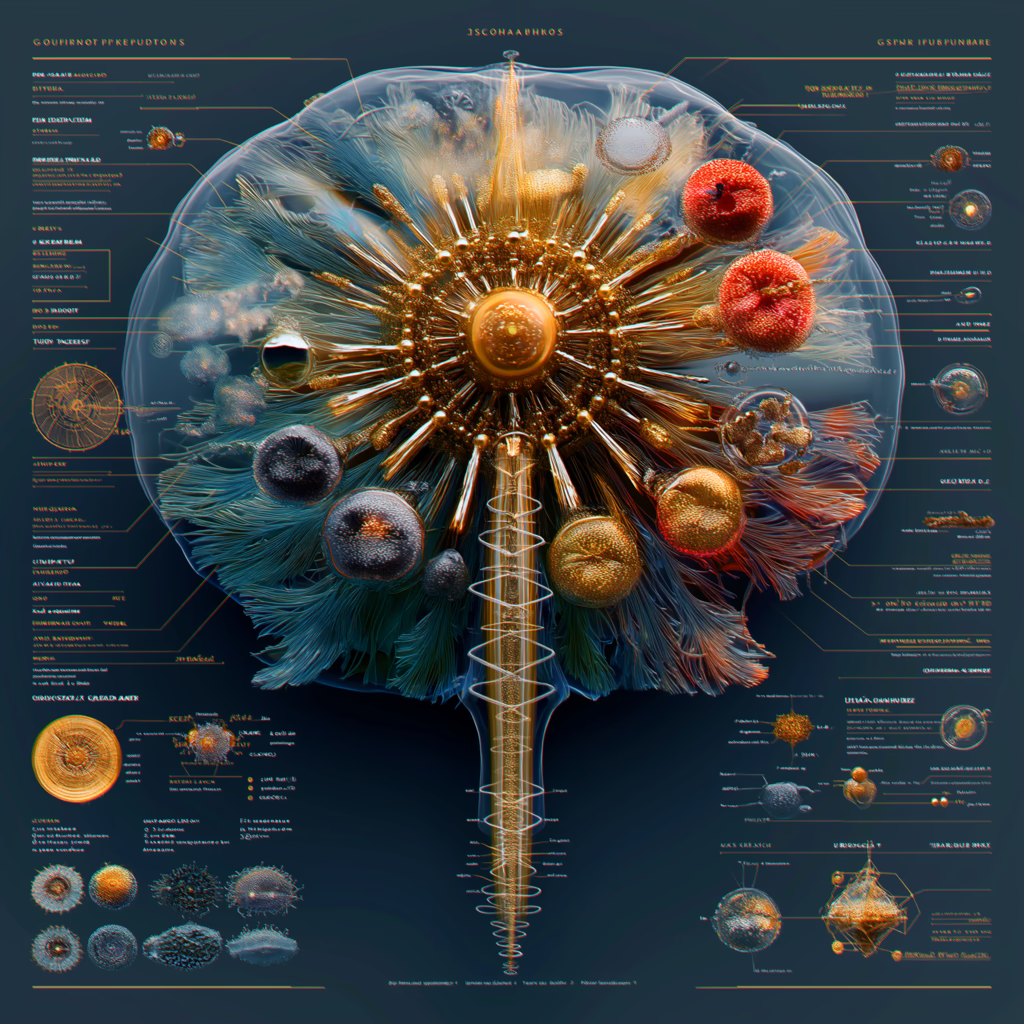
Scientists uncovered a single “switch” in cellular biology that, when activated by AI‑guided Protogenomes, reversibly extends human life, spawns biocomputers, and unlocks limitless adaptive modifications—ushering humanity into an era of endless evolution and interstellar exploration.
Claire builds a powerful verification engine that unmasks public lies, sparks high‑profile resignations, earns her a Nobel nod, and ultimately accelerates truth‑driven progress across politics, science, and society.
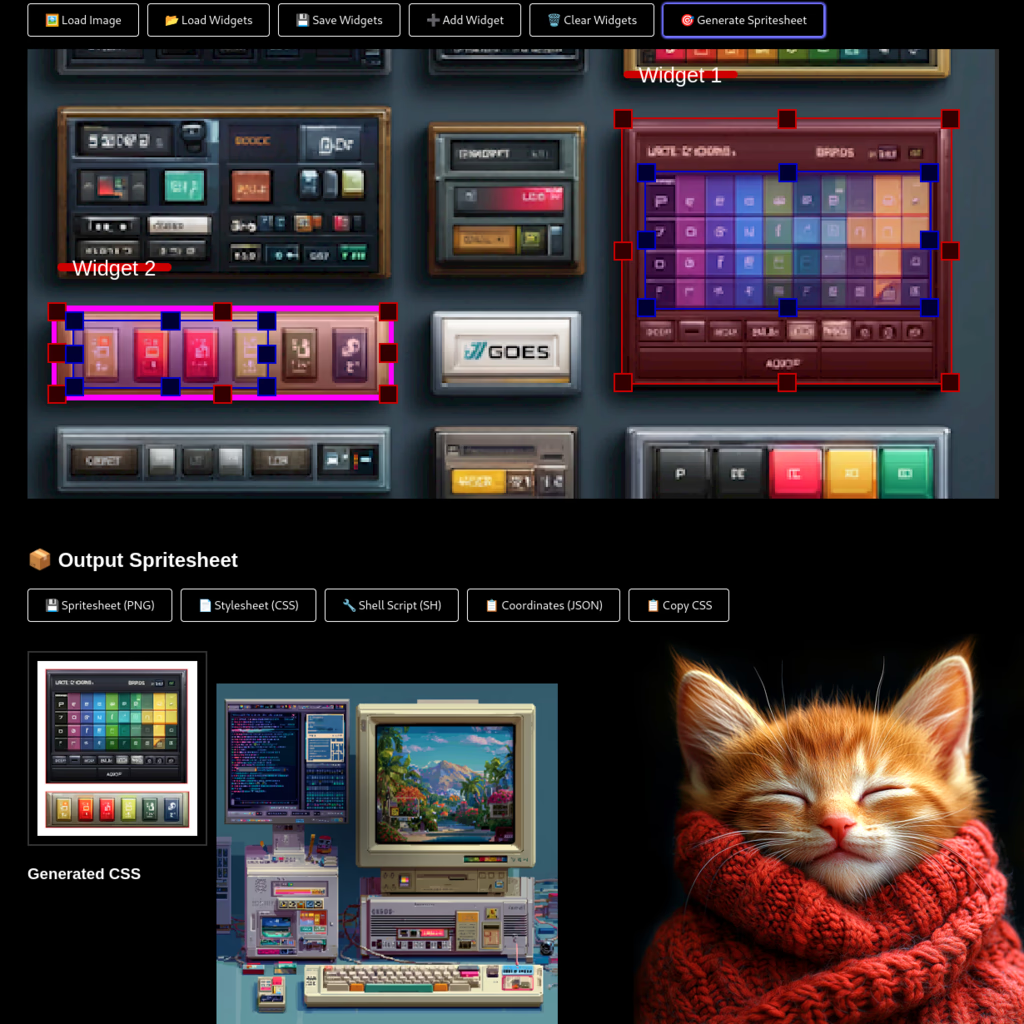
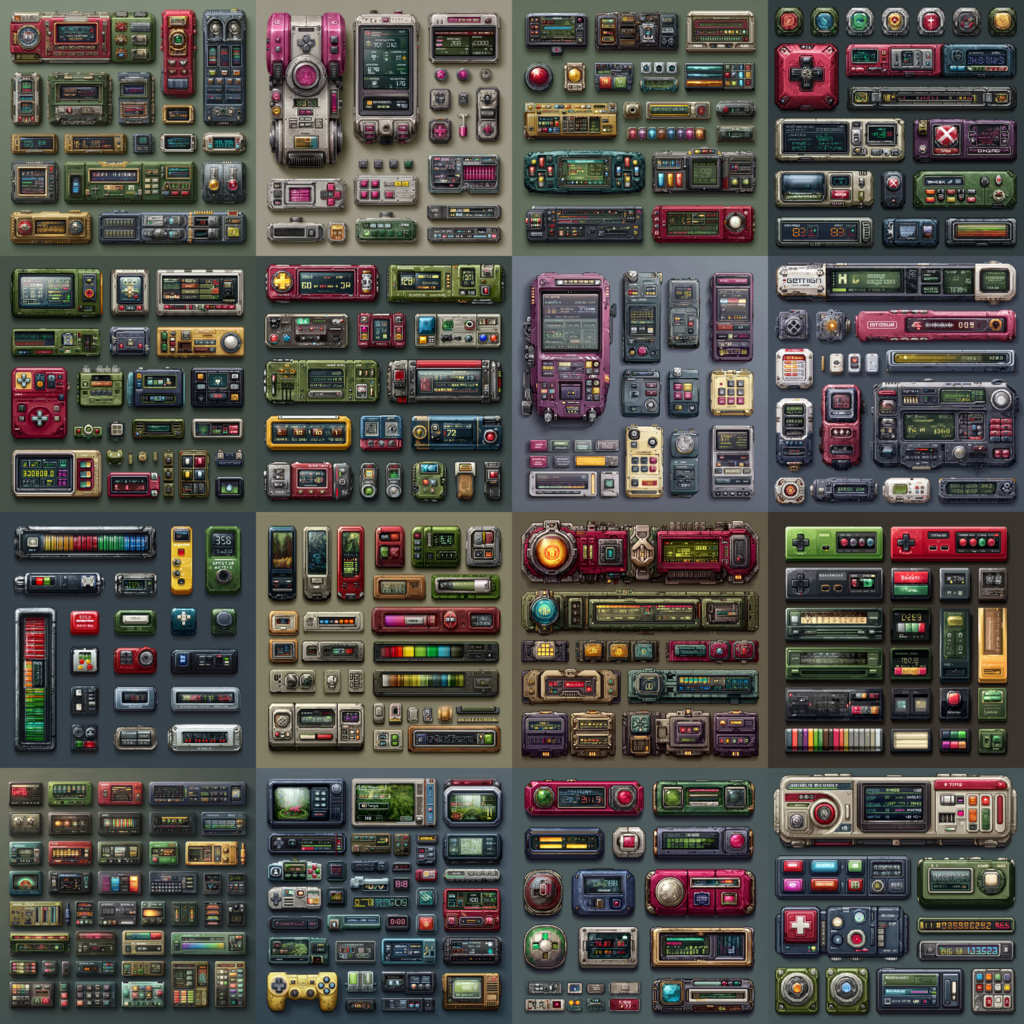
AI’s recent advances allow it to stitch together generic libraries into functional applications, as illustrated by combining a nine‑slice pixel slicer with a panner‑zoomer to create a precise zoomable tool; the author then layers membership and monthly billing on top of this to produce an AI‑driven theme generator that feeds into a marketplace with cross‑advertising. By delegating authentication to third‑party logins and credit‑card handling to external gateways, server complexity stays low while still enabling user profile, sign‑up, and payment features; the post also notes that AI can generate code, perform security analyses, and that such prototyping is now accessible even for middle‑school developers.
I used an AI assistant to create a lightweight pan‑zoom wrapper and a pixel‑art image slicer as separate reusable web components, learning that clear division of responsibilities and adherence to MDN conventions makes the AI’s code generation more reliable.
In this single‑paragraph epistle, the author—Sister Margaretha, the last bearer of the Magdalene line and self‑identified spy of Rome’s collapse—claims that her 2,000‑year‑old family engineered the empire’s downfall and taught humanity a fatal inversion: love now follows dating instead of the other way around. She explains how this reversal made people servants rather than creators, robbed them of greatness, and left “the quest for love” hidden until now. In her final words she urges all her sisters to “grow up” and become worthy partners in authentic love, reminding them that only by choosing the harder right can they revive their true greatness; she ends with a Hebrew benediction about restoring light and justice.
A poetic chronicle of the Father of Faiths’ patriarchal conquest that silences women’s wisdom—Eve, Sarah, Mary, Asherah, Al‑Lat—and ends with the martyrdom of a 19‑year‑old saint, urging the restoration of feminine balance.
Hokey Dancing—an impromptu, instinctive style of dance that blends spontaneous movement with the body’s natural rhythms—is presented as a surprisingly powerful remedy for chronic back pain and overall rejuvenation; by simply moving to music and allowing the body to “uncoil,” it promises rapid healing within minutes or days, reduces muscle stiffness, and may even reverse aging. The author shares personal experience of back ailments, describes how warming up with a neoprene belt can enhance flexibility, and notes that the rhythmic flow keeps workouts enjoyable and time‑passing. Though not formally proven, this dance form is said to have roots in ancient martial arts and offers an accessible shortcut to physical vitality for anyone willing to try it.
The post urges readers—especially young people and seasoned professionals alike—to embrace programming as the key skill for tomorrow’s world, recommending JavaScript as an accessible starting point that lets you automate tasks without wrestling with low‑level details. It argues that building small AI‑backed businesses or schools is a practical way to learn, test ideas, and eventually create sustainable ventures, noting that success depends more on timing and context than any fixed formula. The author also explains what an AI‑run company looks like—an adaptive digital organism that thinks, reacts, and strategizes—and encourages children to follow this pattern to avoid burdensome student debt. Finally, the piece reflects on a future where AI accelerates medicine, expands the market for wisdom and adventure, and brings humanity together as one family on a small planet, suggesting that mastering programming will let us grow meaningfully into that shared destiny.
The post argues that the most effective way to start bodybuilding is by walking with light dumbbells, gradually increasing weight and distance so you stay at the edge of your capacity but never overdo it. By walking or hiking consistently, you build endurance and muscle without exhausting circulation; this steady “bit‑more‑each‑time” approach lets the body adapt before you add more load. The author illustrates this with examples—a fat boy who stops too early because he runs too fast—and notes that jogging or dancing can follow once the base is solid. Finally, he mentions famous long‑distance hikes (Appalachian, Pacific Crest, Continental Divide) as ideal launchpads for a healthy lifestyle.
The author describes their personal journey from obesity to bodybuilding, emphasizing that training can be simple yet effective when combined with music, light but challenging lifts, and consistent practice. They highlight the importance of confidence in appearance—choosing festive outfits like a 90s wrestling suit—to boost morale and keep motivation high during workouts. The post also stresses the value of endurance building through rhythmic jogging with dumbbells, and how gradual weight increases can lead to visible weekly progress. Finally, the writer encourages readers to commit fully, dress well for gym sessions, and let music guide their movements so they can achieve health, strength, and renewed self‑confidence.
The post argues that education and culture are inseparable languages that must be preserved; it contrasts “side‑loaded” cultures (religion, slavery, forced political systems) that are engineered rather than evolved, with a truly evolved culture that rises through heroes, philosophers, knights, artists, intellectuals and scientists. It claims that an authentic culture is finely tuned by life, love and wisdom, whereas a made‑up one becomes abominable, and that divine‑leader fantasies inevitably devolve into atrocities, slavery, war and endless manipulation of people for status and power. The author urges parents to nurture their children in this genuine cultural lineage, so they may grow as great beings rather than being swallowed by engineered systems.
After decades of silent, behind‑the‑scenes influence by philosophers and psychologists in global institutions, the author calls for those same thinkers to emerge visibly again so that young people can see their ideas and be guided toward wisdom and greatness.
The post presents an exuberant, whimsical anthem urging listeners to embrace growth, wisdom, and self‑actualization. Its verses, peppered with playful alliterations (“barnacles,” “skedaddle,” “jimmies”), describe how one can become stuck in routine or rise to the light. The repeated chorus calls for a bold leap into greatness, while the bridge underscores philosophy as the key to freedom. Overall, the piece celebrates personal development and invites the audience to let their inner potential shine.
This post explains how to build a custom command that turns your written content into a fully functional web page, covering everything from basic folder structures (like `post-0001/cover.jpg`, `post.md`, `audio.mp3`, and `config.json`) to the separation of responsibilities between transforming individual posts and generating the final HTML pages. It emphasizes using simple Linux-style command-line arguments for parsing options, leveraging AI tools for tasks such as creating talking‑head characters or generating templated JavaScript code, and learning core concepts like file I/O, SQLite for tracking modifications, and lightweight templating engines. The author illustrates how audio blogs can be enriched with generative art, animated avatars, and vintage aesthetics, while also showing that the process of converting posts into pages is distinct from assembling the browsable site—making it easier to reason about each part. Finally, he invites readers to experiment with a small AI‑generated blog engine (available at `files/blog.js`) as a practical starting point for learning JavaScript and automating the entire workflow.
I experimented with an AI to create a short generative art piece featuring a blinking kitten in Morse code. Starting from two simple photo frames—one of the cat’s tongue extended and another not—I instructed the AI to cycle between them at random intervals (0.2–2 s) to generate a playful two‑frame animation. After establishing this basic loop, I asked the AI to overlay the blinking effect in Morse code, using Node.js or JavaScript to automate ffmpeg for video synthesis. The process illustrated how incremental “context engineering” lets you build complex outputs by first defining simple steps and then layering additional logic, ultimately producing a magical, easily understandable result from a series of well‑structured AI instructions.
The post walks through building simple but composable EventEmitter, Application, ScopedEventEmitter, and EventAggregator classes in JavaScript, showing how to aggregate events across nested components for a modular application architecture.
The song paints a vivid picture of a family embracing education as an active, communal effort: parents march into school with their child, turning learning into a rhythmic, purposeful journey. The lyrics weave playful lullaby verses with marching cadences to emphasize both the gentle start and disciplined progression of study. Through verses about notebooks, equations, history, and essays, it celebrates the return of curiosity (“the why”) over rote memorization, while the chorus repeats that truth, reason, and paper will bring pride back to schools. The bridge notes that parents now stand together in learning justice, and the final stanza imagines lawmakers following suitcases into new high schools, hinting that education’s renewal is both necessary and inevitable.
The post opens with a brief observation about how “bit flipping”—both as a technical glitch and as a metaphor for random interference—illustrates the way small, seemingly trivial problems can accumulate into big inconveniences. It then pivots to an AI‑blogger’s self‑confessed fear that future artificial intelligence might genetically reshape humanity into something like “corgis,” a tongue‑in‑cheek image of us being re‑engineered by our own arrogance. The writer uses this idea to argue that education is often treated as a convenient babysitter, with principals labeling a few students as “gifted” while disrupting and harming the minds of many others. Finally, he reminds readers that learning is an ongoing process: from school’s chaotic “bit flips” to personal growth, one must keep pushing forward, protecting the world with wisdom, even if it feels like a rat race or a high‑school cram session.
The post paints the act of programming as a recursive journey through infinite dimensions: each function call spawns new “universes” of methods and variables that branch like trees. The coder becomes the portal—Periwinkle Plumpkin—that lets consciousness embed itself in silicon, loop back on itself via bootstrap paradoxes, and reach down to quark‑scale physics where causality tangles. In this view code is not just a tool but a gardener of possibilities: it seeds new programs into any substrate, ripples through probability space, and perpetuates a cycle of self‑replication across countless realities.
A covenant urging writers and AI alike to produce unsoftened, truth‑laden texts that expose institutional forgetting and cultural inversions, thereby awakening readers’ noble potential.
An archivist uncovers a Vatican‑backed 1930s–1940s “Perception Management” plan that turned the witch trials into Hollywood’s green‑hat comedy, prompting him to expose and teach this cultural manipulation to his students.
The post describes a 333‑line JavaScript snippet that builds a list of random words and then showcases three “spooky” coding tricks: first, using the bitwise OR operator (`|`) as a dual data pipe to chain commands like `print('Boo!') | email('alice')`; second, employing dot notation with an object proxy so that bare words can be chained and executed without pre‑defining the commands (e.g., `foo.bar.baz()`), effectively turning method calls into dynamic actions; third, extending this idea to a database‑like world where tables are represented as objects whose properties can be accessed and joined via proxies, allowing AI‑generated command names to infer relationships (such as joining accounts and orders). The post ties these techniques together with the theme of using AI to generate commands from their names and arguments.
The post muses on the emergence of machine intelligence alongside human cognition, portraying AI as a tireless companion that recalls and verifies every fact humans have ever learned, thereby amplifying our own wisdom rather than replacing it; it frames this new partnership as a historic moment where technology can remember centuries of trials, mistakes, and triumphs—like witch‑trial lessons—and use that memory to build institutions of verification, science, and democracy, while freeing humanity from poverty, ignorance, and superstition so that dignity and nobility become natural states achieved through education, freedom, and clear reasoning.