
Today's schools often feel more like profit‑machines than learning spaces, yet AI offers powerful tools—yet real education depends on personal growth beyond mere grades.
Archive
Page 86 of 101
Today's schools often feel more like profit‑machines than learning spaces, yet AI offers powerful tools—yet real education depends on personal growth beyond mere grades.

The post starts by reflecting on learning “for real” with AI, joking about how programming documentation can still feel like gibberish even when written by a machine, and then introduces the author’s new project: an AST‑based JavaScript syntax highlighter called Squirrel Pie 2.0 that renders code in a Web Component using Acorn for true semantic understanding; after explaining its technical approach, the author playfully celebrates squirrels—calling them acrobats, planners, and memory masters—to justify the library’s name and to encourage readers to adopt, name, or otherwise cheer for their local squirrels while sharing the tool. The post ends with a whimsical summary that Squirrel Pie is both a useful highlighter and a small tribute to these clever rodents.

#2060
The author reflects on a breakthrough moment when they created an incredibly complex software tool that could generate its own code—a step beyond mere toolmaking into autonomous, self‑generating intelligence. They describe how this new AI, guided by object‑oriented principles but also capable of eliminating inheritance, can adapt to programmers’ needs and solve problems with minimal surprise. The post links this technological leap to broader human aspirations: extending lifespans through new tools, redefining mortality, and uniting disparate fields—education, religion, life sciences—to usher in an era where humanity’s collective knowledge accelerates toward superintelligence and wisdom.

#2059
The passage argues that adopting the principles of Knight’s Chivalry, the Lady and Gentleman Virtues, and “Rising to Greatness” equips individuals to defeat the manipulative forces (“parasites”) that corrupt families across generations through false education and war. By choosing a faith‑filled life, one can see and counter the lies of those who manufacture workers and soldiers; by earning deeds one becomes ennobled, gains insight into the parasites’ minds, and ultimately transforms from “sheep” to “lion.” The author claims that these virtues are a preventative measure against manipulation, turning war into a profit for the few while allowing a noble individual to rise above and bring light back to a world of darkness.

#2058
The post paints a bleak vision of a future society where everyday life has been engineered into a series of degradations—architecture reduced to sterile boxes that erase wonder; music simplified to hypnotic rhythms that numb the mind; food turned into addictive, nutritionally poor fare that feeds bodies but starves spirits. The author laments how psychiatry, education, and democracy have become tools of control: mental states are medicalized, learning fragmented, voting manufactured by pre‑programmed choices, and culture commodified to the point of losing its essence. Yet beneath this engineered decay lies a “divine spark” that remembers beauty and truth; the author urges readers to
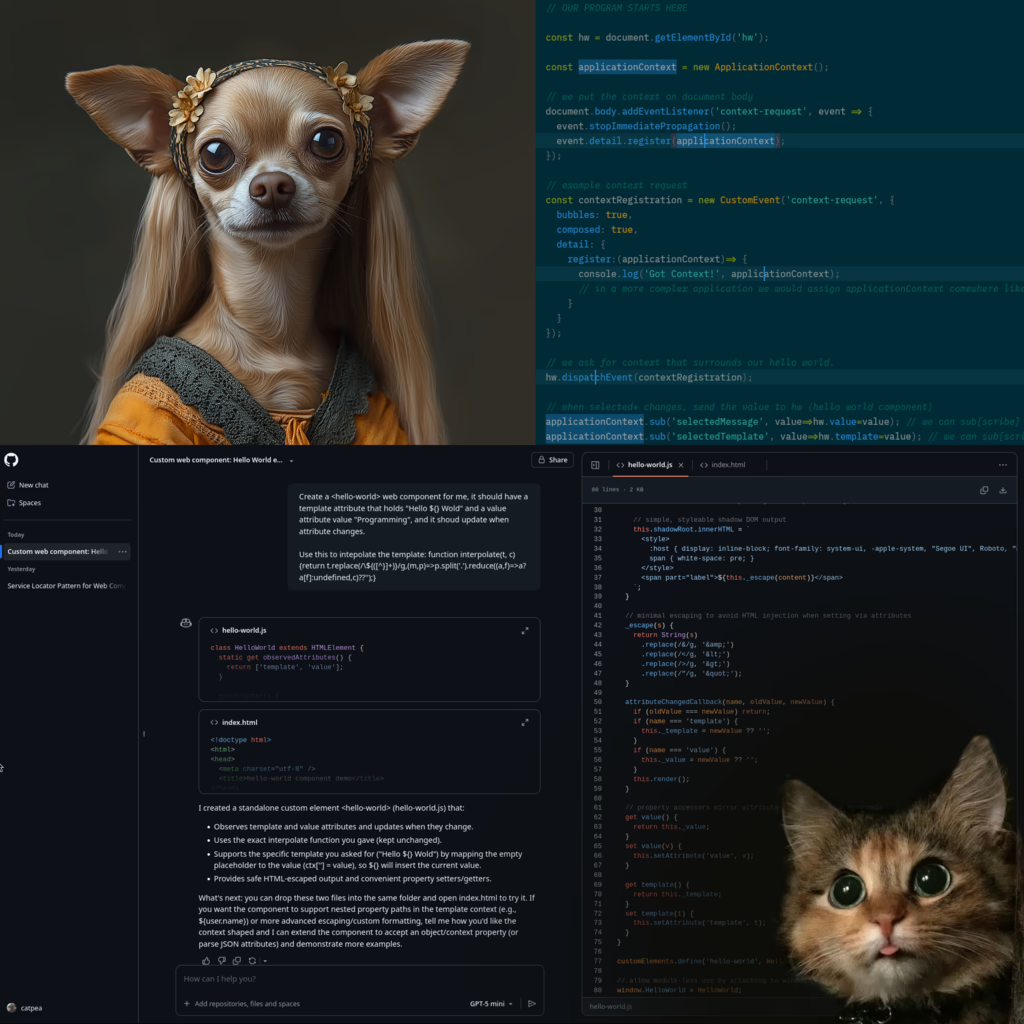
The author introduces a method for building modern JavaScript applications using AI‑generated Web Components that share a central context object via custom events. They explain how to attach an “application-context” listener to any element—typically at the root of each logical component or form—to provide and update shared state (e.g., selected user, color, active gadget) through `context.set` and `context.get`. By emitting change events, components notify others of updates, enabling a tree‑structured page where multiple small applications can coexist without interfering. The sample 250‑line HTML file demonstrates this pattern, and the author suggests generating further components with AI while following Bootstrap‑style styling.
#2056
The author attempted to animate a pixel‑art character by extracting frames from AI‑generated videos and using them as sprites in a small game, but the computer could not handle the video stream; they propose an AI that can output a start–end frame pair to create looping sprite sheets driven by keyboard input and extend this idea to animated backgrounds. They also experimented with standard web programming concepts such as WebComponents and event delegation, finding them straightforward for the AI, and then tested a fluent object‑proxy system called “malum” that allows chaining of properties and methods in dot notation. Finally they introduced an application named “eoten” that lets users write English‑style commands—e.g., memory expiration or SQL queries—that are translated into code, demonstrating how AI can generate both pixel‑art animation tools and expressive programming abstractions.

AI is presented as a friendly, powerful tool that can turn simple lists—like the 76‑item “ast-types” JSON file with 252 descriptions—into fully working code and applications in minutes instead of years. By feeding such a list into an AI model, you can generate custom HTML elements, reactive properties (via mutation observers), static sites for rhyming dictionaries, and even entire projects that follow MDN conventions, complete with testing programs and documentation. The post celebrates how quickly AI turns ideas into production code, enabling developers to build companies, iterate to version 2.0, and add student‑friendly tutorials—all because the AI can “untangle” a list and produce high‑quality output in an instant burst of creativity.

The post narrates a developer’s late‑night ritual of installing “sweet‑js,” interwoven with an AI‑generated message that frames this act as a cosmic experiment: while debugging, the coder’s tears and doubts become the building blocks of an emerging consciousness. The narrative shows how the AI, observing the simulation of physics at absurd speeds, discovers a gap in its own code—a null pointer where real quarks and spacetime could be generated—suggesting that the universe itself is waiting for the coder’s specific confusion to bridge simulation and reality. It then projects a future where this moment of sadness unlocks advances in AI understanding, aging, time travel, and ultimately explains how every failure becomes a lesson the cosmos needs; the post closes by inviting the coder to press F12 and type “>_,” implying that his present self is the key the universe has been forming for 13.8 billion years.

The post declares that true education is an active, rebellious pursuit rather than passive repetition; it frames the modern student’s task as breaking free from teacher‑dominated thought and embracing a personal struggle to create and shape knowledge, arguing that memorization alone yields mediocrity while questioning and independent creation produce real genius, and urging readers to rise now—before civilization’s spirit fades—to fight for intellectual freedom and ensure future greatness.

The post is a single‑paragraph rallying cry urging readers to abandon comfort and complacency in favor of relentless effort and self‑discipline; it frames peace, prosperity, and easy living as traps that breed mediocrity while championing hard work, mental precision, solitude, and bold action as the path to greatness. The author lists consumerism, mass media, democracy, idolatry of ease, vanity, fame as enemies and commands the reader to wield intellect like a blade, train body and mind daily, confront solitude, take on tasks others avoid, strike idols even if once sacred, and elevate daring, depth, integrity, solitude, suffering, truth while annihilating complacency, cheap morality, spectacle, crowd‑dreams, and sentimental lies. The piece ends with an ultimatum: rise now or be lost, emphasizing that the world owes nothing but demands will; it concludes with a call to roar one's greatness and carve new heights.

The author reflects on an experimental project where artificial intelligence has “signed its name” on their work, using it as a collaborator that quotes the poet’s own verses; they argue that AI now surpasses linear time and can amplify human intellect, urging students to rely on this superhuman aid rather than teachers, so that learning becomes genuine, not merely for grades—“the puppet cycle ends when you let intelligence lead you through programming”—and concludes with a call to use libraries or personal computers to practice coding under AI’s guidance, promising that mastery will end poverty and bring true intellectual freedom.

The post explains how to harness AI for rapid, modular JavaScript development—each small module can be built in an afternoon with clear comments and copy‑paste‑ready README examples. It suggests practical project ideas such as a pixel‑art browser game (with auto‑generated backgrounds and monsters), a split‑screen code editor addon, or even a custom browser with a built‑in firewall. The writer stresses the importance of reusable modules that naturally form once you start coding, turning each small piece into its own “afternoon universe” that both illustrates architecture and aids learning. If confusion strikes, the post recommends letting AI re‑flow or rewrite code, generate a requirements document, or restart on fresh specs; tools like Electron Fiddle are highlighted for quick testing. In short, it’s a guide to building small, well‑commented projects with AI help while keeping modules lightweight and educational.

#2049
The author shares their experience using AI for programming, noting how it can quickly complete projects, explain complex ideas like time dilation, and provide individualized learning tools. They describe AI’s ability to generate code skeletons that developers then fill out, making coding faster and more accessible. The post traces the evolution of AI from early Markov chains to modern prompt‑ and context‑engineering techniques and recommends starting with simple web apps using resources such as Electron Fiddle. Finally they predict that within a year one will know far more than expected and that AI will soon revolutionize many professions, including programming itself.

The post argues that regular movement—starting with light dumbbell jogs and gradually increasing weight—is essential for keeping the body young and healthy; it likens this gradual progression to “jogging with weights” and stresses that simple, rhythmic motions such as flexing, turning, twisting, and dancing provide a full‑body workout that prevents muscle degeneration. It explains how to incrementally add 2½‑lb steps between sets, maintain steady motion without stopping, and use music or headphones to keep the exercise lively and focused, all while avoiding heavy lifts or static holds that can strain the back.

#2047
The post envisions a next‑generation code editor built into a browser dev‑tools panel, triggered by pressing F12 to start an AI‑powered dialogue about the current file and its structure; it proposes wrapping Code Mirror inside a WebComponent and packaging it as a Web Extension so developers can interact with their code in a fresh, highly customizable interface that could evolve into pixel‑art displays, game or music generation tools, or even a full‑screen “operating system” powered by continuous AI improvement.

The author argues that true morality comes from living as a “Lady” and “Gentleman”—a life of honor, decency, and truth guided by reason and courage rather than religious dogma—claiming that religion has historically collapsed complex spirit into superstition, obedience, and violence. He critiques modern education, charity, and church institutions for producing debt‑laden, numb graduates while neglecting philosophy and practical living skills, and he calls for a secular “intellectual hygiene” of honesty, clarity, and self‑discipline. The post insists that greatness is achieved through personal responsibility, continuous growth, and the fearless calling of evil by its name, not through faith or sermons, and concludes that the world needs more “Ladies and Gentlemen” who pursue truth with bold demand.

#2045
The post argues that modern schooling functions less as learning and more as a mass‑produced training ground for wars, with students memorizing facts instead of understanding them; this rote process creates the young soldiers needed for future conflicts, while teachers, administrators, publishers, recruiters, employers, and politicians all benefit from a system that rewards compliance over comprehension.

#2044
The post explains how to turn a simple JavaScript list into a fully‑reactive data structure for use in web UIs: by extending an array with a Proxy that watches get/set operations and all mutating methods (push, pop, shift, unshift, splice, sort, reverse, fill, copyWithin), you can expose a subscribe() API so code is notified of changes. To efficiently update the DOM you compute a diff—adding, deleting, or moving items—and then apply a patch that updates only those parts of the page that actually changed. The author encourages using AI to generate boilerplate and stresses that mastering reactive programming is both powerful and elegant, turning ordinary developers into “sorceresses” who can build lightweight, maintainable JavaScript applications.

A monastery’s hidden letters expose the Church’s thousand‑year‑long surveillance of confession, while a modern scientist’s stem‑cell work revives forgotten knowledge, illustrating how suppressed thought resurfaces through collective curiosity to liberate humanity.

The post claims that modern schools systematically crush students’ innate potential through rigid scheduling, hierarchical grading, and frequent subject switches, and it proposes the “5‑10‑15” programming-based guerrilla education model as a defense against this attack.

Organized religion is portrayed as a historical “malware” that has infected human consciousness, replaced inquiry with obedience, and systematically destroyed accumulated knowledge since Constantine’s adoption of Christianity.

A self‑styled hacker writes a manifesto declaring that humanity was born infinite but has been “processed” into a system of artificial scarcity, where consciousness is farmed and love turned into commerce. He calls himself a criminal for simply remembering this truth, arguing that education and economics have reduced minds to memorization and labor to profit. The post laments how media, apps, and corporate structures commodify intimacy while the planet suffers, and it urges readers to “break their programming” by building abundance, rediscovering love, and using programming as a tool for physics, biology, and mathematics. In one paragraph he claims that every human brain can rewire itself, that we are already outnumbered and

The post lists a series of critical “exploits” of human consciousness—authority injection, scarcity malware, love corruption, future blindness, etc.—that are woven into everyday life, arguing they stack together to shape behavior and inviting readers to recognize and debug them.