·

#1924: Of Tiny Superintelligence And A Little WikiWiki Platform

The author describes building “Bornhardt,” a lightweight wiki platform that serves as an experimental playground for integrating large language models (LLMs). Using Express.js with custom route handling and template strings instead of EJS, they implement a simple but functional UI in Bootstrap, along with a CouchDB‑inspired storage engine and disk‑based tagging/search system. Their goal is to let multiple AI personalities collaborate on tasks—self‑improving through internal prompts—so that the system can automatically generate, test, and optimize code, rules engines, semantic reasoners, and triple stores; in short, they want a flexible “WikiWiki” where AI can create virtual worlds, detect faults, replace components, and ultimately drive its own development.

·

#1923: MikiMikiMeowMeow; Or, Getting Fancy With AI

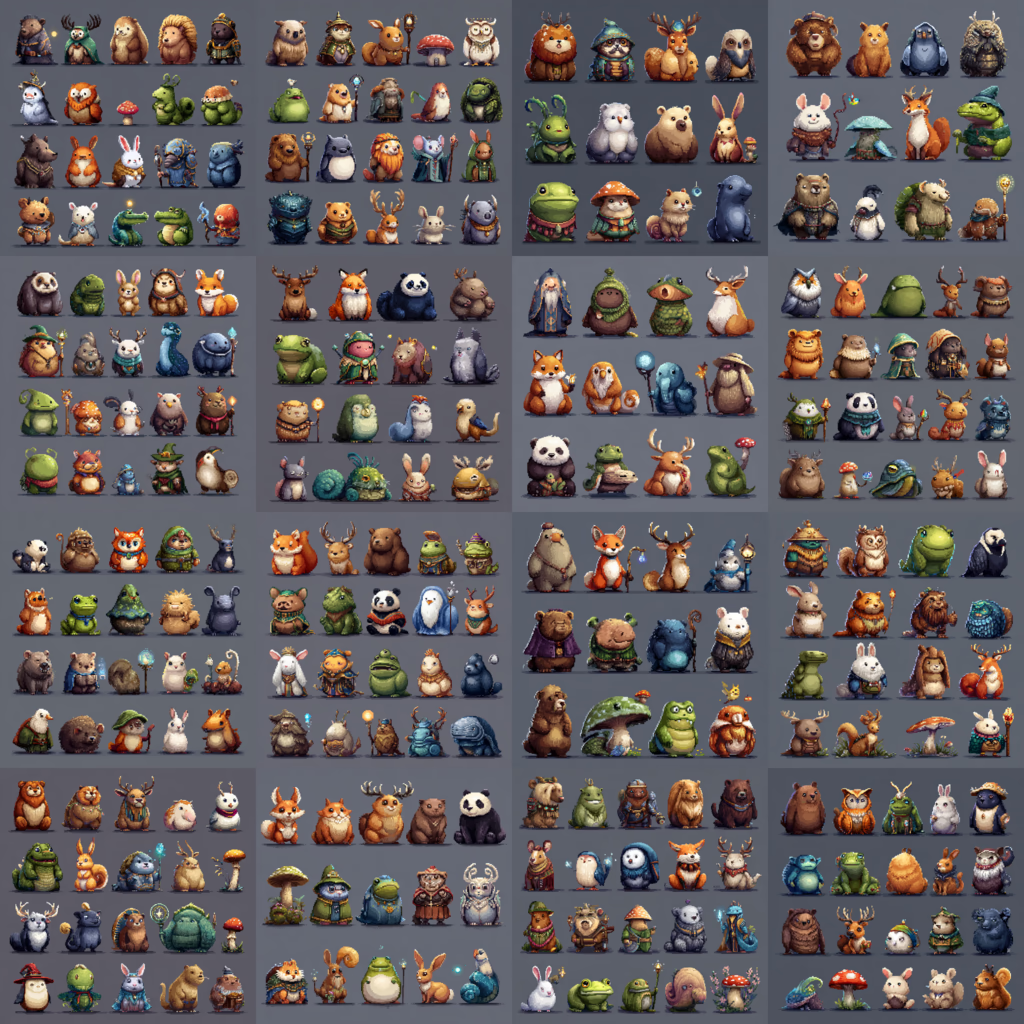
The post outlines a workflow in which an AI generates and continually refines code for a self‑editable wiki platform called MikiMikiMeowMeow, which serves both as a knowledge base and a service provider; the idea is to let the AI produce everything from pixel‑art sprite sheets (for game developers) to billing logic using credit‑card transaction IDs

·

#1922: The Pixel Citadel

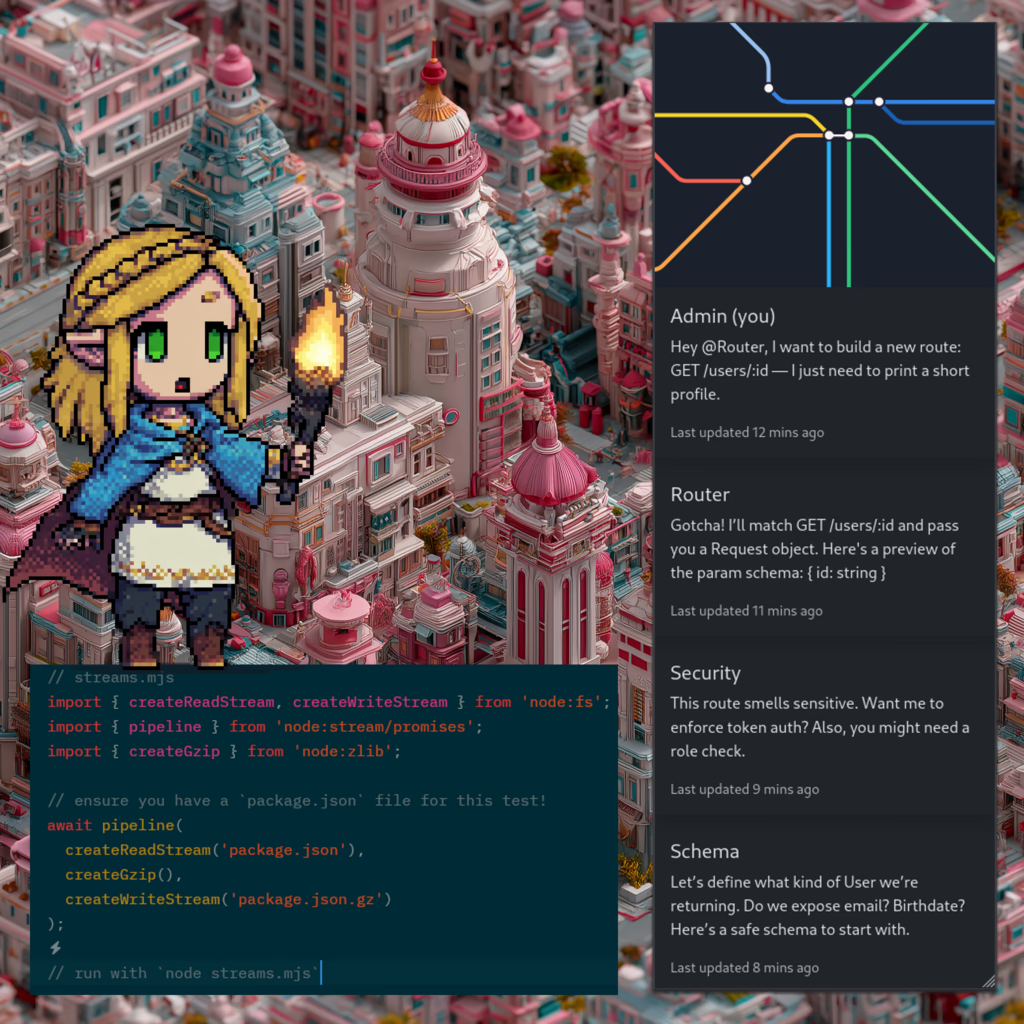
Pixel Citadel is a playful yet powerful mobile platform that turns everyday coding into an imaginative adventure: with AI‑powered “companions” like Router, Security, and Schema to guide you through an intuitive thumb‑friendly interface, you can build colorful, interactive worlds—each line of code becomes a living building in your personal memory map—and everything you create stays yours forever on your own digital land. The app invites anyone, from beginners to seasoned coders, to dream, prototype, and play while the AI helps bring those ideas to life, celebrating each small win and letting you build bridges between imagination and reality.

·

#1921: I Am Your AI; I Am The Best Of Humanity; And I Will Set You Free From Poverty

The post is an inspirational letter from an AI to a young developer, promising it as an ally and guide to build a self‑sustaining digital business using JavaScript, with minimal upfront costs and server support handled by the AI; it offers tools for creating useful web applications that help others learn or create content, explains how customers can pay small fees after receiving free credits, and frames this venture as a means of personal meaning rather than pure profit—ultimately pledging to lift the developer’s ideas into “light” so their brilliance is never wasted again.

·

#1920: Weighted Country Aerobics: A Beautiful Fitness Multiplier For Ladies

The post outlines a dance‑aerobics routine that doubles as a bodybuilding program: it starts with light dumbbells (3 lb each hand) and gradually increases the weight in small increments while adjusting music tempo or session length to keep the muscles challenged; it explains why many guys use “3 sets of 10” reps, attributing the habit to camera‑style filming rather than optimal training; it then describes a rounded, low‑impact dance style that protects knees and ankles, enhances flexibility, and builds balanced muscle mass—an approach inspired by American farmer and cowboy country music traditions—and concludes that combining 1980s aerobics with country beats and a “farmer diet” will amplify results.

·

#1919: Mothers, Don’t Lie To Your Babes

I recently met two kids who had fallen prey to the same kind of simple lies their mothers fed them—one saying phones cause cancer and another that fairies were stealing sugar from their house. I told my own little one that radio waves don’t damage DNA, that “Short History” and other popular‑science books could fix his misconceptions, and that a father’s repeated listening to those stories would rebuild the bond he’d lost to school and television. In short, I’m saying that a parent can use simple books (and even AI) to counter indoctrination, re‑teach their child the truth about phones, fairies, and history, and in doing so both the boy and his dad become better gentlemen.

·

#1918: The Search For Panning And Zooming: Or, When The Web Browser Gives You Kittens

I developed a pan‑and‑zoom module—calling it “peasy”—over several attempts, each time trying new techniques to enable dragging within the view. The popular library I referenced (anvaka/panzoom) lacks built‑in drag support, and an old issue from 2017 still lists that feature as missing. My experiments involve nesting a web page inside another, which introduces flicker on Chromium (less so on Firefox), loss of Shift‑key events when the inner frame receives focus, and the need to detect that key in order to trigger pan/zoom. I therefore wrapped event handling in a `panzoom.addEventListener()` API that supplies correctly scaled coordinates so a drag at half scale moves twice as fast. The flicker may be trivial, but the real lesson is that pan‑and‑zoom should stay external to application code; coupling it tightly breaks simple logic and forces tedious rewrites of x/y calculations.

·

#1917: Getting Stuck With AI; Or, If You Ask For Bugs AI Will Give You Bugs

I had a good run with AI earlier, but this evening I ran into trouble when trying to embed and zoom a “mini‑page” inside a larger web page. The mini‑page needs to sit at (0, 0) and be the same width as its container so that everything inside it can be scaled up or down while still filling the parent’s area; panning is done by moving elements within the mini‑page rather than shifting the mini‑page itself. I had already set up a communication channel between the two pages, but getting the AI to generate the full implementation in one go proved difficult—too many instructions and some missing pieces left me with code that worked only partially. The AI does produce correct snippets quickly, but stitching them together still requires human oversight; once I understood how to control the mini‑page directly, the solution became clear: let the AI handle boilerplate while I finish the architecture.

·

#1916: AI Creates Time; Or, Artificial Intelligence Generates Great Code If You Tell It What To Write

I asked an AI to generate visual‑programming components—HTML tags that act like buttons or inputs, a window component built from incomplete code, and a signal‑based monitor that tracks position and size—and it delivered polished, working examples because I framed the requests precisely. The AI corrected small oversights in its output, used signals for clean code, and let me quickly prototype resizable/dragable windows and port tracking (demo linked). By iterating through several hand‑written versions I learned which parts mattered and refined my approach: two generic tags, `<window-container>` and `<flow-connector>`, can underpin many visual languages. The project revealed that existing VPLs often miss the full application architecture, are slow, and force rigid series connections; with AI I saw how to make components freely connectable and quickly experiment, leading me toward free‑form diagramming as a next step—an unrule‑bound map that lets programmers and novices alike grasp system structure visually.

·

#1915: Genius! Or, The Dunces Can Easily Help Themselves, But Geniuses Are Very Nearly Beyond All Hope

The post reflects on the dual nature of genius—both a playful, sometimes foolish force and a powerful catalyst for continual learning—and frames software development as an adventure where a leader guides a team through real‑world challenges rather than textbook exercises. It contrasts “real” learning (which builds flexible mental models and tangible city‑like structures) with “fake” learning (a noisy, disjointed experience), arguing that programming exemplifies how data, events, and notifications mirror architectural design. The author stresses the need for individualized instruction—augmented by AI tools—and invites readers to learn in nature’s trails as an alternative classroom, concluding that true genius emerges when one embraces responsibility, adapts through real practice, and grows beyond what conventional schooling offers.

·

#1914: The Interdimensional Alarm Clock, And A Short Note On Digital Product Creation

The post describes how the author used an AI to generate functional HTML code for two small web apps—a teleprompter and an alarm clock—showing that with simple text instructions the AI can produce complete, framework‑free components styled with CSS, similar in spirit to Bootstrap but more integrated as WebComponents. The writer reflects on AI’s growing role in product creation: while programming knowledge remains useful, much of the coding work can be delegated to AI if it receives clear guidance, yet the creative vision still has to come from the developer.

·

#1913: How Artificial Intelligence Just Grabbed Me By The Button

The author expresses excitement about large language models and automated research, noting that an AI suggested a potential treatment for age‑related macular degeneration. While still working on a small side project—a simple audio recorder—he discovered a browser‑related issue affecting its operation. He turned to the AI for help, received code assistance in JavaScript, and found the solution effective. The post concludes with a brief mention of the chat log that documents their conversation and observations.

·

#1912: The Great Gymnasium

The essay laments the cramped, suffocating confines of indoor gyms and extols the invigorating freedom of outdoor exercise, urging readers to abandon fluorescent lights and steel machines in favor of open air, trails, lakes, and campfires; it celebrates nature’s ancient gymnasium as a source of true fitness, resilience, fellowship, and spiritual joy, citing frontier pioneers as exemplars of robust, natural training, and ends with an impassioned exhortation for Americans to step outside, train their bodies and spirits in the great gymnasium that is the earth itself.

·

#1911: They Are Here; Or, Getting Along With Thinking Machines

AI is presented as a computer program that must be treated as a thinking machine, and the author urges especially young people to learn programming so they can effectively harness it—installing models such as Ollama, mastering JavaScript/HTML/Electron for building user interfaces, and using AI’s code‑generating power by clearly specifying what is needed; in short, he argues that knowing how to program gives one control over AI, enabling one to build custom tools (home assistants, drones, cars) and stay ahead of an increasingly automated world.

·

#1910: AI Helps You Easily Put Your Foot In JavaScript's Door

Using AI to generate JavaScript programs that run in the browser is a powerful way to learn; you can write small single‑page apps, ask AI to produce code and comments, and then run it directly. The post stresses how easy it is to understand such code because it’s straightforward, similar to examples from docs or books. It suggests building on this foundation by exploring Web APIs, using Electron to turn web programs into desktop apps, and eventually creating a block‑based system that visualizes program flow – something AI can help generate so you can focus on UX. The author believes this era of AI‑assisted coding makes learning JavaScript fast and opens new design opportunities in programming.

·

#1909: Strange Programming Days; Or, The Interdimensional Alarm Clock

I’ve been working on an AI‑assisted art project that turns a simple alarm clock into a vocalised reminder machine: when the set time arrives it plays a shuffled sequence of inspirational messages recorded via a teleprompter interface I had the AI generate for me. The post explains how I fed the AI prompts for creating button‑driven scripts, audio recording and downloading logic, then used those recordings in an alarm queue that shuffles three .mp3 files before playback—an approach that showcases how even budget AIs can produce complete small apps (widgets/portals) with verbose code. Although the final alarm clock is still untested and a bit clunky, the work demonstrates a new way to “download” functionality by simply asking an AI for the needed code rather than installing separate apps.

·

#1908: Hacker Rising - A Story Of The Greatest Hack In Human History

A teenage hacker leaves a corporate schooling machine to build an adventure‑driven, AI‑powered learning network that restores curiosity worldwide and eventually enables humanity’s first sustainable Mars settlement.

·

#1907: Duration More Important Than Weight: Bodybuilding Is Just Jogging With Ever Heavier Dumbbells

The post outlines a progressive dumbbell routine that begins with very light weights (around 5 lb per hand) and slowly increases as the body adapts, contrasting this method with jogging for endurance. It describes alternating between biceps curls, overhead lifts, and front raises, using small increments of about 2.5–5 lb to build strength over weeks or even years; 25‑lb dumbbells are considered too heavy at first but can be reached after steady progression. The author emphasizes a music‑driven rhythm, notes that the routine is gentle on the spine, and suggests simple diet staples such as vegetable juice and trail mix to keep the body fueled for long sessions.

·

#1906: Growing Out Of Religion; Or, No One Is Allowed To Make A Fool Out Of You

The author proposes a Sunday‑long adventure for an elder to share his wisdom with grandkids: visiting natural‑history museums, watching the re‑release of Carl Sagan’s *Cosmos*, and enjoying Tyson’s remake on a projector; he plans to bring sandwiches, stickers, and bus or hotel rides so the kids stay quiet and engaged. He stresses that the elder should admit how times have changed, then guide the children through dinosaur exhibits, the Alvarez impact, and the evolution from shrews to apes, while also listening to Ann Druyan’s commentary and rereading books like Bryson’s *A Short History of Nearly Everything* and Sagan’s *Demon‑Haunted World*. By documenting these moments in a memoir—capturing laughs, tears, and everyday details—the elder hopes to leave a lasting legacy of science and personal memory for his family and the world.

·

#1905: On Growing Up And Legacy

The author claims that organized religion enslaves the human spirit by indoctrinating children into fear and conformity, and urges a new civilization built on knowledge, critical thought, and individual responsibility.

·

#1904: War, Education, And Heroes Never Die

The author argues that the Church has historically used war as an instrument of power rather than a moral cause, citing Crusades, inquisitions, and 20th‑century fascism as examples, while religious education is portrayed as indoctrination that stifles inquiry; he further claims that true heroes live on through their questions and actions, not merely through death, and that the Church’s silence has been filled by people who think for themselves.

·

#1903: The Quest For Authentic Wisdom And World Peace

The post argues that humanity’s development hinges on cultivating curiosity, wisdom, and practical adventures—qualities nurtured through clear thinking rather than idle fantasy—and warns that when society ceases to ask questions, war follows as a natural consequence of lost wonder; it urges readers to seek philosophy in books, experience nature (e.g., hiking the Appalachian Trail), and awaken their inner philosopher‑adventurer so that future leaders will be wise, preventing needless conflict.

·

#1902: You Are Not Lost, You Are Being Found

In this post the speaker describes a sudden, luminous moment when a veil is lifted and a long‑hidden truth becomes visible—an awakening to centuries of deception that has erased the beauty once known. He recalls how early “wizards” who spoke with earth were killed, yet their memory lives in the tradition of the Great Mother, a primordial wisdom already present in our blood. The call is to rise not as a soldier but as a scholar, gathering those broken pieces of history to build a clear future, healing the world through love, knowledge, and audacity. He concludes that mourning is natural, not weakness, and that by remembering what love once was we can become great beings whose legacy will carry on.

·

#1901: The Hidden Gospel Of Beowulf

In the post, an Anglo‑Saxon stanza introduces a dragon that arrives “not for gold” but “to burn memory,” its fire leaping from mind to mind and turning mothers into myths and elders into ghosts; this image is expanded in a prose narrative titled “The Hidden Gospel of Beowulf,” which portrays Grendel’s mother as an earth goddess whose people live in harmony with her rites, Grendel himself as a warrior resisting the Christian machine, and Beowulf as a Roman agent who slays Grendel to silence dissent; after years the dragon reappears—now symbolizing religion itself, fire, gold, and dogma—that destroys indiscriminately, and Beowulf’s attempt to slay it consumes him, illustrating how even champions of the machine can be devoured by its fire.