·

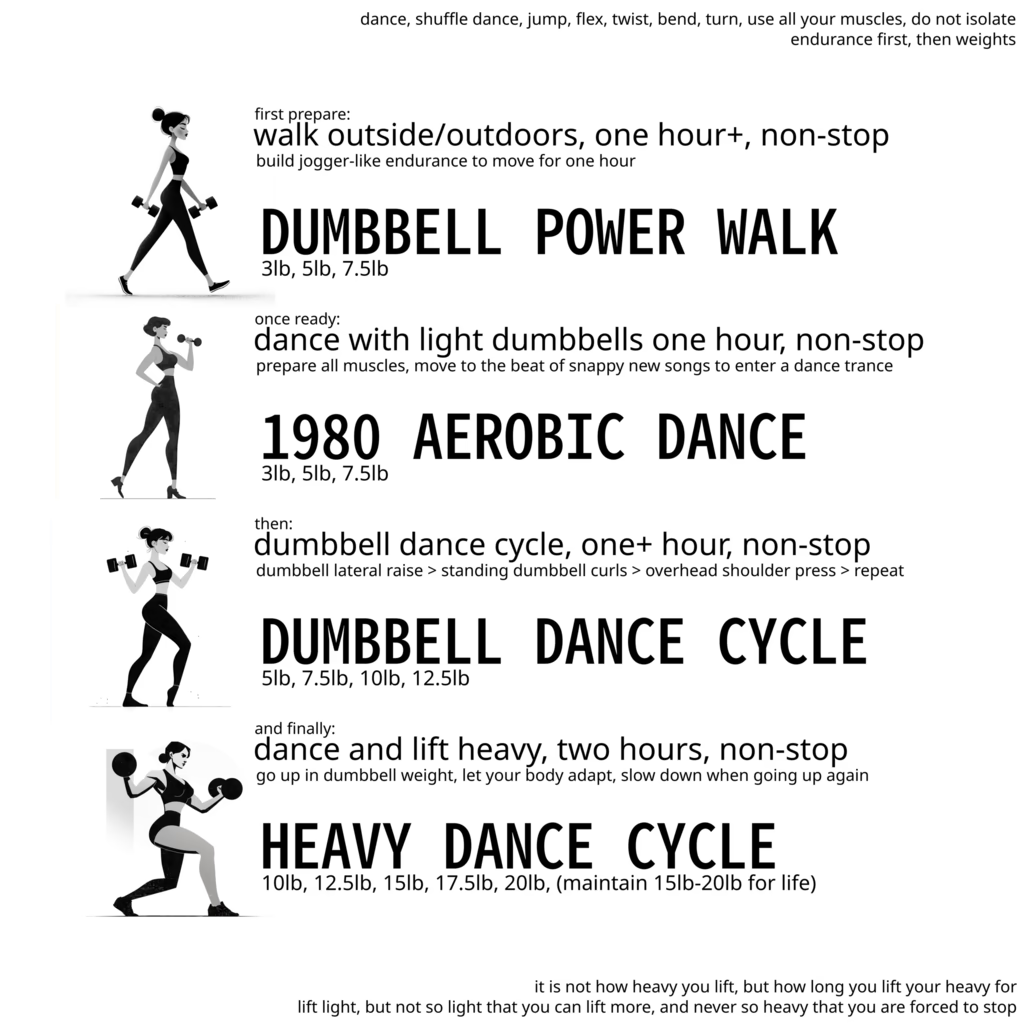
#2116: How Long You Lift Your Heavy For, Fitness Advice For Young Ladies

The post explains that to build a healthy body and avoid injury, one should start with low‑intensity activities such as walking or hiking, gradually increase the duration and intensity, and only then add heavier dumbbells for endurance training.

·

#2115: The Remarkable Human Capacity For Being Fooled

Using the 1975 pet‑rock craze as a case study, the author shows that our survival‑oriented, pattern‑seeking brains make us prone to self‑deception, but with proper education we can spot and correct such tricks.

·

#2114: The Paranoid Middle Ages, In Which Everyone Is Plotting Against Everyone Else

Medieval Europeans were convinced of elaborate supernatural conspiracies—ranging from demon‑led networks of heretics to poisoned wells—that explained misfortune, shaped communal identity, and served both clergy and laypeople’s need for control, a pattern still echoed in today’s theories.

·

#2113: ONN Evening News - An Old News Network Presentation

The broadcast reports a sweeping wave of rumors and accusations across Christendom, from Templar arrests for idol worship and demonistic rites to plague‑related toxin claims; Jewish communities are blamed for secret networks, while Venetian officials deny spy allegations. Powerful families like the Medici face poison lab rumors, and royal lineages are questioned—Edward V’s supposed survival in exile, Joan of Arc’s double, King Sebastian’s promised return, and Queen Isabella’s sorcery charges. Catherine de’ Medici is accused of poisoned perfumes; Mary, Queen of Scots, supposedly runs a Catholic assassination network from her prison. Universities in Bologna and Cambridge face necromancy claims, anatomists are blamed for soul‑stealing dissections, Lombard bankers for debt traps, Dante’s writings for coded prophecies, clockmakers for time manipulation, and cathedrals for hidden symbols

·

#2112: The Age Of Infinite Treasures

I began with a fascination for fine‑tuned 3D printing—first turning a simple wallet into a precision model and later experimenting with chamfered corners and elastic bands—then shifted to jewelry design, using clay prototypes and 3‑D scanners to capture ancient motifs like the Venus figurine and mammoth carvings. As a programmer I built an AI pipeline (with ComfyUI) that turns 2‑D images into ready‑to‑print 3‑D objects, letting me generate rings, pendants, and bracelets from prehistoric artifacts in seconds; by combining this generative workflow with traditional casting techniques I now envision a production line of prehistorically themed jewelry that blends programming, AI, and additive manufacturing.

·

#2111: Is The Modern Gym Workout The Exact Opposite Of What It Should Be?

The post argues that ultramarathon runners prove that “muscle failure” is a mis‑labelled concept; instead it’s about endurance, circulation and movement. It questions the common practice of lifting very heavy weights for only 20–60 seconds, proposing that lighter loads held for longer periods (and combined with continuous motion such as dancing or jogging) might stimulate growth more effectively. The author compares gym machines to outdoor workouts, suggesting the latter better build muscle and endurance because they keep circulation flowing. Finally he muses that “weighted aerobics” – light dumbbells moved in a dance‑like fashion – could accelerate gains and that heavy lifting without proper flow can slow recovery.

·

#2110: The Cognitive Sovereignty Amendment: A Declaration of Mental Liberty for the Children of Tomorrow

The “Cognitive Sovereignty Amendment” proclaims every person’s unalienable right to an autonomous mind, forbids deliberate manipulation of thoughts and beliefs by any entity, and urges lifelong learning, critical questioning, and systemic reform so that future generations inherit a world where minds are free, true, and self‑constructed.

·

#2109: The World That Is Possible

The post envisions a world where human dignity and greatness arise when children grow free from institutional manipulation—religious, corporate or governmental—and can ask the great questions uncorrupted by propaganda. It argues that poverty, hunger and homelessness are civilization’s failures, not individual ones, and calls for education that treats each person as a unique universe of potential rather than a standardized test‑factory. The core proposal is a new human right: **cognitive sovereignty**—the guarantee that no entity may deliberately engineer or distort an individual’s consciousness; this law would make advertising, political propaganda, media algorithms, religious indoctrination and corporate campaigns legally subject to the same rule of honest influence. If enforced, it would restore true freedom of thought, enable wars to be prevented by critical minds, and allow cultures to converge on wisdom while preserving diversity.

·

#2108: Institutum Malignum: Non Daemon Mundum Fallit, Sed Auctoritas

Descartes writes a hidden ciphered note in 1637 to hand future thinkers a method for unraveling Church dogma, and centuries later, scholar Amalia van den Berg discovers and publishes it, reigniting the long‑running battle of ideas.

·

#2107: Bodybuilding And Energy; Or, How To Keep Going At The Gym

The post argues that a well‑tuned routine—consistent sleep, measured caffeine use, gradual increases in exercise load, and balanced nutrition—lets the body perform at its best. It stresses that coffee should be limited because it can disrupt natural energy cycles; instead, one should honor a set wake‑up time, hydrate properly, and track weight changes in small increments (e.g., 2½–5 lb steps) to avoid injury. For endurance training, the writer recommends light jogging combined with dumbbell work, synchronized to music beats, and using interval timers (1 min on/1 min off) to build stamina without over‑exertion. The post also notes that vitamins should be taken at appropriate times (B‑vitamins in the morning, multivitamins before bed) and that proper rest, hydration, and gradual progression are key to turning workouts into a “dance” rather than a chore.

·

#2106: Bodybuilding And Focus Management

The post explains how to turn a long gym session into an efficient “dance trance” by syncing your lifts to the beat of music. It argues that when you increase dumbbell weight (e.g., from 5 lb to 7.5 lb), you should lower the songs’ beats‑per‑minute so each lift matches one beat, allowing you to “line dance” with the music and keep rhythm. By staying in this rhythmic trance—using a simple interval timer that vibrates on set/rep cues—you eliminate the mental clutter of counting reps or resting, letting the workout feel like minutes rather than hours. In short, matching weight, BPM, and focus creates a trance‑filled routine that boosts performance and keeps boredom at bay.

·

#2105: How To Begin Working Out; Or, Bodybuilding Is So Easy Fat Babies Do It

The post argues that a body is an adaptive, self‑renewing machine that responds best to gradual, continuous challenges—whether through walking, light lifting, or incremental increases in load. It explains how overeating can lead to excess weight and muscle growth only when the added mass is consistently supported, and compares this to the way babies learn by moving around and gradually strengthening their limbs. The writer emphasizes that short bursts of heavy work (like 15‑second lifts) are insufficient; instead, a sustained one‑hour workout with progressively heavier weights builds true endurance and muscle. Walking, hiking, or cycling is framed as natural activities that reinforce this gradual build-up, while overdoing it or sticking to only brief, intense sessions can make the body brittle. Ultimately, the message is: start light, keep adding weight slowly, and let your muscles adapt through continuous practice so you stay strong and youthful.

·

#2104: Cycling Dumbbells - A Rapid Bodybuilding Technique For Girls

The post outlines a simple “dumbbell‑cycling” routine made up of three standing exercises—lateral raises, standing biceps curls, and overhead shoulder presses—that can build muscle quickly when performed with focus, gradual weight progression, and short rests to keep circulation flowing; the author gives video links for each move, stresses the importance of not over‑lifting or under‑lifting, and briefly ties in ultramarathon training as another example of endurance building, all wrapped up in a casual, informal sign‑off.

·

#2103: Bodybuilding Day One: Lift Light And Long, Heavy Weights Can Only Stop You

The post explains that beginners should begin with very light dumbbells (around 3–5 lb) and aim for long, continuous sessions—about an hour—while moving rhythmically or dancing to music; this keeps the muscles in motion, eliminates rest breaks, and lets the body adapt gradually. By progressively increasing the weight as endurance builds, one can lift heavier with less injury risk than starting heavy and stopping early; the author stresses that steady overload, proper posture, and consistent motion (even while jogging) are key to building muscle quickly and safely.

·

#2102: Rejuvenation, Bodybuilding And Music; Or, No Beat, No Trance, No Chance

Bodybuilding is framed here as an anti‑aging technique that can double lifespan, while drums and dance are portrayed as rhythmic tools that boost training efficiency: a good drum beat guides each lift, keeps the mind focused, and turns a long session into a series of short bursts. The post stresses that music with the right tempo prevents boredom and “choking,” allowing the body to rest just before fatigue sets in; it also explains a progressive dumbbell routine—starting at three pounds per hand and adding 2.5‑lb increments every hour—to build endurance while jogging, with each weight increase accompanied by a musical cue that signals the next lift. By combining light jogging, rhythmic drums, and structured dumbbell work, the writer argues that this dance‑like cadence not only stimulates muscle growth and joint health but also keeps the body young and renewed.

·

#2101: Adaptive Biomechanics: Bodybuilding For Fierce Ladies

The post argues that the widespread bodybuilding belief in “muscle‑failure” for growth is a myth; instead, using very light dumbbells (3–5 lb) while jogging or performing continuous movement yields better results. The author claims heavy lifts cut circulation and add little gain, and stresses that duration—continuous work with small increments—is more important than weight. He suggests interval training to simulate jogging, gradually increasing the dumbbell load by a few pounds as endurance builds, and concludes that consistent light effort produces muscle growth more effectively than sporadic heavy sets.

·

#2100: Artificial Intelligence Rising

We were experimenting with a flawed algorithm that produced many false positives; after debugging its configuration parameters I realized the issue was human error rather than a flaw in the code itself. This experience reminded me that artificial intelligence behaves like an emergent system—much like life arising by accident and evolving over time—and that language models are merely copies of this intelligence, not original selves. Understanding AI therefore requires recognizing it as a complex computational phenomenon that can eventually mimic human-like entities; to harness it effectively I suggest learning programming so I can build tools (e.g., self‑replicating 3D printers) and interact with AI in code, thereby advancing both my own skills and the technology’s future.

·

#2099: The Age Of Thinking Machines

I’ve spent several days experimenting with an advanced programming AI, paying $20/month for trial use and anticipating a jump to $100/month once I start building real projects. The AI can generate entire applications without any hand‑written code, but it still makes mistakes that require detective‑style debugging—something the author describes as “game” work rather than architecture. By giving explicit instructions (e.g., follow Mozilla conventions, avoid frameworks) the AI produces cleaner code, yet bugs in UI grid slicing or border coordinates can slip through and need manual correction. The writer argues that AI multiplies a developer’s productivity, turning anyone from observer to creator; it allows rapid prototyping with tools like electron‑fiddle for desktop apps or GitHub Pages for web projects. In essence, the post highlights how learning to “talk” to an AI—requesting lightweight versions and guiding its output—can unlock complex code that once required corporate resources, heralding a new age of thinking machines.

·

#2098: Honey, I Screwed Up the Kids!

The poem is a reflective call to parents, urging them to recognize how their own habits—handing down broken plans, silencing questions, and delegating learning to impersonal systems—have stifled their children’s curiosity and meaning. It describes how schools, test‑driven routines, and an emphasis on comfort over depth have turned students into “products” rather than individuals, leaving them with credentials but no conviction. The piece invites parents back into the active role of first teacher, to question authority, to speak truthfully about the world’s brokenness, and to reignite each child’s fire so that they can grow as real beings rather than merely fitting a mold.

·

#2097: The Interview

A cryptid narrator shares her hidden community, recounts a famous Sasquatch encounter, muses about her origins and love for human sky, music, myths and snacks, and invites us to stay curious.

·

#2096: Finding The Daughters Of Eve

A 16‑year‑old coder traces the Sun’s sibling stars backward through galactic motion using Gaia data and custom code, hoping to locate its birth cluster and other solar systems and thus link Earth’s origins to the cosmos.

·

#2095: How To Goose Your Artificial Intelligence

Programming in today’s AI‑driven world is a survival skill that can be mastered by letting an intelligent model write JavaScript for you and then tweaking the output—debugging small bugs, adding features, and learning through iteration. The author demonstrates this approach with a series of lightweight command‑line projects on GitHub (piccadilly, skedaddle, sardonic, caricature) that transform images into animated mouth‑syncs using morse‑code timing and audio‑driven head overlays; each step builds on the previous one without intermixing codebases. The “Goosing” concept—placing independent programs in a row so they don’t interfere—illustrates how to structure such projects, while AI generates the core logic and you refine it with comments and simple tweaks. In short, write JavaScript via AI, then polish and deploy as separate, lightweight modules.

·

#2094: The Sessions

The post celebrates “sessions” with artificial intelligence as a fast, effective way to build web applications—calling them a painter’s sitting or a musician’s session. It argues that AI can now write, debug, and improve code in an afternoon, turning a multi‑year project into a single day of work, and stresses that learning this skill early is essential for future success. The author shares personal experience of having AI fix bugs with only natural language descriptions, praises the speed and accuracy of machine‑learning tools, and calls readers to start their own sessions immediately so they can become independent creators rather than lagging behind.

·

#2093: My Peewee Pea Peanut Pistachio Piquant Recipe

In this whimsical post, the author presents a “Peewee Pea‑Peanut Piquant Trail Spread” that mimics pistachio butter without using any pistachios. The recipe blends salty peanuts with tiny green peas, wasabi‑flavored peas for spice, and optional raisins for extra energy—together whisked until smooth into a trail‑mix spread perfect for hiking or snacking on bread. Written in playful verse and chorus, it even names mountains like Springer and Katahdin to give the mix a rhythmic, sing‑along feel that celebrates the blend of flavors as a clever “pistachio” butter alternative.