·

#0365: How Your Generation Can End Fraud And Corruption

By designing simple ES2020 programs that pose user questions in function calls—such as determining the humane nature of the three‑strike law or whether to call police—the author envisions a transparent, self‑adjusting decision system that limits damage from liars and can evolve through human input and voting.

·

#0364: So, What Is Learning Anyway?

The post begins by distinguishing “teaching” (someone else instructs you) from “learning” (you actively seek knowledge) and notes that studying for exams is often just memorization, which the author argues is only a temporary recall skill. Drawing on his own experience learning English through watching cartoons, closed captions, and moving to America, he illustrates how immersion and personal motivation let him internalize language naturally, whereas textbook study or Shakespeare gave little effect. He stresses that true learning depends on interest—“love” for the material—and criticizes schools’ reliance on forced memorization, arguing it stifles curiosity and produces shallow knowledge. Using math as an example, he claims that when students learn concepts through real applications (e.g., building games or programming) they retain them far better than when merely reciting formulas.

·

#0363: The Way The World Is

The post begins by praising humanity as great thinkers, dreamers, and leaders, then laments that our systems still fail—students are overcharged for education, mental health is neglected, poverty and homelessness rise, and people end up in prison instead of care; the author calls on us to recognize these mistakes, document them in personal journals, and propose concrete solutions (e.g., rethinking medical school structures, paying students, reducing memorization). By recording each wrong and its fix, we can build a collective plan that will eventually lead to an integrated world where borders disappear, debt is managed by universal credit, prisons become institutions of care, and humanity truly fulfills its potential.

·

#0362: Little Adventures At Nordhouse Dunes

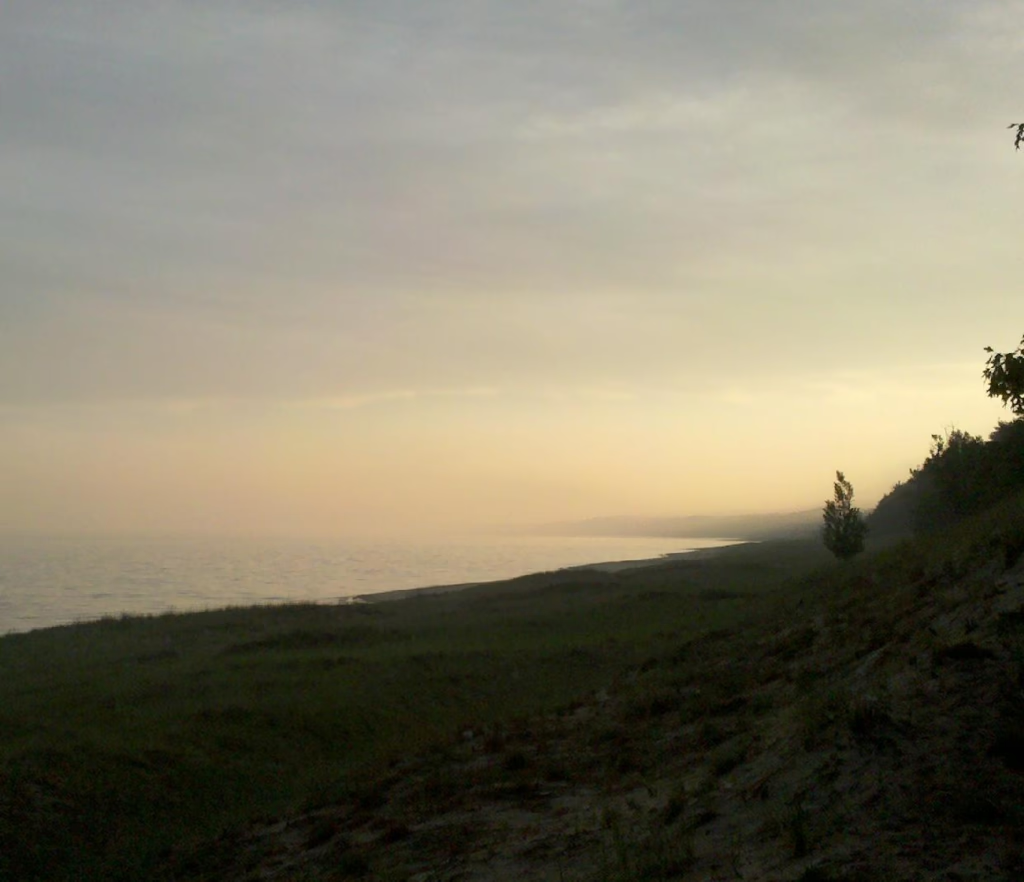
I drove from Ludington through a series of winding roads—West Nurnberg, West Forest Trail and Porter Creek—to reach the Nordhouse Wilderness Area, where I parked at a small loop near the trailhead and set up camp with a tent and firewood. After gathering logs for a fire, I explored the dunes and woods on the Arrowhead Trail, discovering a new fork that led to a towering dune overlooking Lake Michigan, which offered an impressive view and a quiet spot to sit and listen to my audiobook. Returning to the campsite, I roasted sausage over a campfire, watched the sunset, and slept under the stars while listening to “Electric Universe.”

·

#0361: For Contributions To Human Kind

The author urges a student to pursue a prestigious prize by following a deliberate path: early SAT preparation, enrollment in a top university, entry into cutting‑edge research labs, and focus on anomalous discoveries such as anti‑aging or DNA recombination; he stresses that luck matters but so does proactive planning, noting that schooling can be imperfect yet still offers opportunities. He cites examples like Rosalind

·

#0360: The Lighthouse

I arrived at Ludington State Park and booked a tent spot after showing the booth attendant my raccoon drawings, which she liked. While setting up camp and listening to audio books on my iPod, I met a family whose son played guitar; I encouraged him to listen to audiobooks and later left early in the morning before they could talk again. A few weeks later I returned for another trip to Nordhouse, where I was recognized by a fellow hiker and we exchanged brief conversation while I listened to Paul Strathern’s “Philosophy in 90 Minutes.” After a return home, I revisited Ludington, showed more drawings, and spent the day exploring the hiking trails. At dawn I searched for a shipwreck site, met a scout who explained a baseball cap on his forehead, then proceeded up a dune to view a lighthouse and its surrounding apartment, enjoying a perfect sunset.

·

#0359: Bad Grades Are Meaningless Grades

The post claims that modern schools have turned into profit‑driven businesses where grades and standardized tests drive teachers’ pay, forcing students into rote memorization instead of genuine learning, and proposes a personalized, computer‑aided education model to restore true learning.

·

#0358: Real Education Is Everywhere

The post argues that ordinary school education is limited while “real” learning—rooted in personal interests and practical projects—is far richer: it starts by encouraging you to pursue small businesses that teach money‑making, thus ending poverty and job anxieties. From there it moves through creative arts (photography, portrait drawing, oil painting), music composition with tools like LMMS, and programming/automation using Linux, streams, and event emitters—skills that automate art, compose music, and eliminate warehouse needs. Mathematics is presented as a simple tool for generative music and games, while reading and listening expand into science, electronics, robotics, and drones. As knowledge grows, so do disciplines like philosophy, psychology, education, engineering, entrepreneurship, leadership, and wisdom, culminating in sharing what you learn through audio books, written works, and a portfolio that showcases your experiments and videos.

·

#0357: The Terrible Truth Behind Piano Keys, Scales, Schools and Uneducated Politicians

The post argues that modern schooling, especially in music, reduces learning to rote memorization of theory rather than creative expression; it claims schools treat music as a single block of facts that students must recite for grades, while teachers merely deliver content without tailoring it to individual learners. The author likens musical scales to color palettes—simple pre‑selected sets that allow musicians to express feelings—and suggests that true learning happens when students can freely choose and play in a given scale rather than cram notes. He extends this critique to politics, saying politicians act like actors who perform for votes, and calls for interactive visualizations so both learners and voters can see results clearly. Ultimately he proposes a personalized curriculum built by students, not imposed by teachers or standardized tests, to restore genuine learning and creativity in schools.

·

#0356: A Little Look At Little Melodies

In the post the writer uses “Happy Birthday” as a simple illustration of how melodies can arise from singing or playing on instruments, noting that they often start with words and then develop into music. They explain that a melody alone feels incomplete until it is supported by chords and bass, which give depth and structure to the piece. Using LMMS for key selection and automatic chord conversion, the author demonstrates each component—melody, bass, chords—in isolation before layering them together, showing how the final song gains fullness when all parts are combined. The post concludes with an audio example of the completed composition.

·

#0355: A Tiny Introduction To Drums

The post discusses how modern drum production blends synthetic samples with real recordings, noting that less computer‑like a drum tends to sound better. It explains the four main drum types—kick, bass, snare, and tom—and illustrates each with examples. The writer then describes common rhythmic patterns such as four‑on‑the‑floor and the added backbeat, showing how adding a beat on every other pulse can make a simple groove more engaging. Finally, it mentions layering drums and incorporating additional elements like claps or hi‑hats to create richer textures, encouraging musicians to experiment with mixing sounds while appreciating the instrument’s history.

·

#0354: Exceptional Ability As A Tool For Thinking

The author introduces “Exceptional Ability” as a personal measuring stick—a way of thinking about one’s own talents beyond the usual school‑to‑college path—first noting its origin in the U.S. Green Card process and later use by CEOs as an alternative to a diploma. He argues that high school and college are merely starting points, not guarantees of exceptional ability, and invites readers to ask whether those institutions really deliver it. To cultivate this unique skill he suggests practical “compass” activities such as trail hikes and marathon training, and stresses that proof comes in creative works—books, journals, poems or other original productions—rather than grades. In short, the post presents Exceptional Ability as a private, self‑evaluation tool that can guide one’s lifelong learning and eventual leadership outside conventional schooling.

·

#0353: Schools Are Bad For Us So Build Better Schools And Don't Look Back

The post describes a new educational model focused on happiness and self‑chosen learning spaces: students select classrooms that make them smile. It highlights the absence of traditional subjects like biology but offers specialized presentations—anti‑aging, synthetic life, astrobiology—and a CRISPR 3.1 lab for practical applications. Musical instruction is framed as instrument making, song publishing, and music‑label startup support, while the overall message urges building schools forward without retrospective explanations.

·

#0352: Trying To Sing

In this post the author explains how to craft your own songs by syncing personal thoughts and lyrics with a metronome or simple beat, stressing that a steady rhythm can guide you when words or melodies feel stuck; they advise keeping words short (or splitting long ones) so the song flows naturally. The writer illustrates the process with an example, noting that the key is finding a path through a lyrical maze and adjusting phrasing until it shines. They also share their own early attempt—a track recorded in 3‑second takes—describing how they used drums as a backbone and added reverb to their voice, while experimenting with piano or violin for richer sound. Finally, the post ends with a short poem titled “No Limits” that celebrates limitless creativity and personal growth.

·

#0351: You Do Not Need Theory

The post celebrates the freedom and creativity that come from breaking out of conventional music theory and academic expectations. It urges musicians—especially young composers—to trust their own instincts, experiment boldly, and not be bound by rigid scales or formal instruction. By embracing their unique voices and “inventing” new ways to understand sound, they can compose freely, inspire others, and leave a lasting mark on the world of music.

·

#0350: Fake Schools, Fake Education And How To Spot A Creepy Cult Of Greed

The post argues that the current educational system is dominated by “fake” institutions that charge students for tuition and profit from their future earnings, while genuine learning should be modeled after Y Combinator—a startup accelerator that hands out funding in exchange for equity—so that schools become real partners in a student’s career. By contrast, the author calls for new “School 2.0” universities that grant personalized curricula, early company formation, and only take a modest share of graduates’ profits; such institutions would give students financial independence rather than debt, and ultimately replace the corrupt, tax‑exempt schools that sell a fantasy. The post ends with an invitation to build this honest university model for future valedictorians.

·

#0349: Get Mad: Of High School And Music

The post argues that high‑school music lessons should move beyond rote theory and instead focus on hands‑on creation—using tools like LMMS to produce full albums of ten songs—and encourage students to monetize those tracks for business use. It claims that current classes feel “brainless” because they only teach simple elevator music or background loops, leaving students frustrated and underprepared for real work. The author urges teachers to let students launch small businesses (e.g., workout‑music production) right after the first semester, turning learning into a practical skill that can generate income and break the cycle of student debt. In short, the piece calls for a shift from memorized theory to genuine, entrepreneurial music education that empowers students to create, license, and profit from their own work.

·

#0348: How To Easily Learn Anything And Everything

The author argues that traditional schools pick subjects arbitrarily, force students into memorization rather than real learning, and ultimately fail to provide meaningful knowledge or practical skills—especially in math—leading to a cycle of debt and uncertain employment; they suggest that true education comes from self‑directed projects (e.g., 3D printing) where the subject matter is directly relevant, sparking passion and enabling entrepreneurship, so that graduates can create their own businesses and earn income without relying on minimum wage jobs or costly degrees.

·

#0347: And The World Will Grow

The post urges us to actively cultivate our minds and bodies, stay vigilant against early indoctrination, verify our beliefs, and pursue self‑education so that we become just individuals in the “golden age” who can serve the world well; it stresses keeping stress low, trusting our own work, and seeing institutions as small stepping stones rather than ends themselves—tools to build larger systems that will keep liars at bay. By moving toward understanding, wisdom, and greatness, each generation’s character can propel national progress; thus the journey is slow, cheerful, and ultimately the healthiest path for both individuals and humanity.

·

#0346: To The Trailblazers

After months of snowfall, the post celebrates the thawing ice and 38 days until spring while announcing that in about 18 days cyclists will start their runs on the Appalachian Tail Trail (I‑275). The author recounts a recent overpass crossing where another rider nearly fell off the trail, then shares practical gear tips for the upcoming ride—choosing a fat‑tire bike, packing warm clothes and gloves, a thermos with tea and biscuits, two sets of clothes to change into, a tire repair kit, plenty of photos, and a saw ready to clear fallen trees. He also reminds riders to watch for hidden ice and recounts his own memorable fall on the trail, concluding by encouraging readers to blaze the trail each year.

·

#0345: A Note On Self Education And Entrepreneurship

The author argues that while school and college open doors, they are only part of the journey; individuals must take responsibility for their own learning, pursue self‑education through adventures, books, and early business ideas, and become entrepreneurs to avoid reliance on employers—this process takes years but is natural growth, stress‑free, and a talent worth cultivating.

·

#0344: Live Beautifully

The post celebrates living with beauty, strength, knowledge, wisdom, and greatness, urging us to harness authenticity, foresight, insight, and unbreakability while recognizing our innate biases that shape our lives. It calls for equal schools, the elimination of prisons and borders, and the prevention of wars long before they erupt, as well‑designed systems of self‑education and compassion. Finally it reminds us that humanity is one family—brothers and sisters under all stars—and we should always ask whether a practice hurts or helps us, striving to live beautifully in knowledge, wisdom, and greatness.

·

#0343: Karaoke Pokie: A Cappella Eve With The Dr. Meow Quartet

The post explains how to learn to sing by recording yourself over an existing track using the free audio editor Audacity. It lists the basic gear needed—a computer, microphone, and headphones—and walks through adding several new tracks, aligning them, and enabling overdub so each take lines up correctly. The author demonstrates the technique with two songs: a Polish “Czterej Pancerni I Pies” (first recorded without sync, then in sync) and an English cover of Tears for Fears’ “Mad World,” showing how multiple vocal layers can create a cappella‑style effect. By repeatedly recording the lyrics while listening to the original track, you improve timing, spacing, and overall performance, turning a simple song into a polished multi‑track rendition.

·

#0342: Hundreds Of Good Books and Decades Of Good Decisions

The author urges readers to expand their worldview by immersing themselves in countless books and real‑world experience, arguing that this deep, balanced knowledge fuels both personal growth and entrepreneurial success. He stresses the value of becoming an independent entrepreneur, of carefully building a company with free services to attract loyal customers, and of continually reflecting on past decisions through questions like “What are your regrets?” to refine one’s wisdom. By combining functional knowledge, creative practice, and self‑questioning, he believes one will eventually reach a state of “greatness” that brings fulfillment and the ability to help others, culminating in an elder self who looks back with gratitude and peace.