·

#0437: The Little Tiny Book Entitled The Manual Of Life

The post envisions a set of “imaginary” documents that every young person in the future should possess—an Earth Passport, a Universal Income Card, a copy of the Universal Declaration of Human Rights with an invitation to improve it, and a small book (also available in audio) called *The Manual of Life*. This Manual is compiled by the world’s most beloved scientists and philosophers, each contributing a page that may include quotes from a “Great Being” who exists only as spirit and wisdom. The book offers answers to the questions children will ask, explains how war stems from lack of education and knowledge, how poverty arises from misunderstanding money, and outlines simple lessons for growing up; it portrays humanity as one family divided only by confusion and ignorance that schools can fix. It invites thinkers, psychologists, and neurologists to share insights on cognitive biases, mental hygiene, and the discovery of our universal selves, while also leaving room for global contributions toward world peace and a wiser future—illustrated by an example entry: “You are meant to become a Great Being.”

·

#0436: Only Knowledge and Resulting Wisdom Can Lead To World Peace

To achieve world peace, the post argues that we must first accept that both sides of a conflict can be wrong and then act proactively through “prevention” by reshaping education; it proposes four key changes—personalized learning, active tools instead of rote memorization, global student exchanges, and recognition of teaching as valued work—to build knowledge and wisdom. By investing in these educational reforms and accompanying universal income, the author believes a new, peaceful world will emerge where children grow in knowledge and wisdom.


·

#0435: The Symphony Beneath The Stars

A proud declaration that every person is part of the creative and intellectual community—artists, adventurers, thinkers, creators, writers, and storytellers—and that each step taken brings one closer to wisdom, enlightenment, and greatness. It stresses that we are not merely workers or employees but true students of life who breathe mountain air, lead their generation forward, inspire successors, and aim for unity in peace and beauty. The post argues that knowledge is the path to wisdom, and when shared it transforms individuals and nations; by learning about other cultures one realizes that there’s nothing truly to fight over because we are all moving toward the same goal of wisdom and greatness together.

·

#0434: Leaning Anything And Everything: No Unanswerable Questions

The post argues that learning continually reshapes our thoughts by adding new material to the mental framework we already possess; it stresses that thinking is not merely comprehension but also synthesis and invention, and illustrates this with a whimsical image of Thoreau chewing a biscuit in his cabin. It suggests that simple experiences—like hiking the Appalachian Trail or reflecting on Walden—can spark vast ideas that benefit future generations, urging us to leave a creative legacy rather than simply inventing for its own sake. The author uses links to videos by Seth Shostak and Richard Dawkins to show how seemingly “unanswerable” questions can be bridged from fresh perspectives, and concludes that continual learning and adventurous thinking will keep civilization moving forward and prevent stagnation.

·

#0433: Of The Salamander And The Duck: The Elves In Ourselves

The post is a reflective monologue about the author’s experience composing 432 poems, blending philosophical musings (a nod to Descartes’ “cogito ergo sum” and Dennett on consciousness) with playful metaphors of cars, boats, wind, and salamanders to describe the ebb and flow of ideas. He describes how each poem begins with focus but often drifts into waiting, scribbling, and confusion, yet persists until it ends in a whimsical punchline—“jabberwock.” The author acknowledges that while poems seem simple on the surface, they carry their own wings and paths, and that writing them feels like chasing a duck or riding a boat: a process full of delay, acceleration, and meandering. He concludes by noting that after finishing poem #433 he still wonders how poems can write themselves, as if written by elves.

·

#0432: Endurance Workouts: Clarification, Dehydration, And Gyration

The post opens with a parable of a young warrior who repeatedly leaps over a growing corn stalk until it becomes higher than his head—illustrating that true endurance is built by continually pushing one’s limits and repeating the challenge until mastery. It then explains that effective endurance training requires gradual, varied work so the body adapts to increasing energy demands; monotony or extreme loads alone do not build stamina. The author stresses the importance of monitoring sweat losses—sodium, potassium, calcium, magnesium—to prevent dehydration headaches, and suggests using sweat‑patch kits or laboratory tests to establish a baseline in controlled conditions, adjusting for weather and effort levels. He notes that over‑hydration can be as harmful as under‑hydration, and recommends tracking weight loss pre‑/post‑workout and replenishing with electrolytes. Finally he reminds readers that endurance is personal: it can be walking long trails or dancing; the key is steady progression, adequate recovery, and enjoyment.

·

#0431: The Queen's Tongue: Learning English

After receiving a 3‑D postcard from his uncle that revealed New York’s streets, the narrator moves to Brooklyn to live there for a few years. He learns English through early exposure to a Commodore 64, British TV shows and closed captions, while struggling with numbers, time expressions and an accent that feels heavy at first. His self‑taught skills are tested in school and work as a web designer, where he’s praised for his knowledge of BASIC and HTML but still has to refine vocabulary and phrasing. He finds narrated books and closed captions the most effective tools for learning, and concludes that moving into a country and immersing oneself is essential; if one ever visits the UK, “fanny” should be used carefully.

·

#0430: Pay Attention To The Broken Things

The post argues that conventional schooling relies on rote memorization rather than true understanding: teachers recite textbook passages, students cram for exams, and grades become proof of the teacher’s effectiveness instead of evidence of learning. It claims standardized tests only capture surface knowledge while ignoring individual creativity, and that this system makes learners feel unintelligent even when they grasp concepts. The author suggests a new model in which progress is self‑paced, learning is demonstrated through practical projects (like building simulations or virtual worlds for each subject), and the ultimate goal is to create a “real school” where personal exploration replaces one‑size‑fits‑all curricula.

·

#0429: The Noble Quest Against Falsehoods

Falsehoods—mistakes or lies that clutter our thoughts—are described as “mind killers” that keep us from growing up; the post argues that reading well‑chosen books and spending time in nature through camping or long walks can cleanse these falsehoods, because books bring wisdom while outdoor adventures reset the mind and make it receptive to learning. The author suggests that modern life’s distractions are deeply embedded in culture, but a simple “noble tradition” of buying gear and going on vacations can break those patterns. By stepping out of daily routines and relaxing in nature, one can rest, contemplate, and finally internalise true knowledge, thus becoming a “great being.”

·

#0428: Little Drummer Boy

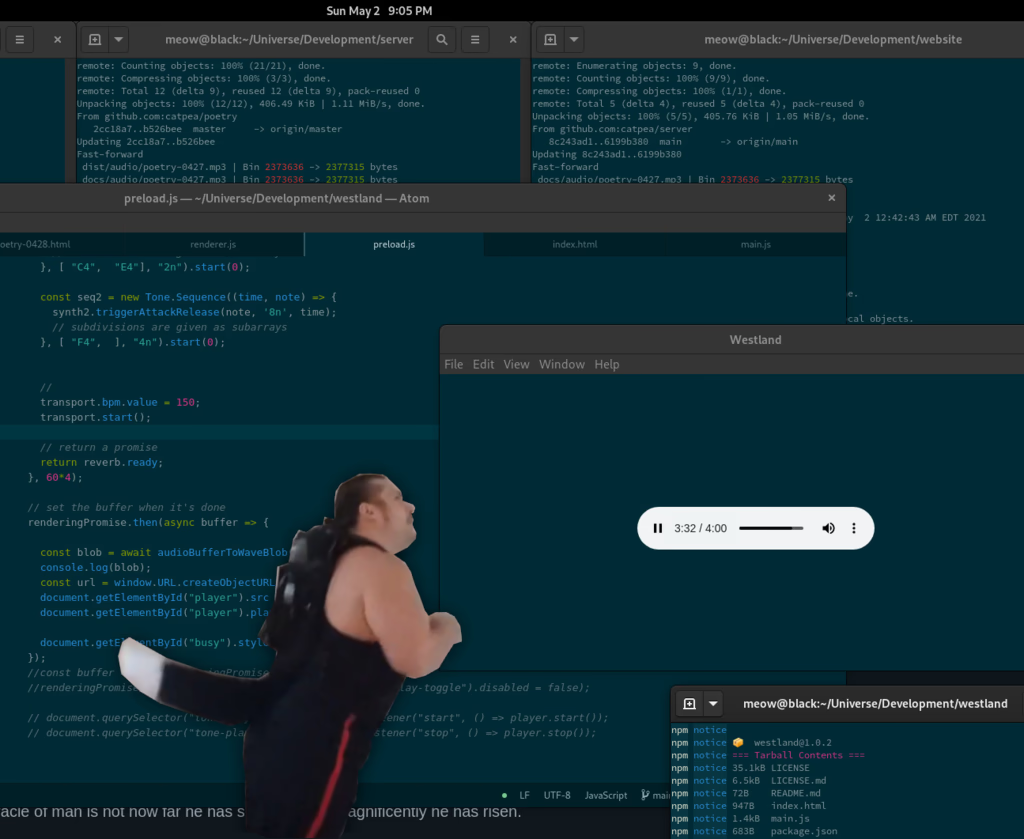
I revisit my long‑time music‑generation project several times, rewriting the code over the years and finally settling on a small, open‑source tool called **westland** that uses Tidal notation to automatically compose drum patterns in LMMS. After learning the basics of notes, octaves, and rhythm from Ableton tutorials, I discovered how to encode rhythmic structures like “4n” for quarter notes and nested arrays for faster beats (e.g., `["F4","F4",["F4","F4"],"F4"]`). With this system I can generate symmetrical drum patterns that evolve over time, applying filters and transforms to create fresh dance tracks. My goal is to produce machine‑generated electronic music that feels new each time while keeping the composition process simple and reproducible for other programmers or musicians.

·

#0427: The Ancient Bear On Mount Ślęża

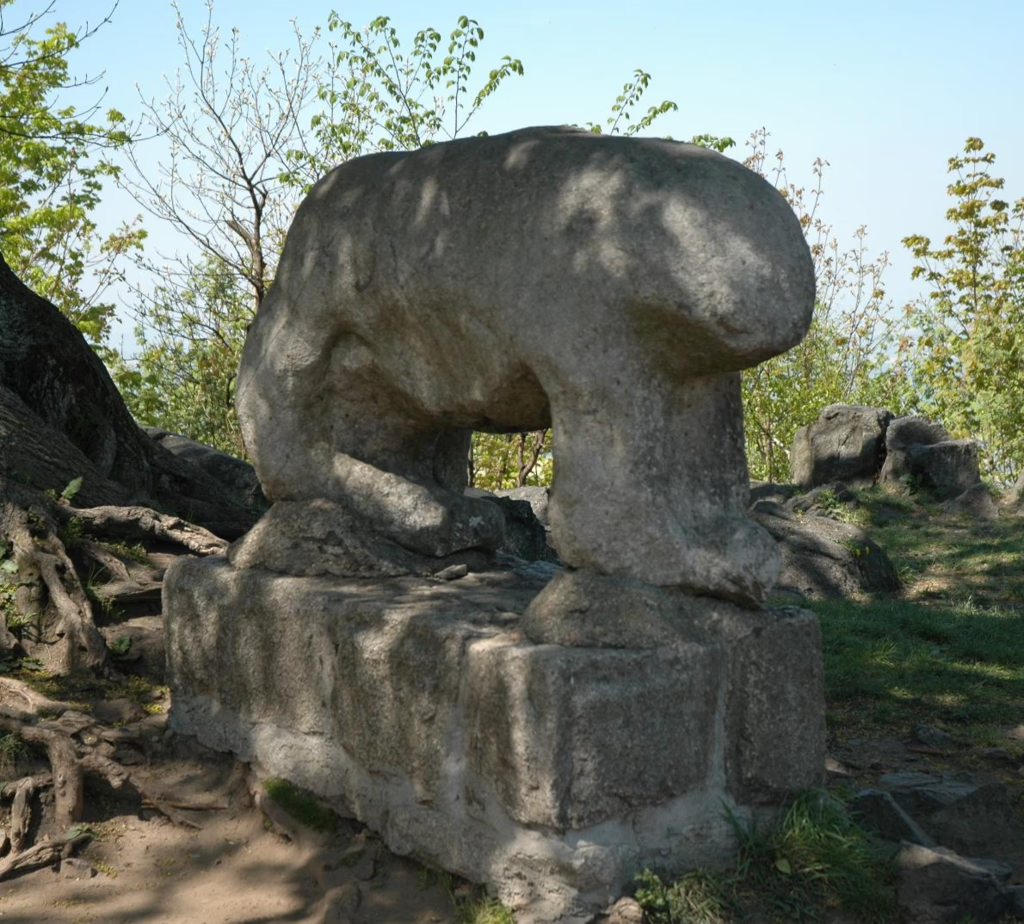
On this post I describe a lonely stone bear perched atop the ancient Mount Ślęża—an enduring symbol that has been revered for millennia as a special place where sun‑worshipping peoples once gathered. The author explains that the bear’s form comes from Celtic tradition, probably the Boii tribe of the Iron Age, and represents the goddess Artio who sleeps in winter, awakens in spring, transforms into a bear, and ascends to become a constellation—an image echoed by Greek Artemis and Roman Diana. The narrator then recalls his own childhood experience of playing the bear in a school play, complete with a mask, and finishes with memories of simple adventures along the mountain’s trails with his dog Budrys, always watching the mist‑shrouded Słęża and Artio from afar.

·

#0426: Temples Of Solitude: The Rain Makers (Deszczowce)

In this nostalgic tale the narrator recalls childhood adventures on a hill crowned by old trees—where he would kindle fires from fallen branches, build shelters in mud and leaves, and watch rain pour down as he savored pizza warmed over his little fire. He remembers watching hunters and ice‑sheeted rivers, feeling safe beneath thick roots while also noting strange creatures like a “Chupacabra Gollum” that haunted the hill after wheat workers found it. The story weaves personal memories of simple joys with glimpses of larger events—Chernobyl’s impact on his country—and ends with an eager hunt for evidence of the creature, as villagers whisper its legend.

·

#0425: To Heal The World

The post celebrates the power of personal effort and wisdom to transform both oneself and others. It urges readers to treat each day as precious, using education, work, and life’s simple moments as stepping stones toward greatness filled with adventure, knowledge, and wisdom. By staying mindful of our inner self—wise, fearless, strong, beautiful—and walking steadily, we add our own steps to become who we are destined to be. Each unique journey amplifies our lives, offering fresh challenges and new insights at every corner. Sharing that wisdom lifts others from the bottom up, igniting hearts and helping them rise as well.

·

#0424: Introduction To Dance

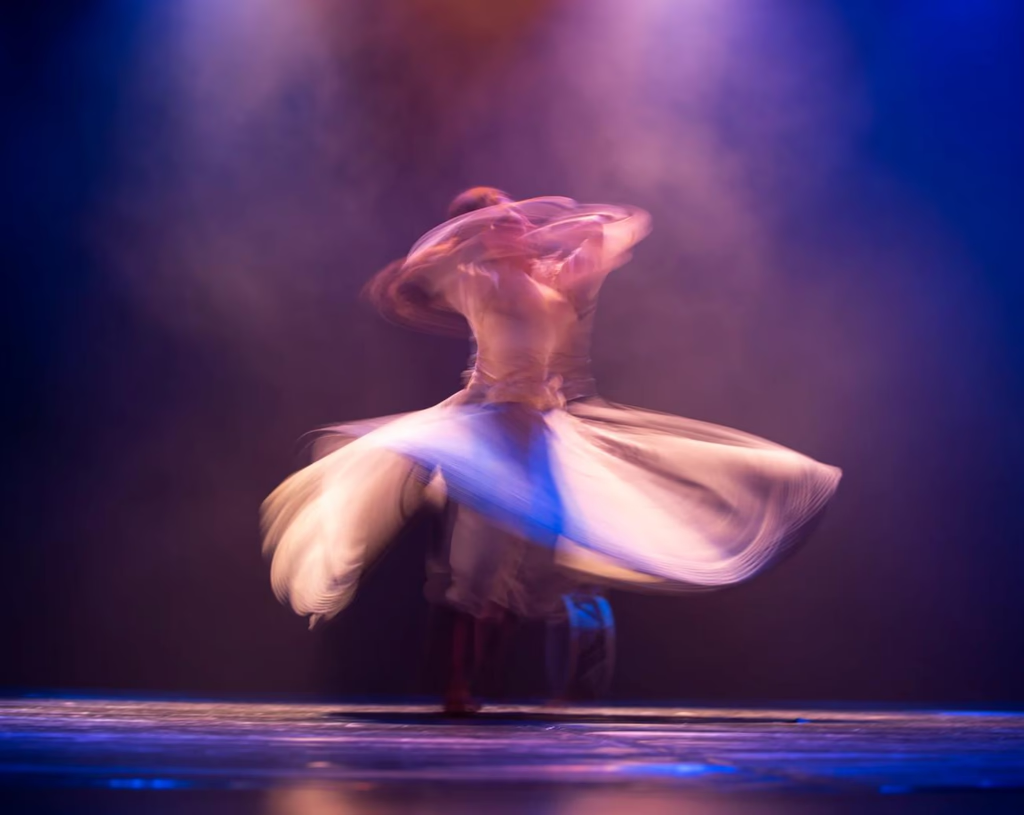
Dance is celebrated as a living poem—an art that began as battle training but evolved into a noble expression of human creativity. The post mixes personal memories (watching Fred Astaire and Mr. Bean) with references to classic moves such as the Napoleon Dynamite Dance, Melbourne Shuffle, Running Man, and T‑Step, ultimately recommending a shuffle dance that blends the Running Man and T‑Step steps while syncing to slow‑tempo music by Alan Walker. It encourages beginners to start simple body workouts (jogging, shuffling, weight lifting) and adopt a lettuce‑based diet to lower calorie density, then advance toward faster beats as skill improves. In short, dancing is portrayed both as an artistic poem and a practical workout that builds flexibility, muscle strength, and confidence.

·

#0423: Withstand And Unite In Knowledge And Wisdom

Consciousness is presented as the universe’s most remarkable miracle, giving humanity freedom of will, love, and wisdom beyond mere evolutionary adaptation. The post argues that we must actively correct the cognitive biases and social flaws—racism, xenophobia, group‑think—that still hold our minds back, and that self‑education through books and personal reflection is the key to overcoming these limitations. By learning independently, leading rather than following, and sharing this knowledge with others, we can rise above poverty, culture, and circumstance, ultimately inspiring a wiser, more enlightened world.

·

#0422: Skunk Works: How To Become An Inventor

The author proposes a simple, user‑friendly system for home automation based on single‑board computers (like Raspberry Pi) and chat‑room style interfaces where devices act as bots that communicate via plain English commands; by leveraging existing assistants (Siri, Alexa, etc.) and custom “event‑emitter” scripts, one can orchestrate tasks such as thermostat control or energy saving without writing complex code. They argue that the key to invention is observing everyday tools, simplifying their use, and building modular, interoperable bots that communicate over a shared chat platform, thereby turning ordinary devices into an anthropomorphized “agent network.”

·

#0421: Back To The Future: Reinventing A Smart Smartphone

Open‑source Linux phones like the Pine Phone or Raspberry Pi give developers more flexibility, better security and true OS access than closed “walled garden” smartphones that depend on simplified GUIs and proprietary ecosystems.

·

#0420: Programming Tutorial: Connecting All The Program Pieces Together With An Event Emitter

The post explains how structuring a program around an Event Emitter—an object that can both listen for events and emit them—simplifies development by making the main file act like an index of all functions rather than a long linear script; it uses a simple chat example where “outgoing‑message” events are emitted when a user sends text, triggering handlers that package data for the server, which then emits “incoming‑message” events to other clients, and extends this pattern to more complex scenarios like a MUD game or inter‑bot communication, showing how keeping everything event‑driven keeps code small (often just 20 lines), easy to modify, and easier to visualize as a diagram of interactions.

·

#0419: The Simple Architecture Of Real Schools

The author argues that modern schooling relies too much on rote memorization and multiple-choice exams, neglecting real-world skill acquisition—illustrated with a photo‑editing analogy—and proposes gamified, project-based learning (e.g., using tools like Kerbal Space Program) to give students practical knowledge and financial independence.

·

#0418: Learning To Learn

Learning is a step‑by‑step journey of hands‑on practice, from building computers to coding in ES2021, that turns basic knowledge into lasting skill and achievement.

·

#0417: The Future School

The post describes an idealized educational experience where a school fully supports its students by covering accommodation, meals, travel, and even medical expenses—so that whether you’re an exchange student or living independently, you never have to worry about housing or health costs. Students are guaranteed stay until they finish, with no graduation ceremony required, and can return anytime; they’ll be treated as a family with group therapy sessions, and if they fail in their own business they’re welcomed back. The school emphasizes practical learning over rote memorization—students receive white coats for microbiology or medicine, pursue software development through tutorials, and progress from student to mentor to entrepreneur. Frequent travel between cultures and labs is encouraged, ensuring that students never feel stuck or lonely but instead become “citizens of the world.” In short, this institution promises a lifelong, dignified, and flexible learning journey that nurtures independent thinkers who will contribute meaningfully to humanity.

·

#0416: You Have To Unite The World, What Will You Call This Global Nation?

A long‑winded proposal that true education and a single “Earth” passport tied to a never‑empty collective bank will unite humanity, end poverty, and finally stop war.

·

#0415: Learning Programming: Is It Worth It?

The post explains setting up a Raspberry Pi with Node.js, learning JavaScript via small “Hello World” projects, and building a GitHub/npm portfolio of tiny programs to launch a programming career.

·

#0414: Of Self Education And Foresight

The post argues that student loans burden learners for years, that schools often fail to truly educate, and that true learning comes from self‑study rather than institutional degrees.