Fix Schools And Protect Education

Fix Schools And Protect Education

zoom read listen

The post argues that modern teaching often fails to convey true learning, with teachers who are unprepared, overburdened, and sometimes deceptive, causing students to memorize instead of understand; it calls for a return to authentic education—where knowledge flows naturally from curiosity rather than rote drills—and suggests practical solutions such as audio‑book lectures, self‑direct study in philosophy, science, and biographies, and hands‑on software development that turns learning into real job skills; ultimately it proposes that students become their own teachers, using accessible devices and web applications to build a new kind of school that blends learning with remote work opportunities.

#0984 published 07:05 audio duration 575 words education teachers learning audio-books software-development web-application books philosophy self-learning

Programming Teaches How To Learn For Real

Programming Teaches How To Learn For Real

zoom read listen

Programming is a discipline that sharpens clear thinking, encourages humility, and rewards deliberate learning over convenience. It teaches us to avoid letting personal favorites dictate our choices—whether we pick the easiest or most popular path—and to choose languages and tools based on their fit for the problem at hand, rather than on tradition or grade‑focusing curricula. For example, JavaScript’s early slowness gave way to a powerful web language that is now indispensable. When building UI, a single well‑placed logic statement can keep an animated button’s click handler from firing too early; separating UI and program logic keeps complexity in check. Exposure to such controlled challenges trains intellectual hygiene: we see the “hood” of code, design our own sequence of learning, and pace it to match our existing knowledge. Finally, programming’s instant feedback loop lets us examine errors and revisit theory, ensuring nothing is skipped and every concept is truly understood.

#0983 published 04:15 audio duration 421 words 1 link programming javascript ui animation event-handling code-simplification debugging

Programming For Your Users, Yourself, And The Older You; Or Writing Valuable, Maintainable, And Non Crazy Code

Programming For Your Users, Yourself, And The Older You; Or Writing Valuable, Maintainable, And Non Crazy Code

zoom read listen

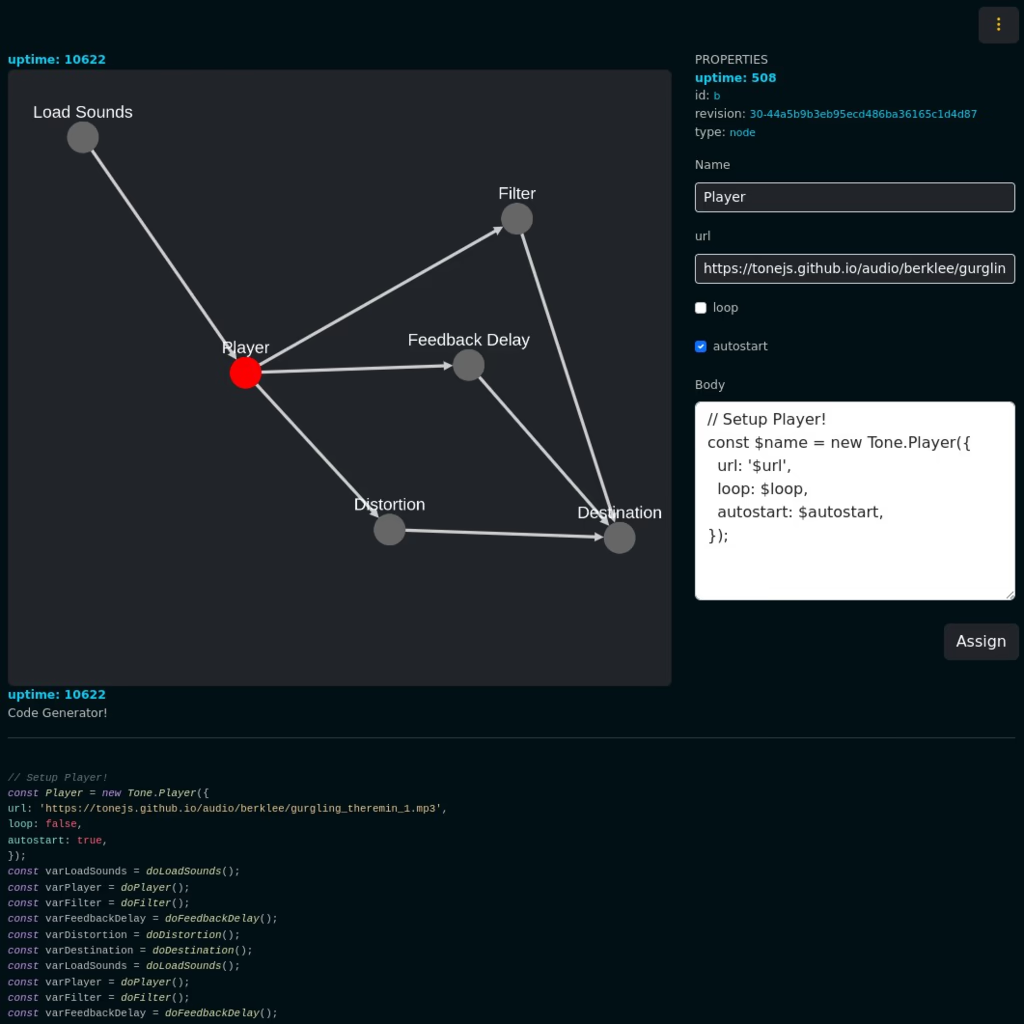
The post describes a creative way to embed a “file‑manager” style interface inside a phone or web application, using a tree‑like data structure built from simple node and edge arrays rather than recursive objects. By closing the main app with a magic key combination you can drop into this hidden file manager, which mirrors the application’s structure and represents all user resources; it serves as both a development aid—letting you remember code and track listeners—and a prototyping platform, enabling tools such as a form designer, theme generator, or finite‑state machine builder that output ready JavaScript via templates like EJS. Ultimately, this self‑editable system becomes a sellable product (e.g., a theme with bundled generators) that lets buyers generate, customize, and run applications directly in the browser, offering both practical utility for new projects and potential side income.


#0982 published 04:58 audio duration 449 words file manager tree structure node array edge array object oriented nodes javascript ejs templates pouchdb theme development code generator finite state machine

Potatoes; Or, The Biggest Problem In Application Programming

Potatoes; Or, The Biggest Problem In Application Programming

zoom read listen

The post introduces “potatoes” as a lightweight abstraction for CouchDB documents that makes it easier to keep data in sync across a networked application and the user interface. Each potato has a unique ID and revision number, so changes are stored as separate files and the latest revision is chosen by sorting filenames—an eventual‑consistency approach that works even when many users update concurrently. By treating potatoes like Svelte stores or Bootstrap components, the author shows how UI elements can automatically refresh whenever a new winner revision appears, while “views” (small programs) filter changes to build the visible collection of potatoes. The article explains that this model supports simple list handling, page re‑calculation, and fast searches, all while keeping the system free from overwrites or hacks because each change is uniquely identified and propagated through Pouch/Couch or a custom storage layer.

#0981 published 15:37 audio duration 1,107 words couchdb pouchdb svelte javascript eventual-consistency document-store ui-components bootstrap

Introduction To Programming: The Heck Is A State Machine?

Introduction To Programming: The Heck Is A State Machine?

zoom read listen

A state machine is a simple programming pattern that forces an application into well‑defined states, each represented by a verb (e.g., “driving,” “warning,” “stopping”). The post uses a traffic light as an example: green → yellow → red → back to green, and shows how misnamed states (“red” for the stopping state) can confuse developers. It explains that actions are short commands that trigger transitions, while states persist over time; thus a state might be named “sleeping,” “driving,” or “warning.” Proper naming keeps the machine clear, enabling complex user‑interface flows to remain predictable and error‑free, because each transition is explicitly defined by an action leading into a verb‑named state.

#0980 published 08:30 audio duration 606 words 1 link fsm state-machine programming-pattern traffic-light-example ui-state

The Super Culture; Or The Road To Wisdom, Fairness, And World Peace

The Super Culture; Or The Road To Wisdom, Fairness, And World Peace

zoom read listen

The author reflects on the

#0979 published 23:54 audio duration 858 words 35 links poetry culture emergence design-culture unity philosophy bibliography

Don't Generalize, Specialize; Or, How To Invent And Program Useful Web Applications

Don't Generalize, Specialize; Or, How To Invent And Program Useful Web Applications

zoom read listen

The author argues that applications become truly useful when they specialize into domain‑specific tools such as code editors or spreadsheet builders, rather than remaining general‑purpose; he cites Excel’s inevitable formulas and other legacy systems to show how users always need to learn a language, then introduces a song‑builder app that auto‑generates tracks with randomize settings, album covers, etc., proving that quick generation plus easy customization creates powerful tools—finally concluding that building specialized, customizable apps like a nature‑noise machine with recorded sounds and a simple web interface is the winning path to success.

#0978 published 09:16 audio duration 541 words application-design ui code-editor excel song-builder music-production random-generator audio-music website

How To Learn Big Programming With Little Programming

How To Learn Big Programming With Little Programming

zoom read listen

Start by exploring several‑hour JavaScript courses, then dive into pixel‑based projects with p5.js or playful JavaScript games; from there you can move on to Svelte (a 2022 technology) and its interactive tutorial for building graphic UIs. These tools let you tackle more complex topics like PouchDB by creating management programs, and a great hands‑on example is a color‑theme generator that teaches you rgba and HSL models—exploring opacity, hue, saturation, lightness, complementary colors, triads, and dynamic palettes inspired by clrs.cc. By letting users pick a starting angle (0–360°) or generating 360 themes, you can showcase vibrant color schemes on a portfolio site, turning the project into a simple yet powerful web app that reinforces your grasp of color models.

#0977 published 07:04 audio duration 499 words 6 links javascript p5js svelte hsl rgba color-math webapp tutorial

How To Become A Real Programmer

How To Become A Real Programmer

zoom read listen

The author reflects on the value of working for oneself, arguing that a paycheck job ages you and breeds boredom, while self‑education fuels wisdom and fulfillment. He encourages envisioning his future self to decide whether to pursue simple coding or beautiful ideas, noting that lack of ideas stems from fear rather than talent. The post then shifts to practical advice: choose efficient, language‑unified web stacks—JavaScript in the browser with PouchDB/CouchDB for data sync—and front‑end frameworks like Svelte and Bootstrap—to write once and run everywhere. Finally he reminds that short cuts derail progress, urging honest, trail‑blazing effort.

#0976 published 09:11 audio duration 691 words 4 links life programming selfeducation trails couchdb pouchdb svelte bootstrap javascript webdevelopment

On World Peace And Fraudulent Demands For Unearned Respect

On World Peace And Fraudulent Demands For Unearned Respect

zoom read listen

The post argues that modern education systems—shaped by religion, centralized schooling, and rigid borders—have stalled human progress and fueled conflict. It calls for a new, reality‑based learning model: self‑directed, individualized lessons that reward real results and are grounded in authentic cultural knowledge, all aimed at world peace and human advancement. The writer believes that if young people see how standardized schools fail, they will take initiative to program their own projects, attract investors, and break the poverty cycle that keeps them obedient. Ultimately, he urges a swift overhaul of schooling into an effective, universally funded system that empowers children to become great beings and ends ignorance for good.

#0975 published 06:24 audio duration 477 words education self-directed-learning youth culture global-peace books innovation

Social Application Development; Or, Self Editable Applications In The Twenty Twenty-Something

Social Application Development; Or, Self Editable Applications In The Twenty Twenty-Something

zoom read listen

Self‑editable applications let end users build and tweak UI elements on the fly—adding, rearranging or deleting controls like username fields, passwords, buttons, drop‑downs and menus—all through a simple code editor embedded in the app (often using JavaScript or Svelte). By dynamically constructing these controls from data structures such as JSON, developers can avoid predefining every component and let users experiment with layouts while still seeing the underlying source. This approach, echoing early tools like SmallTalk’s HyperCard and Wikipedia’s editable pages, promises a low‑barrier learning curve for programming, faster task automation, and a new wave of “social application development” where anyone can share customized features.

#0974 published 08:21 audio duration 510 words javascript svelte json ui-builder dynamic-ui self-editable-applications smalltalk hypercard view-source web-development gui-controls dynamic-instantiation

When Teachers Don’t Know What Teaching Is

When Teachers Don’t Know What Teaching Is

zoom read listen

The author argues that our current educational system—especially at the middle and high‑school levels—is fundamentally flawed because it relies on standardized, compartmentalized teaching that leaves students unmotivated and ill‑prepared to prevent future problems like war and poverty. They claim that real learning happens when a student actively studies something they are genuinely interested in, for a few weeks, which unlocks lasting skills and knowledge. By moving away from rigid subject divisions and grade‑based rewards toward individualized, project‑based, hands‑on experiences (e.g., 3D printing, programming, DIY drones), schools could create instant, life‑lasting results and give children the tools to become wise and great beings. The post concludes that parents and teachers must revive this personalized approach so kids can grow fully and carry their culture’s wisdom forward.

#0973 published 09:44 audio duration 728 words 1 link education middle-school high-school learning-methods teachers kids 3d-printing DIY programming

Generating An Infinite Number Of Digital Products? Not Quite Impossible...

Generating An Infinite Number Of Digital Products? Not Quite Impossible...

zoom read listen

The post argues that while machine‑learning is still an emerging technology, true AI will eventually be able to read, explain and improve its own code; it then explores the difficulty of generating digital products—especially code—by describing how a complex code generator can produce simple, bug‑free programs such as Bootstrap cards, yet remain limited by programming conventions and human expectations, and suggests that generative art and music illustrate the potential for AI to learn from existing digital artifacts, while recognizing that large projects like full Bootstrap themes are still too complex for one person but may become feasible with a machine’s own assembly logic.

#0972 published 04:51 audio duration 408 words 3 links generative programming code generation bootstrap artificial intelligence digital product generation generative art generative music

The Strange Relationship Between Computer Programs And Their Diagrams

The Strange Relationship Between Computer Programs And Their Diagrams

zoom read listen

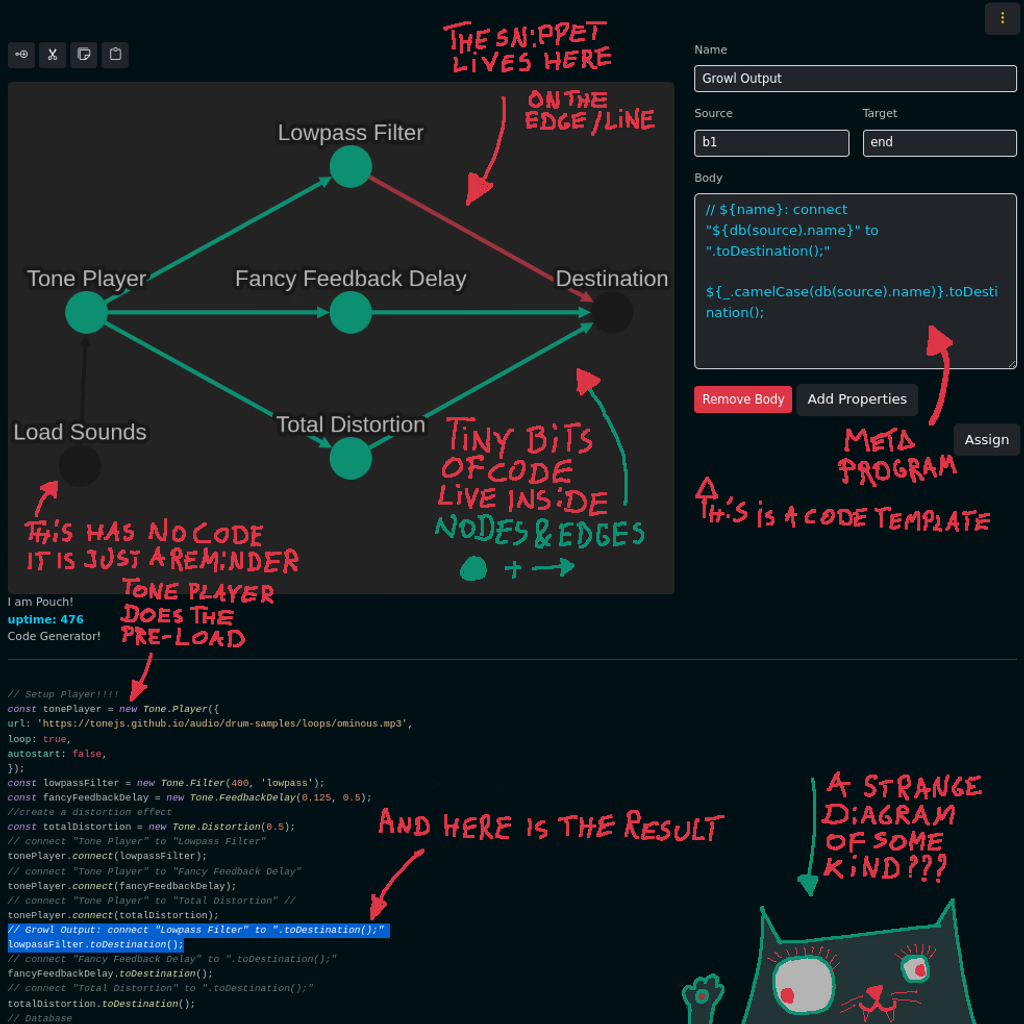
In this post the author argues that drawing with pencil is essential for learning programming, describing how visual sketches help understand and remember concepts. He explains that a program can be seen as a diagram of nodes (major steps) connected by edges (links), each edge carrying its own snippet of code; the diagram thus becomes a “file pane” of the editor. The post stresses that while REPLs and computers are useful, they cannot replace the creative act of sketching—each line or circle in a drawing has meaning only within that visual context—and that this dream‑like visual thinking ultimately produces the actual code.

#0971 published 03:51 audio duration 298 words diagram pencil programming visualization mind-mapping memory-palace

Code Generation And Education

Code Generation And Education

zoom read listen

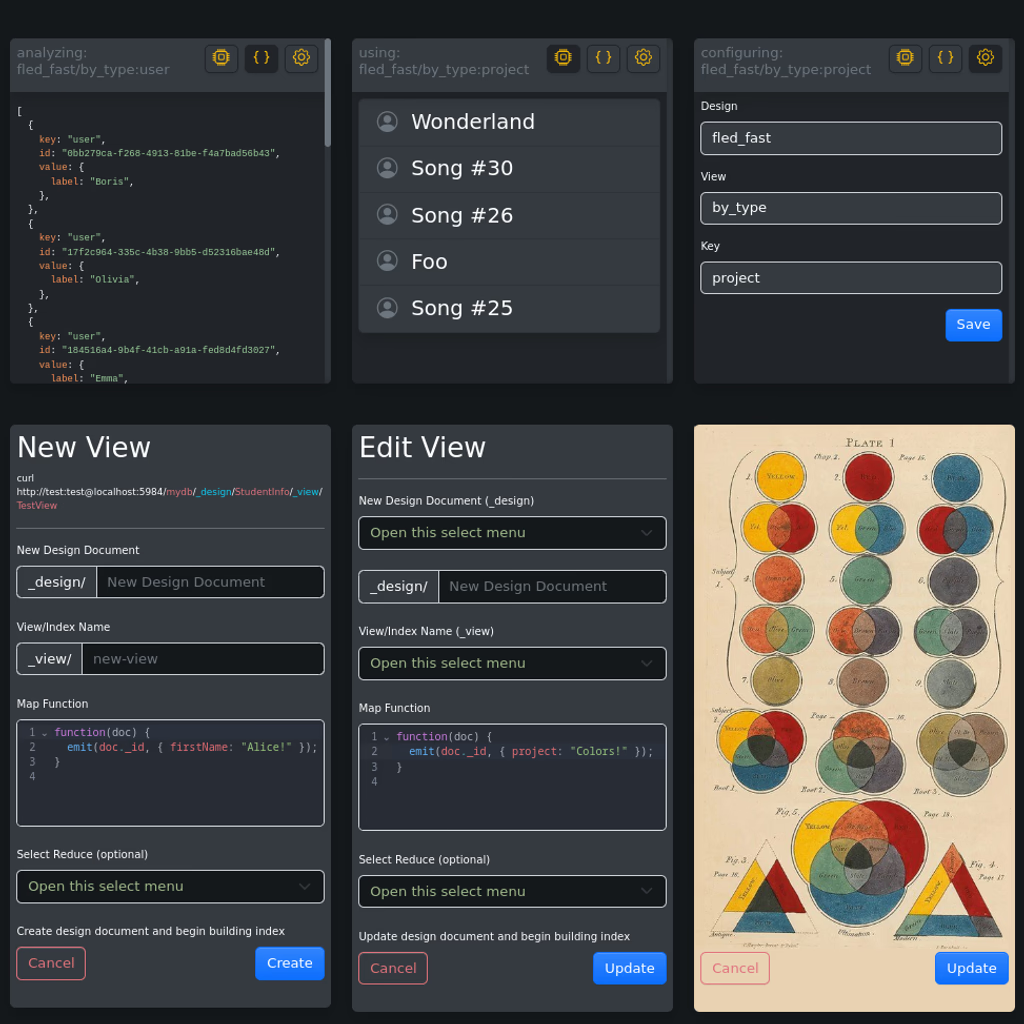
In the post, the author outlines a strategy for creating an efficient, cross‑platform application that runs on a Raspberry Pi and can be hosted in a colocation facility, emphasizing the use of JavaScript both on the server (via Koa or Express) and client side to avoid language switching. They recommend using PouchDB with Bootstrap and Svelte for an offline‑first, mobile‑first UI that scales well to desktop, and stress the importance of responsive design and low traffic. To streamline development, they propose building a code generator—specifically a Cytoscape‑JS graph interface on the front end and a collection of Node module templates on the back end—that automates repetitive coding tasks, saves time, and can be packaged as sellable themes or plugins for new technologies learned along the way.

#0970 published 05:08 audio duration 478 words javascript node.js express koa svelte pouchdb bootstrap raspberry pi offline-first code-generator cytoscapejs unit-tests

How To Become A Powerful Programmer

How To Become A Powerful Programmer

zoom read listen

The post argues that an EventEmitter is a fundamental programming concept—much like classes or try/catch—and explains why it’s especially valuable in modern frameworks such as Svelte. In Svelte, developers typically build a “pyramid” of state: a top‑level data object whose fragments are passed down to components. While this works for small, self‑contained apps, integrating external services (auth, databases, websockets) can become cumbersome; an EventEmitter lets components broadcast and listen for events across the entire pyramid without rigid structural rules, creating a spiderweb of communication. The author notes that junior developers sometimes view EventEmitters as “evil” but they actually simplify data flow and UI structure—illustrated by a complex properties pane that reacts to a single “selected” event and persists changes via an “save” event—showing how this pattern can make building applications quick, powerful, and visually intuitive.

#0969 published 05:00 audio duration 432 words event emitter svelte components state management event-driven architecture reactive programming

The Human Tail Research Trials; Or, Beyond The Science Of Biology

The Human Tail Research Trials; Or, Beyond The Science Of Biology

zoom read listen

In late September 2022, I began an experiment by attaching a fluffy tail to myself to explore whether humans would respond differently to a full prosthetic tail—an inquiry I intended to publish in the Journal of Science years later. During October, people initially ignored me until the 20th, after which they greeted me with smiles and kindness; this shift spurred personal growth: my programming skills surged (thanks to Svelte, PouchDB, Cytoscape‑js, and CodeMirror6), I lifted heavier weights, became more cheerful, improved my music composition, and even recalled a childhood song about a mixed‑breed puppy. The tail experiment has thus catalyzed both social interactions and creative development in my life.

#0968 published 06:43 audio duration 368 words 1 link personal-chronicle experiment tail javascript svelte pouchdb cytoscape-js codemirror6 music-composition puppy-song

Searching About For New Instruments

Searching About For New Instruments

zoom read listen

The post argues that, while high‑quality studio samples and perfectly synthesized sounds sound nice on paper, the real magic of music comes from complex, noisy, and surprising elements that keep a song interesting far longer than predictable patterns—something especially true for workout tracks that need to sustain energy over time. Using a 1929 Jimmie Rodgers track (“Waiting for a Train”) as an example, the author shows how short random snippets can be stitched together with added noise to create fresh beats; simple techniques like low‑pass filtering on loud sounds or even tapping a mic can yield drum-like instruments. Overall, the piece celebrates randomness and old technology as powerful tools for crafting engaging, unique music.

#0967 published 06:31 audio duration 307 words 2 links music-theory sampling beats audio-production workout-music

The Whole Cybernetic Digital Enchilada; Or, Entry Into The World Of Programming

The Whole Cybernetic Digital Enchilada; Or, Entry Into The World Of Programming

zoom read listen

To become a programmer you need self‑study, patience, and a solid environment: start with a free Debian GNU/Linux system on inexpensive hardware such as an 8 GB Raspberry Pi 4; choose JavaScript/ES2023 as the first language because it powers the web and will stay relevant for decades; use vim (preferably SpaceVim) as your editor to master terminal‑based coding; then begin with simple command‑line Node.js programs, employing modules like commander for CLI handling and sharp for image processing.

#0966 published 12:29 audio duration 702 words 5 links linux debian raspberry-pi javascript nodejs vim programming command-line tutorial

Simple Explanation Of How Individualized Education Can Guide Us Toward World Peace

Simple Explanation Of How Individualized Education Can Guide Us Toward World Peace

zoom read listen

The post uses an operating‑system metaphor to argue that human minds are dynamic, evolving machines whose education can be upgraded much like software updates. It claims that standardized learning feels like eating the same “broccoli” over and over, whereas personalized, technology‑driven instruction—especially via smartphones—lets learners build their own knowledge paths, experiment with real projects, and earn rewards for solving problems. By creating a privacy‑respecting, self‑paced school where students can freely assemble curricula, collaborate online, and gain experience through bounties, the author believes individuals will feel empowered, overcome poverty fears, and continually refine their skills, just as an OS is upgraded or replaced to improve performance.

#0965 published 09:34 audio duration 788 words poetry technology education operatingsystem smartphone

If You Got A Tailbone You Need A Tail

If You Got A Tailbone You Need A Tail

zoom read listen

Research shows that having a tail—whether literal or metaphorical—offers practical benefits: it helps distribute weight, supports the back, and can even enhance intelligence. The post emphasizes that animals from squirrels to whales naturally possess tails, suggesting humans could benefit similarly. It stresses choosing a tail that fits one’s scale and size, implying careful selection is essential. Finally, it playfully suggests wearing a tail for style—whether on Halloween or year‑round—to feel mighty and strong.

#0964 published 01:52 audio duration 182 words poetry tails rhymes

One World

One World

zoom read listen

Our world is complex, yet cultures are destined to converge toward wisdom and peace. Young people struggle to grasp group identities, often simplifying them with the vague “they,” which deepens divisions and fuels conflict—an old trick that exploits our minds’ need for coherent narratives. When we accept falsehoods as truths, our worldview warps, and groups hate each other because of these shared lies rather than any real difference. Children can quickly abandon local labels if taught to build their own certainties: they must learn to evaluate assumptions and check premises. Schools were intended as the cradle of modern civilization, pushing beyond “them” into deeper understanding; however, this often forces children to disobey parents and politicians to cling to status quo. Yet the real task is elevating all cultures through wisdom so they unite without conflict. Standardized schooling has become factory‑like, prompting self‑education as a replacement. The world’s mission—to end poverty, lift cultures, grow, learn, rise—remains in our nature; one day students will marvel at how we once demanded obedience yet hoped for change.

#0963 published 06:44 audio duration 422 words culture education group identity children school learning self-education worldview wisdom

Saving Progress

Saving Progress

zoom read listen

The post is an introspective ode to becoming a “great being” through the synthesis of art, philosophy, and personal experience: it urges the reader to cultivate poetry, music, invention, and wisdom, all inspired by ancient philosophers and cosmic wonder; it weaves together poetic reflection on life’s cycles, the transformative power of books, and the author’s own sailing adventures as a means of self‑discovery

#0962 published 16:35 audio duration 1,379 words poetry free-verse philosophy creative-writing

A Handful Of Observations On The Subject Of Writing Books

A Handful Of Observations On The Subject Of Writing Books

zoom read listen

I’ve been thinking about writing a book since high school, but my idea of what a book is has evolved into an audio‑book project that lasts for hundreds of hours—each 10‑minute poem a small chapter in a larger program that adapts to the listener’s mind. I started with simple verses and now weave them into software‑development themes, treating each recording as a dynamic “software” upgrade for the mind rather than a static sheet of information. I see a 300‑hour audio book as roughly thirty separate books, and I repeat ideas often so they stick; I let my audience from many cultures hear the same thought in different ways. I keep it free to share, finish one project before starting another (calling it “Part Two”), and believe well‑narrated audiobooks are a way to move humanity toward the future.

#0961 published 05:27 audio duration 430 words audio-book poetry self-education writing ten-minute-poems high-school software-development