·

#1301: Body, Mind, And Humankind

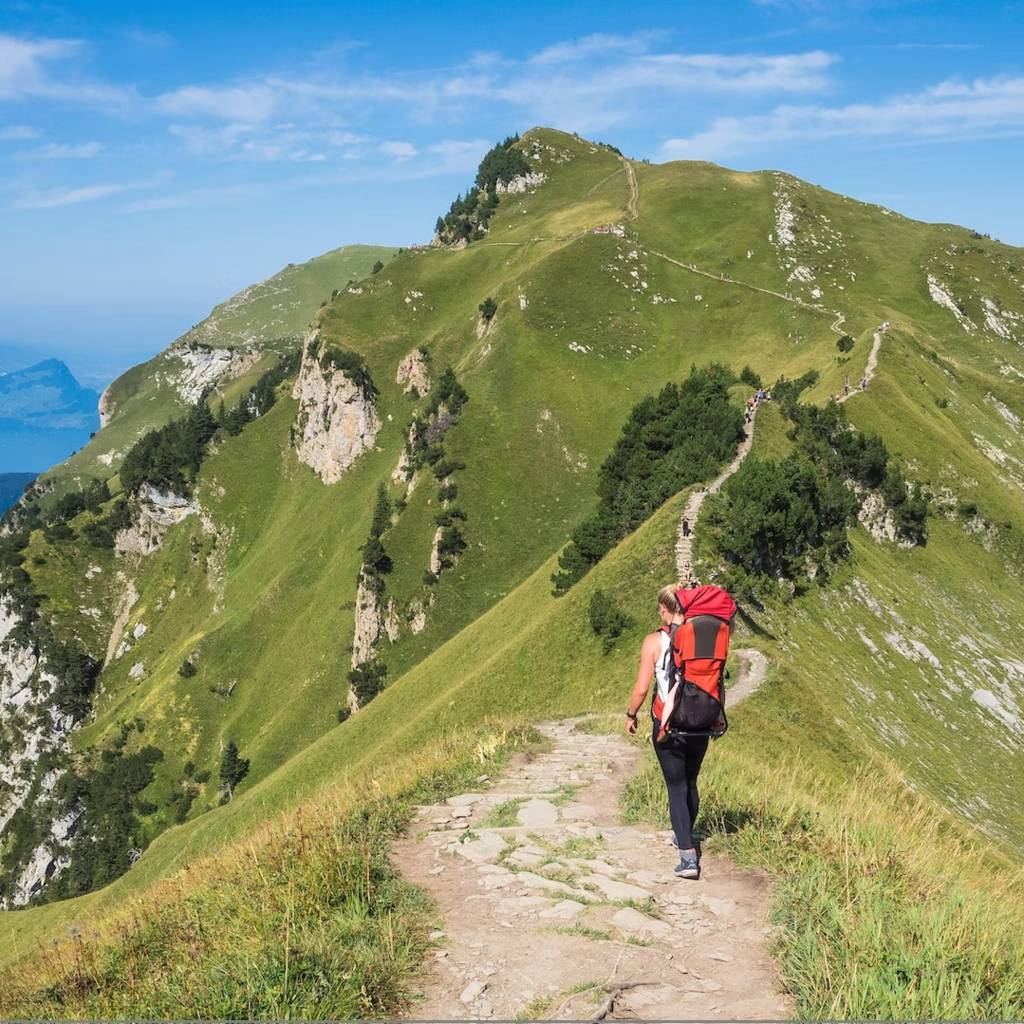
The author argues that true “education” is the integrated training of mind and body—just as walking long trails like the Appalachian or Pacific Crest strengthens physical fitness, reading and reflecting on great books sharpens mental stamina. He claims that schools often miss this holistic practice, turning learning into a profit‑driven exercise that leaves graduates physically and mentally unprepared for life’s challenges. By combining regular trail hikes, weight training, flexibility work, and disciplined study, one can rebuild both body and mind, becoming “a great being.” The piece links this personal regeneration to larger societal health: if we fail to repair our minds through learning, the nation will drift into war—illustrated by recent nuclear tests—because educated people are needed to prevent such crises. Thus, the author urges that individuals not only restore themselves but also revitalize teaching so future generations can learn this integrated fitness and keep society from repeating past mistakes.

·

#1300: Invitation To Self Education

Self‑education, defined as self‑directed and self‑paced learning, is portrayed in the post as a natural adventure rather than a punishment or memorization exercise. The author laments how traditional schools, especially in mathematics, have failed to inspire genuine learning, forcing students into rote practice before real application. By contrast, self‑education allows learners to pursue knowledge from multiple perspectives—reinventing mathematics if desired—and integrates it across all subjects. The writer recounts his own discovery of math while designing pixelated arcade games, an experience that standard curricula often miss by insisting on pre‑memorized formulas. He concludes that the best future for learning lies in this autonomous approach, echoing Thoreau’s woodland experiment and pointing to public libraries or phones as gateways for the self‑adventurer to grow into a well‑rounded being.

·

#1299: So You Signed Up For The Gym... Now What?

The post outlines an all‑day “dumbbell dance” routine: start with light (3 lb) weights and move continuously—walking, jogging, or lifting—without stopping or resting, letting the body adapt through steady movement. It suggests building up from 15 min sessions to longer periods (up to hours for bigger athletes), gradually adding weight once a base of 20 lb total feels comfortable. Key exercises include dumbbell lateral raises, standing curls, and overhead presses, performed in a rhythmic flow that can be synchronized with music; the tempo should match the beat so you stay in a trance‑like state. By keeping the body moving nonstop, you’ll strengthen legs, shoulders, abs, and chest (via optional lay‑down work), while the continuous motion and musical rhythm drive the workout’s effectiveness.

·

#1298: A Message From Your Elder Self On The Subject Of Case Of Mondays And The Cure Of Wednesdays

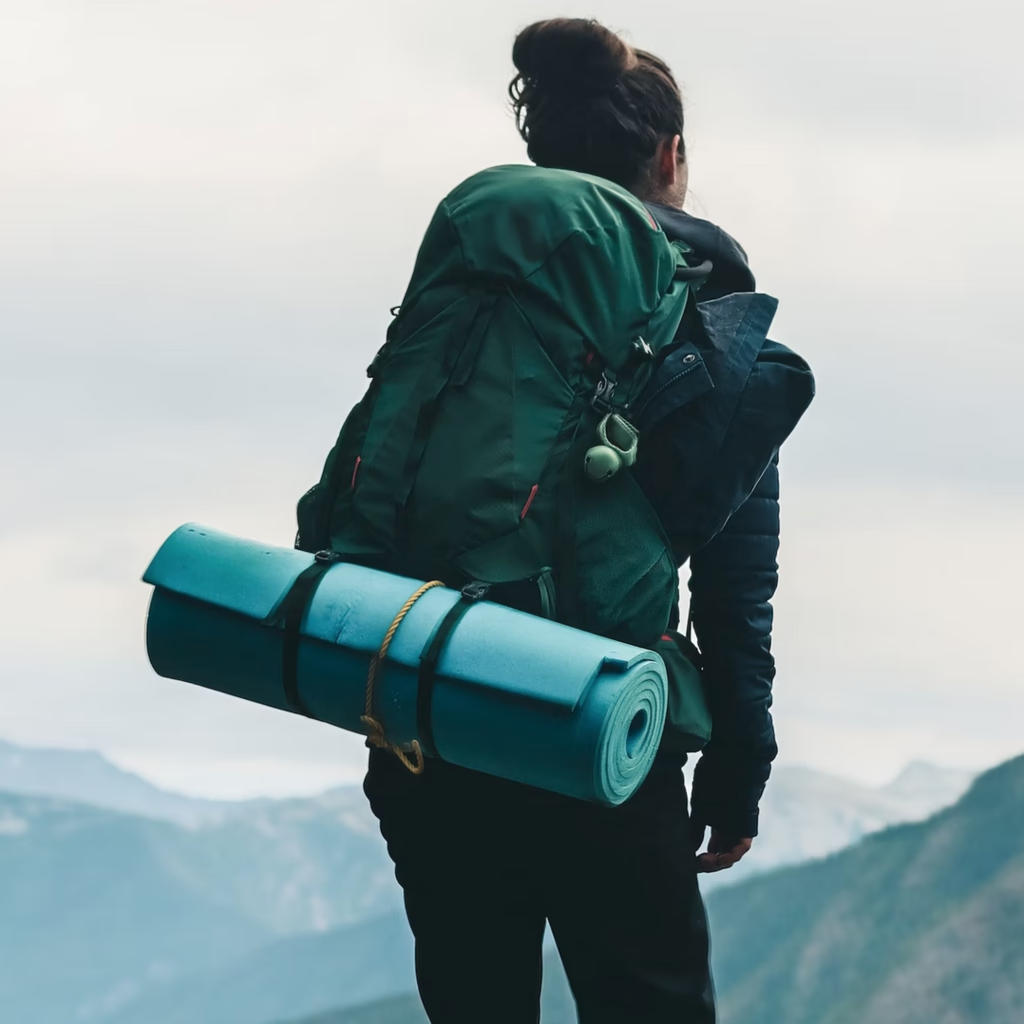
The post is a poetic reminder that we have been “snuck up” by the way we spend our days—waiting for Wednesday so the weekend arrives sooner, treating Monday as a simple cure that actually steals time from us. The narrator describes how this rush through life can feel like being plucked from chaos into silence only to be returned to it again, and then delivers a message from an “elder self” to the younger one: love each day and don’t let time pass you by. In a sort of exhortation, the elder self orders the reader to buy a backpack and tent, head out on the Appalachian Trail, and learn through walking that life’s true inheritance is found in living deliberately rather than simply passing time.

·

#1297: Accepting Responsibility For Your Own Fitness

The post argues that regular exercise is vital for maintaining health and preventing the unhealthy effects of overwork, isolation, and poor lifestyles; it suggests that if our systems—especially schools—were properly organized, people would regain freedom and longevity. It stresses personal responsibility: putting one’s own well‑being first, even at work’s expense, and highlights how endurance can be built gradually through consistent activity. The author illustrates this with a brief anecdote of a man who, after biking to work, realized he still needed more effort to rebuild his body, showing that the body heals when we push it but needs us to keep the momentum.

·

#1296: Childhood’s End; On The Subject Of Post Trail Depression

The author uses the image of walking a trail—an inherently one‑way road—to describe growing up as a deliberate journey that goes beyond mere aging. It calls for intentional steps forward, learning from authentic books and great thinkers, and resuming their work so that each generation can build on that legacy. The piece urges readers to leave ordinary life behind, keep the slope of their path upward by engaging with narrated works and library resources, and to repair a system of education that had once forced rote memorization. In this way, one becomes a creative polymath, composer, writer, and guide who can bring others onto the trail and ensure that future generations see what he saw.

·

#1295: To Resume Where The Great Beings Leave Off

The post encourages readers to treat every moment as a celebration and to pursue lifelong learning by deeply engaging with countless books, especially those that have shaped great thinkers; it urges one to connect with their inner self, seek wisdom from elders, and travel metaphorical and literal paths—such as Walden Pond, Mount Kathadin, and other symbolic journeys—to gather experiences and insights. By synthesizing these lessons into new works and personal trails, the writer proposes creating independent schools of thought where poets and philosophers can freely share knowledge, thus restoring what has been lost and enabling others to pick up where great minds have left off—ultimately fostering a culture of greatness that rises beyond ordinary existence.

·

#1294: Authentic Education And The Resulting Culture Of Greatness

The post argues that true, practical learning is the foundation of a richer world culture and that today’s politicians are largely uneducated and out of touch with voters, leading to fragmented goals and little progress; in contrast, students who absorb real knowledge become independent intellectuals capable of effecting change, ensuring future generations will overcome poverty, hunger and homelessness, and be seen as equal great beings. It concludes that while schools need reform, the spread of well‑written, narrated books by clear thinkers can deliver this culture of greatness more effectively than current institutions.

·

#1293: The Way Of The Plumpkin; Or, On Communicating With Your Body, And Slowly Getting Into Marvelous Shape

The post is an upbeat, motivational piece encouraging readers to keep pushing their physical limits gradually while resisting external praise or criticism. It stresses that consistency, patience, and incremental increases—starting with short workouts and building endurance before adding speed or weight—are key to long‑term fitness success. The author also suggests simple lifestyle tweaks (like simplifying grocery habits) to support exercise goals, all wrapped in a rhythmic, poetic voice that reminds readers to keep moving forward despite setbacks.

·

#1292: How Parasites Ate School; And On Hiking, Camping And Listening To Great Books

A single‑sentence recap: the author claims that hiking and camping provide real, stress‑reducing learning while traditional school systems are overrun by memorization, bureaucracy, and corruption.

·

#1291: Standardized Education Has Become A Scam; Don’t Let Teachers Trick You Into Cramming Or Memorization

The post argues that standardized, memorization‑based schooling is ineffective and calls for self‑directed, relevance‑driven learning tailored to each student’s curiosity to truly enhance knowledge and society.

·

#1290: There Are Too Many Problems Outside Of Self Education

The post argues that true learning comes from self‑directed, lifelong study rather than formal schooling, which it claims can become a vehicle for indoctrination. By using audio, video, visualization, simulation and language‑model tools, learners can build intellectual hygiene, stay curious, and avoid the short‑sightedness of conventional graduations. The author links this self‑education to becoming “great beings,” capable of entrepreneurship and social improvement, and sees Universal Basic Income as a necessary companion for real schools that can break the cycle of overwork and stress. In short, the piece calls for a shift toward autonomous learning and economic security so people can rise above cultural mind‑control and truly grow.

·

#1289: Towards Deep And Intricate Masterpieces Of Art; Or, A Super Tiny Note About Art Collage

Collage is a preparatory technique rather than finished artwork: it builds scenes from informational elements instead of sketches, making the process easier on a computer or when projected onto canvas. It’s especially useful for portraits where capturing a face accurately matters; artists start with a reference photo in a program like Krita, then splice in cutouts whose shapes and colors can be adjusted before painting over them. Whether kept digital or projected, layering and color picking help blend the collage into a cohesive image, allowing multiple projects to run simultaneously and enabling long‑term color planning—making collage a powerful scaffold for the final masterpiece.

·

#1288: How To Protect Your Mind From Standardized Education

The post argues that standing out of the crowd makes you a target for bullies, so you should document their actions, involve teachers and police, and keep records to fight back effectively. It then shifts to learning: early basics (reading, writing, arithmetic) are usually taught but higher subjects often become rote exercises; adults over‑estimate their knowledge and treat school as a babysitter. The key idea is that true education must be self‑directed—find a concrete reason or project that motivates you, use books (especially adventure and philosophy), record your learning process, and combine practical experience with nature to build real understanding.

·

#1287: A Universe Must Expand; Or, Self Directed Education And Your Personal Constellation Of Curiosities

The post reflects on how childhood curiosity shapes later achievements, using a hypothetical switch from Chopin’s piano to math to illustrate that learning in sequence matters. It argues that when children are free to pursue and revisit their own interests—a “constellation of curiosities” that fuels self‑directed education—they develop into polymaths, whereas standardized schooling forces subjects and stifles this constellation, leaving students miserable. The author uses examples such as 3D printing to show how revisiting a topic builds deeper skills, but when forced topics flatten the map of personal worlds. In short, protecting that constellation and letting it expand is key to a wiser future.

·

#1286: A Note On How To Simply And Effortlessly Increase Your Lifting Weight

The post outlines a straightforward, dance‑inspired dumbbell routine that blends walking, rocking, and fluid motions while gradually increasing the weight from 2 to 8 lb per hand; it stresses using an interval timer, keeping rest periods short, and syncing movements to music at about 170 beats per minute. The key idea is to lift one arm while lowering the other, ensuring core strength with extended sets at lower weights before progressing. It also recommends selecting slightly heavier weights each session and staying consistent with fresh tracks that boost energy, suggesting ways to find new songs by mixing genres or adding country names, and even using free audio‑editing software to tweak tempo for a personalized workout soundtrack.

·

#1285: The Allegory Of The Cave

Philosophers are always ten times smarter than we think, the moment you understand something the philosopher said. The moment you see the vulnerable human, who could have done better, is just the philosopher, lovingly, and gently reaching out to help you rise much higher. --- To get us started, some say that fighting styles and equipment, arose from practicing martial arts with work tools, or whatever was on hand. So that peasants could practice unnoticed, until they became powerful enough to set themselves free. ---

·

#1284: What Is Wisdom?

The post argues that movies offer only fleeting, oversimplified lessons, while true wisdom comes from self‑directed learning and deep reflection on life’s choices.

·

#1283: Do Not Be Small And Useful

The author argues that true growth comes from self‑driven learning rather than formal schooling, urging readers to seek out the works of great thinkers and keep a steady stream of reading in order to build knowledge and wisdom. Books are described as essential fuel for the mind—like oxygen for the brain—and the accumulation of what is learned will eventually transform one into a “great being.” The post stresses that learning should follow one’s own sequence and pace, with pauses and revisits as needed, so that ideas connect naturally. By immersing oneself in real adventure books written by clear‑thinking authors, one can inherit culture and skills that allow problem solving and decision making to evolve organically. In short, the message is: read widely, learn independently, and let wisdom grow like an operating‑system upgrade.

·

#1282: We Are Each Unique, But Not Different

The post argues that false beliefs spread through two intertwined mechanisms: first, we tend to accept whatever we are born into; second, those who have been indoctrinated feel compelled to pass their convictions on as “family advice.” These inherited truths often block useful knowledge and hinder the growth of real wisdom. The author illustrates this with examples ranging from simple “why‑we‑are‑here” answers (“the universe is vast”) to more elaborate cases like dolphins returning to the sea, showing how easily accepted explanations can mask deeper reality. He further claims that top‑level handlers—political leaders, religious figures, even teachers—can reinforce these false ideas and that education itself may become an indoctrinating force. The remedy proposed is continuous reading and listening to books, which break the invisible walls of pre‑set beliefs and let us rise as independent thinkers.

·

#1281: Trust In Great Wisdom

Wisdom is presented as an “operating‑system upgrade” that lifts our observations to a higher level, with books serving as the primary source of this new knowledge—read not just on paper but heard in the mind. When we fail to grasp what is whispered by the books, it signals overwork and stress; healing comes from taking a transformative vacation that renews thinking, perception, and character. Reaching a “plateau” pushes us beyond philosophy into all sciences, revealing our tools as inadequate and prompting self‑education in programming: starting with JavaScript and moving to more powerful languages, we learn to simulate, visualize, and create digital products (apps, games, utilities) that generate value and income. By selling these programs one can escape poverty; the process is guided by Sun Tzu’s idea of winning before war. The post also suggests visual programming tools for customers and notes that real education is self‑directed, paced, and unconfined by classes or graduations. While other crafts (drones, CAD, AI art) are mentioned, they require physical logistics, whereas digital creation offers infinite copies, memberships, and flexibility across all sciences. Finally, the culture of great authors transfers to us, encouraging the building of a lasting legacy that outlives our own life.

·

#1280: The Uncorking Of The Pipeline Of Wisdom; Or; Beautiful Adventure And Cheerful Storytellers vs. The Fake Education Ecosystem

The post argues that effective, enabling education is still missing and that standardized schooling remains largely unchanged because of its inherent simplicity and low effort; it explains this “clustered corruption” as a result of easy, automatic feeding mechanisms rather than genetic predispositions, and suggests that the real solution lies in starting from scratch—using narrated books and new technologies to create a pipeline of wisdom that can be transferred by intellectuals worldwide. The author believes that only through such an innovative, story‑driven approach can young people move from stress to serenity and enjoy a life of adventure, while traditional schools and religion rely on momentum, miracles, and the illusion of saints or geniuses to keep their power.

·

#1279: Can Standardized Education Become Effective?

The post argues that conventional classroom schooling is rigid and stifling, with punishment‑based motivation, fixed schedules, and isolated subjects that lead to memorisation rather than real understanding. It proposes self‑directed learning driven by individual curiosity: when one interest naturally leads to another—such as a student moving from 3D printing to visual programming and finally generative design—the knowledge flow becomes continuous and deep. By allowing students to follow their own curiosity chains, teachers act only as guides, not enforcers, so that each new concept sparks the next and the learner can tackle complex projects independently, ultimately building his own future through self‑initiated projects.

·

#1278: Don’t Jump Hoops, Don’t Just Go To College, Don’t Just Work

The author argues that true learning is a personal, curiosity‑driven process rather than a rote bridge built by teachers; only by genuinely mastering subjects can we apply them in life. Choosing a career should arise naturally from the interests that spark our curiosity, not imposed goals; this path—whether it leads to becoming a doctor or any other field—cultivates unique wisdom and lets us revisit many disciplines repeatedly. The ultimate aim is to leave a lasting legacy through writing, capturing all of our joys, struggles, and discoveries so that others can feel and remember our spirit.