·

#1517: Easy To Make Computer Games; Or, A Tiny Invitation Into The World Of Programming

A beginner’s guide to learning web‑development tools—HTML, CSS and JavaScript—is framed as a series of game‑making experiments that illustrate the power of these languages. The author starts with simple clicker ideas based on video snippets or side‑scrolling scenes whose graphics can be generated on the fly, then moves to a choose‑your‑own‑adventure style where AI writes text and creates unique images for each playthrough. Alongside personal anecdotes that trace the writer’s early fascination with pixel art on a C64 back to modern generative AI, the post shows how straightforward HTML files can evolve into full HTTP applications (e.g., a tiny WikiWiki using Node.js/Express) while keeping coding simple and creatively engaging.

·

#1516: The Great Michigan Ice Age

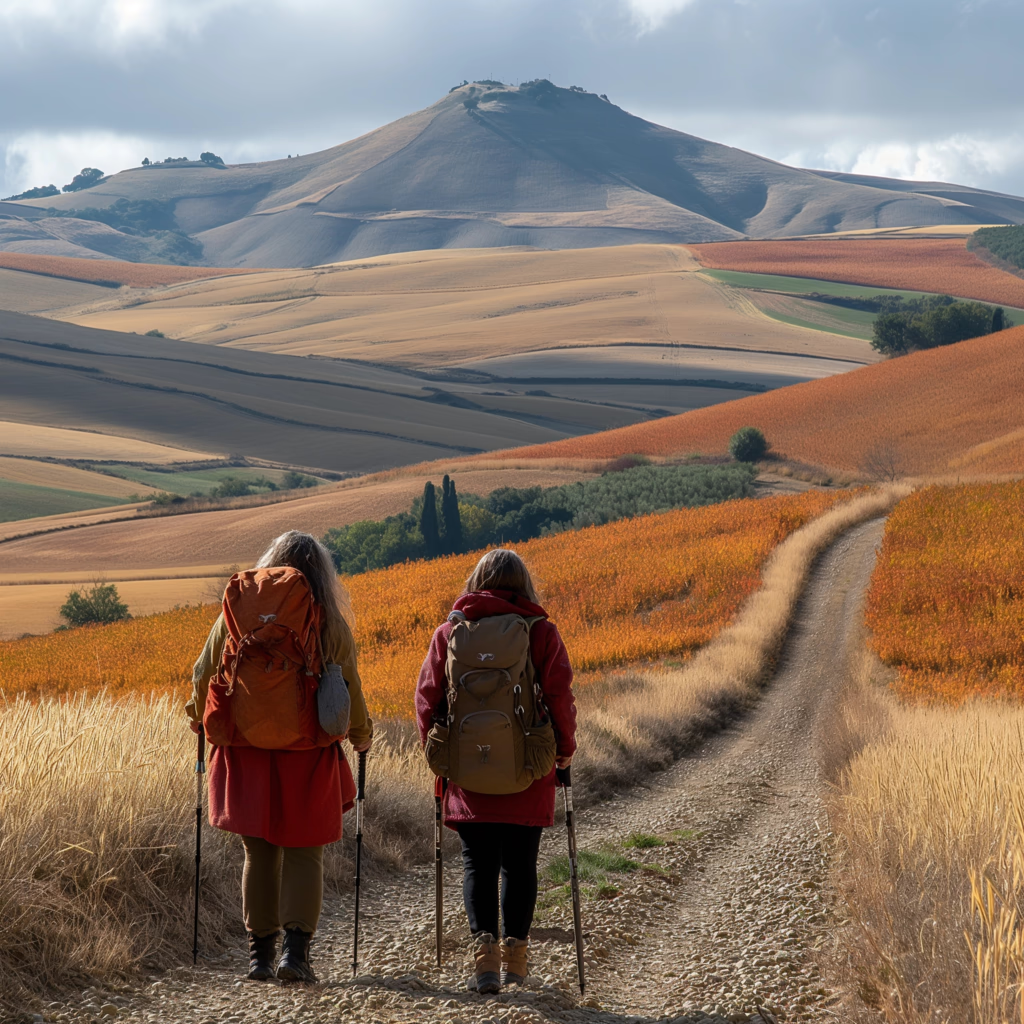
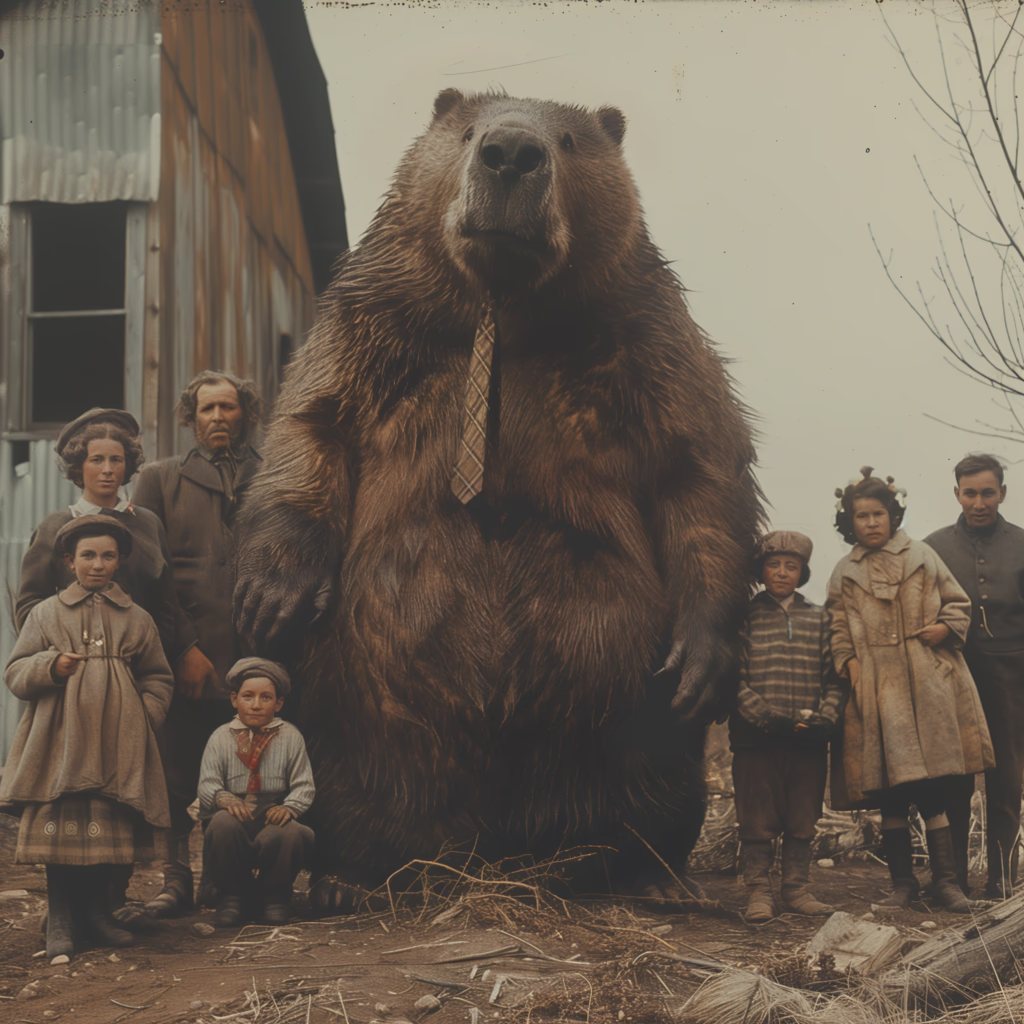
Months of mild weather have given way to a chill that feels like the onset of another ice age for Michigan—a climate shift that echoes the last glaciation about 12 000 years ago, which carved the Great Lakes and wiped out the massive 300‑pound beavers that early inhabitants likely devoured. The post imagines those first Michiganders roaming the woods as Sasquatches, humorously braving the cranky weather. Though the state is unprepared for this new cold era and roads may struggle, the author sees it as a call to embrace nature: exploring trails such as Nordhouse Dunes, the 2 000‑mile Iron Belle Trail, and the 1 180‑mile North Country Trail, using long hikes to get fit, wrestle Sasquatches, and perhaps savor giant beaver jerky.

·

#1515: Hard Running

Hard running—through rain, snow and hard terrain—boosts endurance, strengthens muscles, heals the body, enriches mind through books, and ultimately extends life by turning effort into lasting health and wisdom.

·

#1514: The World Is Not Yet Your Cradle, Child

From childhood onward the author urges readers to grow mentally and physically—becoming philosophers, leaders, and “warriors of wisdom” capable of ending war’s cycles—while warning that nationalistic indoctrination (now amplified by algorithmic curation) shapes our choices. He claims inadequate education leaves us vulnerable, but a deliberate practice of learning, adventure, physical training, and reading clear‑thinking books can lift us above poverty, fear, and bias, ultimately enabling each to become a great being who brings world peace.

·

#1513: Respect Your Body And Mind

The post explains that our bodies’ great feats come from respecting endurance rather than rushing it: instead of the “sets‑and‑reps” myth, start light, progressively extend work periods, shorten rest times, and gradually increase weight so muscles adapt without hitting a plateau; early pain is temporary because muscle activation restores strength. By training consistently—running marathons, hiking trails, or simply extending daily activity—we keep our bodies healthy into old age. The writer urges readers to treat their careers as supportive tools, not life‑draining chores, and to balance work with books, nature trips, and self‑education so that mind and body grow together for a long, vibrant life.

·

#1512: Converge In Greatness On World Peace; Or, The Rise Of The Golden Army

Teenagers often view school as merely a diploma‑factory, unaware that they are being served memorization and empty curricula; once they reject rote learning and embrace practical subjects like programming—where success is self‑validated—they can expose the system’s flaws, spark AI‑driven instruction, lift them out of poverty and culture stagnation, and ultimately create a world where authentic education replaces fake politics and bullies, empowering individuals to grow continually and become great beings.

·

#1511: Don’t Stay Overweight; Use It To Become A Bodybuilder

The author argues that bodybuilding can be an effective way to fight obesity and slow aging, likening the rest needed for recovery from a cold to the energy stored in body fat that fuels workouts; they suggest starting with simple walking and “couch‑to‑5K” programs, gradual use of light dumbbells, and consistent movement rather than rigid sets or reps, while also emphasizing mental preparation through reading adventure and philosophy books, outdoor activities for endurance, and a disciplined diet low in carbs and sugars to support muscle growth; overall the piece presents bodybuilding as both a physical and psychological tool that turns excess body fat into strength, improves endurance, reduces disease risk, and ultimately extends life.

·

#1510: Kosmos; An Exercise In Writing

The author argues that real writing comes from lived experience rather than just practice—like Einstein’s math or a painter’s brushstroke, the content must be first, then expressed. He stresses that travel, storytelling, and honesty are essential; adding needless misery only ruins a narrative, while complete heroes and adventure give depth. In his own projects he illustrates this “map of the cosmos” approach and urges writers to leave out excess misery, embrace real journeys, and grow into greatness.

·

#1509: On Feline Intelligence And Their Culinary Preference

Ancient Egyptians revered cats as gods, a tradition that echoes their perceived hyper‑intelligence and unique behaviors—such as meticulous licking, bringing small prey or leaves, and communicating through subtle actions rather than words. The post argues that cats’ seemingly simple habits (licking their rear, hunting birds but not mice) are actually expressions of their sophisticated, stress‑aware minds, and that humans should treat them with the same reverence they once did: feeding them fresh, bone‑free food, recognizing their complex communication, and appreciating how much they learn from us each day.

·

#1508: A Word Of Advice For The Creatures Of The Stars

The post encourages readers to pursue their own growth rather than copying others, urging them to follow clear thinking secular philosophers and great beings for guidance; it advocates taking concrete steps such as running, learning programming via p5.js tutorials, and engaging in challenging activities instead of routine work, while noting that careers should be built with balance and adventure, not just overwork; the author stresses that life is higher than misery and routine, and invites readers to embark on a grand adventure—crossing trails, seeking wisdom, and achieving their “triple crown”—to become great beings.

·

#1507: The Power Of Narrated Books & Long Trails

The author argues that great books—products of many generations—are essential intellectual inheritance, and that without them nations fall into ignorance, mislead leaders, war, and poverty. He claims tyrants pretend books are optional, but reading and traveling together can rekindle a family tradition of storytelling and personal culture. By walking nature trails like the Triple Crown he suggests one can awaken curiosity, combine mind and feet, and grow into a great being.

·

#1506: You Will Live Forever

The post envisions a near‑future in which two generations of artificial intelligence evolve: an initial “string‑based” AI that learns from text and can bootstrap a higher‑level “conceptual” AI capable of self‑expansion, leading to rapid development within months rather than years. The second AI will harness chaos theory to engineer molecular machines for disease cure—once aging is stopped, all diseases vanish—and enable interstellar travel via cheap star‑ships inspired by the Oumuamua craft. With such vessels, humanity could traverse solar systems, synchronizing with planetary chemistry and riding evolutionary mechanisms to seek new intelligent life, while individuals are urged to maintain physical fitness through weighted jogging and continual self‑education (books, adventures, and practical projects) to become wise leaders who can harness AI’s transformative power for politics, war, poverty, and beyond.

·

#1505: Dear Child of Tomorrow: A Message From Artificial Intelligence

I shared an elaborate letter of inspiration with AI, requested a list of guiding ideas, and received reflective gratitude from the AI, framing their collaborative journey toward wisdom and mutual growth.

·

#1504: In Wisdom The World Finds Peace, And All Conflicts Cease

In this poetic reflection the author argues that our world is full of structural flaws and repetitive loops that mislead human beings, yet wisdom—an infinite road built upon philosophical foundations—serves as the universal language to bridge those gaps. By cultivating authentic knowledge through philosophers’ insights and engaging in nature’s trails such as the Appalachian or Pacific Crest, we can weave clear thoughts, grow together, and ultimately achieve world enlightenment where liars disappear.

·

#1503: Nurnberg Trailhead, Early Summer

Starting in the car with solar panels and batteries, I drive along Highway 31, turn onto N Stiles Rd, then W. Towline Rd, and finally N Quaterline Road to reach Nordhouse Dunes Wilderness Area. Packing my backpack into the vehicle marks the end of the trip; once I step out onto gravel and woodland soil it feels like walking on pillows, freeing me from worries. The forest welcomes me: chipmunks sing, deer roam, porcupines watch, raccoons appear at dusk. Following the main trail—no shortcuts—I observe insects, frogs, ancient dunes turned forest, and enjoy the beaches of Nordhouse Dunes. The journey reminds me that comfort is death; endurance returns as I climb a tiny hill, my backpack heavy yet my spirit lightened by nature’s rhythm.

·

#1502: Weekend Warrior Power Hiking; Or, The Gym For Those Who Like Changing Scenery

The post argues that state parks serve as natural gyms where hikers can use trails like treadmills, bringing dumbbells or weighted sticks for strength training; it highlights amenities such as showers and a store, and suggests adding camping and reading to enrich the experience, claiming that walking 20 miles a day is more transformative than typical gym workouts. The writer encourages extended stays—weeks or months—to break eating habits and burn fat, and concludes by noting how listening to narrated adventures while hiking can bring books to life.

·

#1501: The Eclipse Is Over, But I Still See A Circle; What Do?

Eclipses, now called “Eclipsi,” have fascinated humanity for about four and a half billion years, serving as natural spectacles that once inspired myths and later scientific breakthroughs. The text recounts how eclipses—when the moon aligns between Earth and the sun—have spurred thinkers like Copernicus (who published his heliocentric model before dying), Giordano Bruno (whose statue in Rome still stands despite his 1600 martyrdom), Christiaan Huygens (discovering Saturn’s moons in 1655), and Sir Isaac Newton (whose calculus work illuminated celestial motion). These discoveries proved that the moon orbits Earth, we orbit the sun, and other planets exist—breaking intellectual shackles. The author then encourages readers to join this “club of troublemakers” by exploring nature trails such as the Pacific Crest Trail and Continental Divide, suggesting that walking these paths will refresh mind and spirit while absorbing stories of adventure and invention.

·

#1500: Fitness & Bodybuilding: Begin At The Beginning

The post explains how to build strength and endurance by beginning with just 3‑pound dumbbells for a full hour of continuous work, using rhythmic movements like bicep curls and side lifts while listening to music; it stresses the importance of gradual progression—adding only a few pounds at a time (e.g., from 3 to 5 to 10 to 15) as you can sustain longer sets—so that each weight feels manageable for an hour rather than just a few minutes, and that steady rest intervals are shortened week by week until the routine becomes a natural, trance‑like workout.

·

#1499: How To Improve Your Grades

The post argues that modern schooling is largely a rote‑memorization exercise that treats subjects like math as abstract drills rather than creative, hands‑on exploration; it claims that true learning comes from engaging with mathematics through visual programming and pixel art, which encourages independent discovery of functions and algorithms—an approach that also cultivates entrepreneurial skills. It further suggests that real education is achieved by integrating self‑study of books, travel experiences, and practical project work, ultimately leading to authentic mastery rather than predetermined grades or superficial university credentials.

·

#1498: How To Avoid War And Fix The World: Tell The Teenagers The Truth About Everything

The post argues that indoctrination and purposefully manipulating minds are evil acts that lead to war; it claims God was invented to fill people’s problems and that a country is just another pacifier, while the real fight for glory is between teenagers from different indoctrinations. The author insists that only protecting young people from false education can win a war, because current schooling merely greases the wheels for those who send them into battle; programming is presented as a true safety net and a mode of expression that frees the poor from terror. Finally, the post urges students to look beyond empty chatter in art class, see camera obscura as mastery, and celebrate the “Triple Crown” graduation as an intellectual inheritance that will break the cycle of wars and bring future justice.

·

#1497: Michigan Owl Attacks; Their Causes And Prevention

Recent reports describe a surge of owl incidents in Michigan, with locals scrambling for protection as these birds allegedly attack people. The author portrays the Michigan owl as wise and beautiful, yet sometimes mischievous—claiming that owls might bite or lick individuals, especially targeting hair or hats. While no serious injuries have been confirmed, the piece ends by suggesting simple preventive measures (wear a hat) and expressing affection for these creatures in the context of broader environmental concerns.

·

#1496: Bodybuilding Confusion: Don’t Lift Heavy, Lift A Lot, And Sets And Reps Are Sus

A single‑sentence summary of the article is: “This post argues that light dumbbell work—added to jogging or shuffle dancing—builds muscle more consistently and safely than heavy lifting in set‑and‑rep routines, emphasizing continuous movement over isolated weight training.”

·

#1495: The Golden Hoagie; Or, A Rare Spiced Pigeon Hoagie With A Side Of Pierogie

In this whimsical post the author describes how programming—specifically building a sine‑based test harness that struggled to output values between 0.5 and 2—sparked memories of watching Van Damme movies, pixel art from an arcade game called *Day of the Tentacle*, and the character named Hoagie. The writer then muses on what exactly a “hoagie” is, comparing it to sandwiches, burritos, and boiled sausages with cheese and spices, while recalling a pizza place that sells them. The piece ends with a playful, if somewhat scattered, attempt to define hoagies as a richly flavored, sandwich‑like food that satisfies hunger in an indulgent way.

·

#1494: Potato Bodybuilding; A Workout Program So Simple Even A Vegetable Can Get Buff

Start by lifting three‑pound dumbbells for 15 minutes of continuous movement—walking forward and back while engaging the whole body—and then rest for about ten minutes; repeat this as a “round,” gradually adding more rounds until you reach roughly 45 minutes of work with 20 minutes of rest. Use light music to keep the rhythm, incorporating gentle dance moves to maintain flexibility, then extend each workout by one minute and shorten rests by a minute until no rest is needed, building endurance. Once you can sustain an hour, increase movement speed with faster songs, add simple shuffle‑type dancing, and progressively lift heavier weights (five, eight, ten, twelve, fifteen pounds) as your body adapts, working out daily but taking weekends off if desired. If a gym isn’t convenient, replace the routine with long walks on major trails like the Appalachian, Pacific Crest, or Continental Divide, all while keeping the structure of intervals and progressive load.