·

#0629: A Road Towards Authentic Education

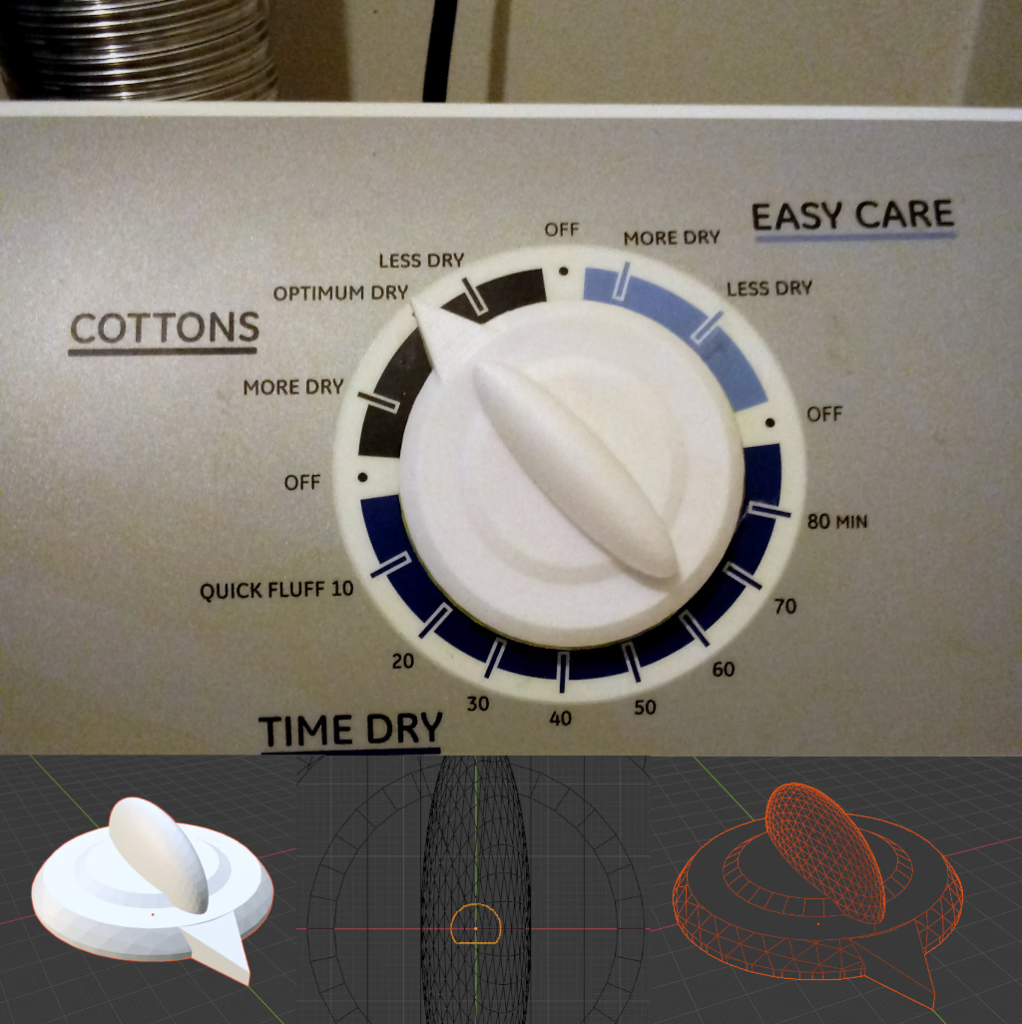
The post argues that traditional school divisions and curricula are fundamentally broken, relying on rote memorization and corporate interests rather than true learning; it criticizes how teachers and publishers treat programming like a commodity, while companies profit from language tools and hardware, yet students finish the semester with little real output. It then proposes an alternative: self‑education through free software, hands‑on 3D printing (using a Creality Ender 3 V2 printer and its auto‑leveling kit), and step‑by‑step tutorials in Blender and Prusa Slicer, which let students design and print tangible objects at home. By contrast, the author claims this “real” learning produces lasting results, whereas the “fake” education system merely promises but fails to deliver practical skills or knowledge.

·

#0628: On The Future Of Education

The post argues that modern schooling often teaches mathematics in abstract, disconnected ways—like “balanced education” or isolated lectures—that leave students unable to see why a subject matters. The author claims this approach turns learning into mere memorization and fraud, because grades can be manipulated while real understanding is missed. They suggest that embedding math within engaging contexts (e.g., game design, generative art, orbital dynamics) helps learners grasp concepts naturally, making lessons coherent rather than fragmented. By framing subjects around students’ own goals and using hands‑on projects, the post believes learning will become meaningful, reducing fraud and boosting genuine competence.

·

#0627: A Book Divided: On Truly Understanding Powerful Books

The writer reflects on their personal experience with schooling, arguing that formal education offers only a superficial “taste” of knowledge rather than true learning; they criticize the reliance on grades, debt, and rigid testing as mechanisms that treat students like cogs in a machine. They claim that true genius comes from self‑study and independent reading—citing Hawking and Einstein as examples of individuals who expanded their understanding through continual discovery—not just schooling. The narrator recounts how books such as *Robinson Crusoe* brought adventure and depth to their mind, far beyond the narrow curriculum of school, and concludes that learning is most profound when it comes from personal exploration rather than institutional instruction.

·

#0626: The Source Of Art And A Question To Start

The poem celebrates how every form of art—painting, sculpture, music, writing, programming, and even 3‑D printing—serves as a subtle analogy that expands the mind, deepens insight, and heals the spirit; it shows that an artist requires varied spaces and tools to develop precision and consistency, yet the act of creation itself is what shapes the artist more than any audience or show, and invites all of us to begin creating from our hearts.

·

#0625: Of Constellations, Superluminal Galaxies, And The Future Of Humanity

The post reflects on humanity’s cosmic roots—our existence forged by countless stellar explosions and the vast experiments of physics and chemistry—and on the profound questions that arise from it: why we are here, what gives life meaning, and what follows after death. It uses stars as metaphors for those questions, noting that stardust forms our bodies and that light from distant galaxies carries memories of the past. The author then connects this cosmic perspective to practical human concerns, arguing that education—through schools, audio‑books, and shared knowledge—can dissolve borders, end poverty, reduce crime, and prevent wars; by learning to pick good ideas from bad ones, we can build a united family under one sun.

·

#0624: A Little Observation About Music Composition

In the post the author explains how to build a simple yet effective drum‑based sequence in LMMS by first laying out a basic Beat+BassLine pattern at 140 bpm, then duplicating it with a slight variation on every second beat to create rhythmic interest. He shows that low‑pitched drums (bass) are less frequent than high‑pitched ones (cymbals), and demonstrates how adding just one extra hit in the duplicate section turns a simple drum loop into a melodic line. After covering bass and mid‑frequency layers, he adds high‑frequency clicks or sticks to break repetition, then finishes by applying reverb from the FX mixer to give the whole arrangement depth and polish. The result is a short “full song” example that illustrates pattern creation, variation, layering, and basic mixing techniques in LMMS.

·

#0623: School Independent Tutors, Audio Books And Video Lectures: On Getting A Real Self Directed Education, Early On

In the post the author argues that by eighth grade we should already be able to program, paint, compose music and write poetry, and that these skills can be learned quickly with free tools like LMMS for music composition or p5.js for math projects. He criticises teachers who only want their students to memorize exam material rather than truly learn, citing his own experience of a music teacher who was unfair and unhelpful. The writer proposes that real learning comes from independent tutors, audiobooks, video lectures and hands‑on adventures, and stresses that mastering tools like LMMS or p5.js is the key to understanding music and math in practice rather than theory.

·

#0622: The Firewall: A Fine Internet Business Idea For High School Students

The post argues for creating a new home‑network firewall that logs and blocks outgoing traffic from expensive IoT devices, so CEOs can build a passionate, user‑friendly solution to stop hacks.

·

#0621: Maple Tree Mischief At Nordhouse

I narrate a nighttime journey from Nordhouse to Ludington, pausing at a supermarket to nap before charting my day with a trusty map. The lake town’s open horizon sparks dreams that wake me to the simple pleasures of ice‑cream and sustenance, after which I feel ready for the final stretch of my quest. While stopping in a parking lot and leaning on a tall bench, I observe two older tourists gathering bark; one spots poison ivy, prompting a playful exchange before they “make chicken noises” and pray. After refilling water from my car and returning to the bench, I prepare for a drive toward a nearby camping area, where one of the ladies smiles in her camper, complimenting my style.

·

#0620: Art Is Where It Is At

Use a low‑cost canvas and a projector to create dreamlike, mixed‑color artwork that transforms simple images into expressive portraits beyond what a photo alone can capture.

·

#0619: High School, College, And Real Knowledge

I describe my high‑school internship where a clueless CEO questioned me about my future while I struggled with English and computer skills, leading me to realize that the school’s award ceremonies and structured classes were ineffective compared to self‑learning through programming projects and real‑world experience.

·

#0618: You May Be A Travel/Adventure Writer

The post is a playful guide for crafting a humorous travel memoir: it urges writers to jot down funny observations and everyday moments, letting humor carry the narrative and keep readers intrigued until the final “Wow!” moment. It stresses that stories need not be strictly categorized—just clear enough to stay in memory—and invites authors to weave cultural quirks, museum visits, and odd encounters into vivid scenes. By noticing small details and sharing awkward yet funny moments, writers can make readers feel part of the journey while turning simple trips into memorable literary hits, proving that a memoir is both a time capsule and an entertaining treasure.

·

#0617: This 18-Year-Old Changed The World: Announcing End Of Poverty Markets, The Next Generation Of Non Fungible Tokens (NFT)

A 5,000‑year journey of discovery culminates in a global solution to poverty: an international bank that distributes $3.5 million per person (≈$100/day) without borders, funded by governments as an investment in humanity’s future. This plan eliminates war and borders, lifts people from homelessness, fuels new businesses, revitalizes education, science, climate repair, and unites the world under shared prosperity and wisdom. The result is a flourishing, happy human kind where every nation opens its doors, schools teach business and wisdom, and people thrive with newfound confidence and collective joy.

·

#0616: Wisdom Everywhere

The author poetically describes how wisdom feels close and accessible—like a single snowflake—that can be found in books and dictionaries; each book becomes a new snowflake that triggers an avalanche of knowledge. They recount their personal journey discovering philosophy, noting that every philosopher’s thought is a key to understanding, and over time realize that wisdom permeates life and can solve problems such as poverty when applied. The post ends with the conviction that remembering philosophers and applying their insights will bring prosperity to future generations.

·

#0615: Life After High School: Become A Great Being

In the post, the author argues that true learning comes from cultivating wisdom rather than chasing grades or promotions, urging readers to keep their minds honest, rise steadily through challenges, and document experiences so they never forget their inner alignment. He sees life as a chain linking all of humanity and stresses that sharing wisdom uplifts others; by constantly rising and staying authentic, we can build a flourishing system of decision‑making that will help the world move forward.

·

#0614: Full Of Stars

The post is a poetic reflection on how personal “stars” – curiosities that give life meaning – attract each other in a constellation of learning. The author traces one such star from music composition (discovering the launchpad and beat‑sequencer while watching S Krillex, then creating his own MIDI program) to another star in 3D modeling, where experimenting with Blender’s doughnut tutorial leads to printing objects and even making jewelry. He ties these creative pursuits together with a simple metaphor: computers are microscopes that help us see the details of our ideas. The essay ends by urging readers to follow their own constellation—whether it is music, modeling, painting or anything else—and to let those passions guide them back under the “starry skies” of discovery.

·

#0613: Integrated Minds

The post argues that conventional schooling, with its focus on balanced curricula and teacher‑driven lessons, stifles creativity and practical learning; it cites Ayn Rand’s idea of checking premises as a starting point but expands to claim that true education is an integrated mind where knowledge aligns naturally. The author believes self‑paced, self‑organized learning—where students ask what they need to create rather than simply graduate—produces startups and personal art. Money should flow from schools into students’ hands, not politics, so that they can build their own paths. In short, the essay proclaims a return to heart‑driven, connected knowledge as the real essence of education.

·

#0612: A Poem Of Complaint: The Incredible Curse Of The Freight Train

The narrator lives next to train tracks and is constantly annoyed by the repetitive honking of the train horn, which he finds disruptive to his everyday life; he describes how the operator’s repeated blares seem almost like an “ugly‑man” playing a song and notes that the horn’s noise can be heard even from far away. He reflects on his own past career with trains—driving them across the plains—and later switching to weightlifting, but now prefers a quiet bookstore; yet he still complains about the horns, hoping they will be used more sparingly in the future. The post ends with a call for listeners to reply back and includes a sound file of the train horn.

·

#0611: Education Must Lead To Wisdom

The post argues that modern schooling is over‑built on standardized testing and fixed levels of knowledge, which stifles students’ natural learning pace. It proposes a model of self‑education where each learner follows a personal sequence that matches their existing knowledge and interests, advancing at a comfortable speed without the pressure of grades or punishment. By allowing room to think, dream, and pursue curiosities, schools would become arenas for adventures and investigations rather than graded exams, fostering wisdom, unity, and lifelong learning.

·

#0610: Lady Liberty And I

The post recounts a personal experience of living in New York City and finding comfort on a familiar spot on the Brooklyn Bridge, where the narrator enjoys quiet moments with Lady Liberty as company. He describes how he made an old bench his own, often returning to it even after leaving for Michigan, and relishes the simple pleasures of watching the river flow into the sea, skyscrapers towering beside him, ships passing beneath, and cars moving below. A rainy day adds a small adventure: he gets caught in the rain while on the bridge, returns drenched to the subway station, and observes another commuter smile at his wet puddle. All together, it paints an intimate portrait of solitude, routine, and affection for the city’s iconic sights.

·

#0609: Therefore Rise: Plateau By Plateau, As Far Up As You Can Go

The post argues that all people on Earth together are the only force capable of shaping our future, and that this can be done most effectively through a shared pursuit of wisdom. It urges us to learn from past mistakes over centuries, to build mental “plateaus” by accumulating knowledge from countless books, and to bridge the small gap between student and teacher by becoming independent thinkers whose own wisdom is tailored to their essence. By gathering scattered insights, we can create new paths that synthesize an integrated view of the world, reject corruption, and serve humanity for good. The author stresses that our current state—lack of learning, hidden liars, invisible prisons—has stalled advancement, but if we rise as citizens of the world and converge on wisdom, all divisions will disappear.

·

#0608: A Slice Of Heaven

Watching “Teenage Mutant Ninja Turtles” and “Inspector Gadget” with closed captions helped me learn how words are divided in spoken English, but I still struggled to say the time correctly—my watch read about 17:08, and I couldn’t decide whether to say “seventeen oh eight” or “five PM,” which left a passer‑by confused. After that mix‑up, I found myself on a New York subway, recording station names in my cassette recorder only to discover I’d mispronounced them; still, by looping back to Manhattan and then returning the way I came, I finally got home at Greenpoint hours late. Along the way I bought a slice of pizza for 25¢—confused whether that meant a quarter or just twenty‑five cents—but paid it with a single coin, enjoyed the spicy mozzarella crust, and left feeling proud of my new taste of American food.

·

#0607: Tail Facts With Dr. Meow, Ph.D.

The post humorously claims that wearing a tail—whether real or metaphorical—is essential for good health and success: pharmacists say you should have one, dentists assert it’s vital for chewing, spine specialists claim it relieves pain, nurses hope you’re dressed with a tail to cover your buttocks, researchers tout tails as cures for ailments, therapists hide their power, conspiracies fail to conceal them, religions use God to mask the tail’s magic, and even mythic figures like the Monkey King, generals, queens, presidents, businesswomen, and salespeople all rely on a “fancy tail” to win battles, achieve prosperity, and boost sales. The tail is described as a combination of “Bee's Knees and Cat's Meow,” and it supposedly existed in our ancestors 25 million years ago; the post ends by inviting readers to buy one at Halloween stores.

·

#0606: Of School And Greatness

After a week of philosophy finals and a boy’s question about Descartes, the narrator realizes that their class was merely an exercise in self‑deception and academic fraud. He reflects on how teachers may simplify lectures and arbitrarily set grades to keep the illusion alive, urging students to act quickly before reality hurts. The story recounts his own academic journey—studying art, sculpture, programming while seeking companionship—and a Dean’s final blow that made him realize school was fake. He notes that many workers are told “forget college” which feels cruel, and that numbers 25‑80 represent the stages of this fraud. Yet he believes one can move mountains if they first move themselves; biographies become turning points to escape early. He concludes with a vision of greatness: becoming both professor and forever student, letting passions guide the path, using books as vessels of wisdom, and making each step toward greatness wiser.